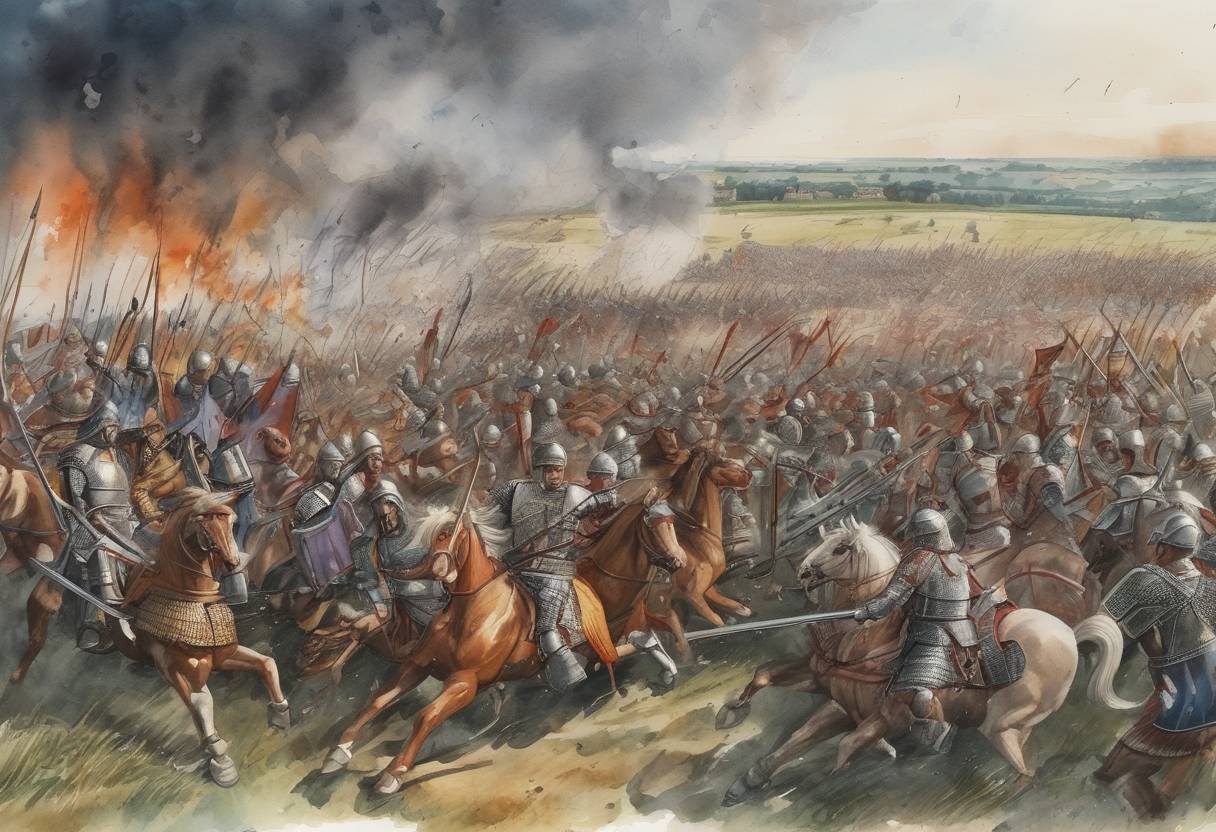
The Battle of the Catalaunian Plains (Battle of Châlons)
Date and Location
- Date: Traditionally dated to June 20, 451, though some sources suggest September 20, 451.
- Location: Near Châlons-en-Champagne, in the region of present-day northeastern France.
- Roman Empire: Flavius Aetius, a Roman general known as the “last of the Romans.”
- Visigoths: King Theodoric I, leader of the Visigothic forces allied with the Romans.
- Huns: Attila, the formidable leader of the Hunnic Empire.
Background
The Battle of the Catalaunian Plains was a pivotal confrontation during the waning years of the Western Roman Empire. By the mid-5th century, the Huns, under Attila, had become a formidable force in Europe, threatening the stability of the Roman territories. Attila’s campaigns across Europe had already devastated parts of the Eastern Roman Empire, and in 451, he turned his attention to Gaul (modern-day France).
Prelude to Battle
- Attila’s invasion of Gaul was part of his broader strategy to expand his influence and power across Europe.
- The Roman general Flavius Aetius, recognizing the threat posed by the Huns, sought to form a coalition to resist Attila’s advance.
- Aetius successfully allied with the Visigoths, led by King Theodoric I, as well as other Germanic tribes, including the Franks and Burgundians.
The Battle
- The battle took place on the Catalaunian Plains, a strategic location that allowed the allied forces to confront the Huns.
- The fighting was intense and brutal, characterized by the chaotic and ferocious nature of ancient warfare.
- King Theodoric I was killed during the battle, but his son, Thorismund, took command of the Visigothic forces.
- Despite heavy casualties on both sides, the Roman-Visigothic alliance managed to halt Attila’s advance.
Aftermath and Significance
- The battle is often regarded as a strategic victory for the Roman-Visigothic alliance, as it stopped the Hunnic invasion of Gaul.
- Although Attila’s forces were not decisively defeated, the battle marked a turning point that curtailed the Huns’ expansion into Western Europe.
- The battle demonstrated the effectiveness of Roman diplomacy and military strategy in forming alliances with barbarian tribes.
- The death of Theodoric I and the subsequent leadership of his son, Thorismund, had significant implications for the Visigothic kingdom.
- The battle is considered one of the last major military operations of the Western Roman Empire, highlighting the empire’s reliance on barbarian allies to maintain its territories.
Broader Historical Impact
- The Battle of the Catalaunian Plains is often cited as a critical moment in the decline of the Hunnic Empire, which would eventually disintegrate after Attila’s death in 453.
- It underscored the shifting power dynamics in Europe, with barbarian tribes playing increasingly prominent roles in the post-Roman world.
- The battle is emblematic of the transitional period from Roman to medieval Europe, illustrating the complex interactions between Roman and barbarian forces.
In summary, the Battle of the Catalaunian Plains was a significant event in late antiquity, marking a crucial moment in the defense of Western Europe against the Huns and highlighting the changing landscape of power in the region.