Ascension of Edward III to the English Throne
1328 · London, England
Edward III of England is declared King of England after his father Edward II is deposed.
January 13, 1547
Henry Howard, Earl of Surrey, is sentenced to death for treason, marking the end of the Howard family's influence in the English court.
London, England | English Court
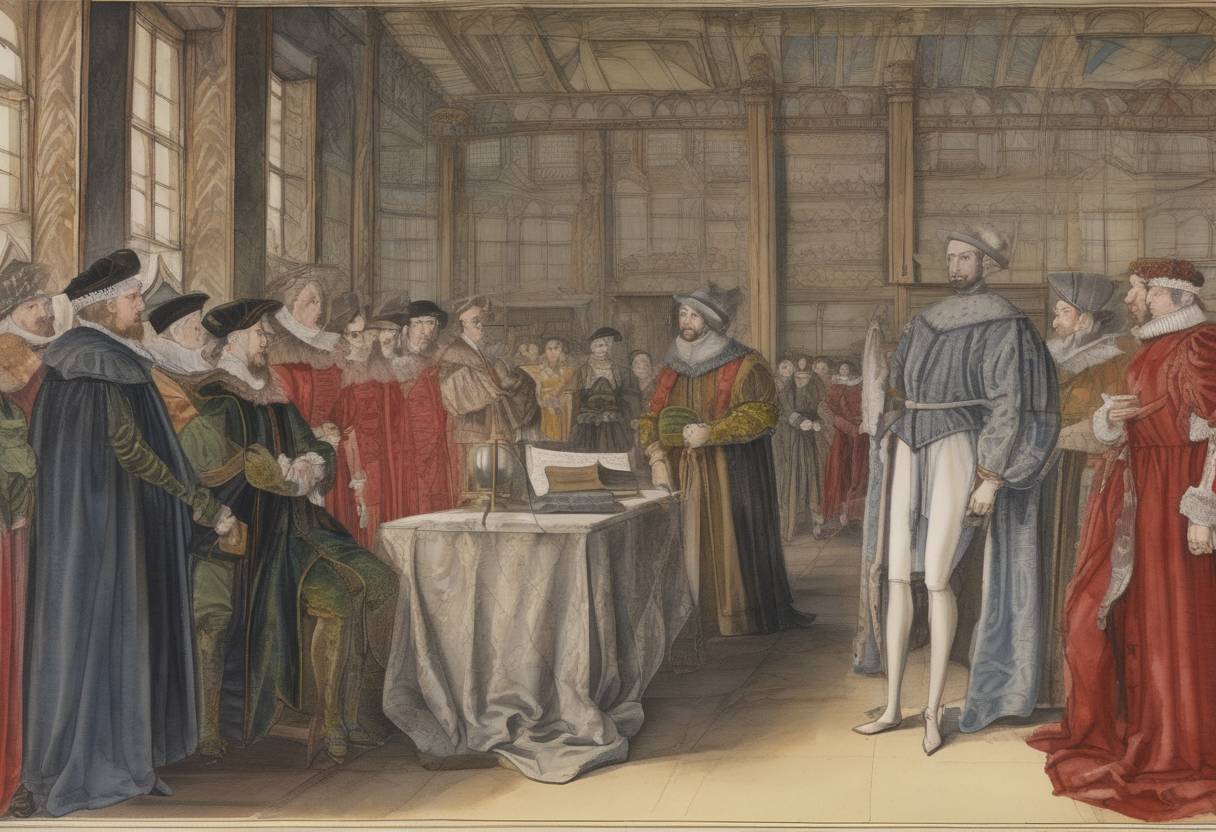
On January 13, 1547, Henry Howard, Earl of Surrey, was sentenced to death for treason, a pivotal moment that marked the decline of the Howard family’s influence in the English court. This event unfolded against the backdrop of the turbulent final years of King Henry VIII’s reign, characterized by political intrigue and shifting alliances.
Henry Howard, born in 1517, was a prominent nobleman and a distinguished poet, often credited with introducing the sonnet form to English literature alongside his friend Sir Thomas Wyatt. As the eldest son of Thomas Howard, 3rd Duke of Norfolk, Surrey was a key figure in one of England’s most powerful noble families. The Howards had long been influential at court, with connections to the royal family through marriage and service.
The downfall of the Howards was precipitated by several factors:
Political Rivalries: The Howard family had numerous enemies at court, partly due to their Catholic faith and their proximity to the throne. The Protestant faction, gaining influence as Henry VIII’s health waned, viewed the Howards as a threat.
Surrey’s Ambitions: Surrey’s own actions contributed to his downfall. He was accused of displaying the royal arms of Edward the Confessor, a symbol of royal ambition, which was interpreted as a challenge to the Tudor dynasty.
Henry VIII’s Paranoia: In his later years, King Henry VIII became increasingly suspicious and ruthless, eliminating perceived threats to his rule. The Howards, with their royal connections, were seen as potential usurpers.
Surrey’s trial was swift and politically charged. He was accused of treason, primarily based on the charges of bearing the royal arms and alleged conspiracies against the king. Despite a lack of concrete evidence, the court found him guilty, and he was sentenced to death.
On January 19, 1547, just days after his sentencing, Surrey was executed by beheading at the Tower of London. His death marked the end of the Howard family’s dominance at court, as his father, the Duke of Norfolk, was also imprisoned and narrowly escaped execution due to the king’s death shortly thereafter.
The execution of Henry Howard, Earl of Surrey, had significant repercussions:
In conclusion, the sentencing and execution of Henry Howard, Earl of Surrey, not only marked a personal tragedy but also a significant turning point in the power dynamics of the English nobility during the Tudor era.
Source: en.wikipedia.org