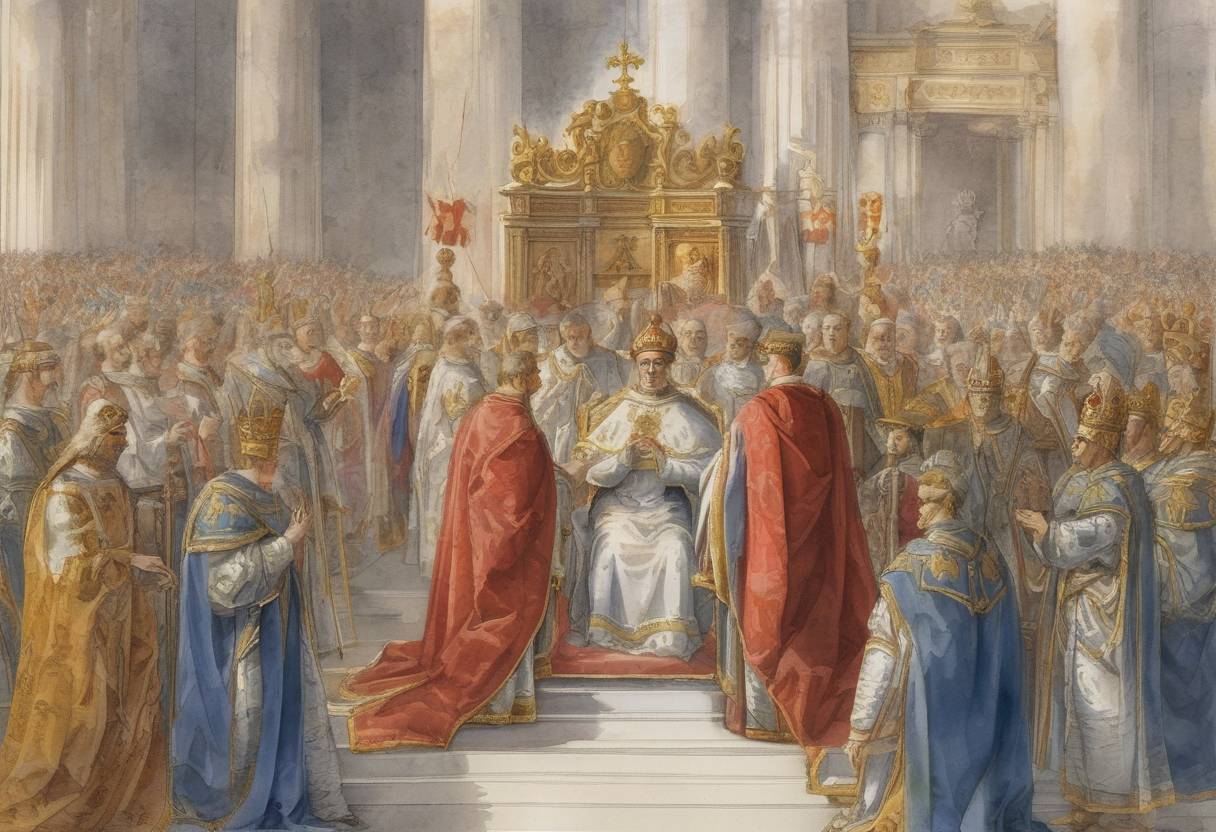
Otto I’s Coronation as Holy Roman Emperor
On February 2, 962, Otto I, also known as Otto the Great, was crowned as the Holy Roman Emperor by Pope John XII in Rome. This significant event marked the formal establishment of the Holy Roman Empire, a political entity that would play a crucial role in European history for centuries.
Background
- Otto I’s Rise to Power: Otto I was the Duke of Saxony and King of Germany, having ascended to the throne in 936. He was a member of the Liudolfing dynasty, also known as the Ottonian dynasty.
- Consolidation of Power: Otto’s reign was characterized by efforts to consolidate power within the fragmented territories of the former Carolingian Empire. He achieved significant military victories, notably against the Magyars at the Battle of Lechfeld in 955, which secured his dominance in Central Europe.
- Relationship with the Papacy: The relationship between the German monarchy and the papacy was mutually beneficial. The papacy sought protection and support from secular rulers, while Otto aimed to legitimize his rule through association with the Church.
The Coronation
- Papal Alliance: In 961, Pope John XII sought Otto’s assistance against Berengar II of Italy, who threatened papal territories. Otto responded by leading a campaign into Italy, which culminated in his coronation.
- Ceremony: The coronation took place in St. Peter’s Basilica in Rome. By crowning Otto as emperor, Pope John XII reinforced the notion of a Christian empire in the West, reminiscent of the earlier Carolingian Empire under Charlemagne.
Significance
- Imperial-Papal Relations: Otto’s coronation established the precedent of the Holy Roman Emperor being crowned by the pope, symbolizing a powerful alliance between the papacy and the German monarchy. This relationship would become a defining feature of medieval European politics.
- Holy Roman Empire: The coronation is often regarded as the founding moment of the Holy Roman Empire, which would endure in various forms until its dissolution in 1806.
- Legacy: Otto’s reign set the stage for the Ottonian Renaissance, a period of cultural and intellectual revival. His policies and military successes laid the groundwork for the future expansion and consolidation of the empire.
Aftermath
- Otto’s Reign: Otto continued to strengthen his empire, focusing on internal stability and external expansion. He maintained a close relationship with the Church, which played a crucial role in his governance.
- Succession: Otto’s son, Otto II, succeeded him, continuing the Ottonian dynasty’s influence over the Holy Roman Empire.
Otto I’s coronation as Holy Roman Emperor was a pivotal moment in European history, establishing a legacy of imperial authority intertwined with the spiritual power of the papacy. This event set the stage for the complex political and religious dynamics that would shape the medieval period.