Umberto I Crowned King of Italy: January 9, 1878
1878 · Rome, Italy
Umberto I is crowned King of Italy.
September 20, 1870
Italian troops entered Rome, completing the unification of Italy and marking the end of the Papal States.
Rome, Italy | Kingdom of Italy
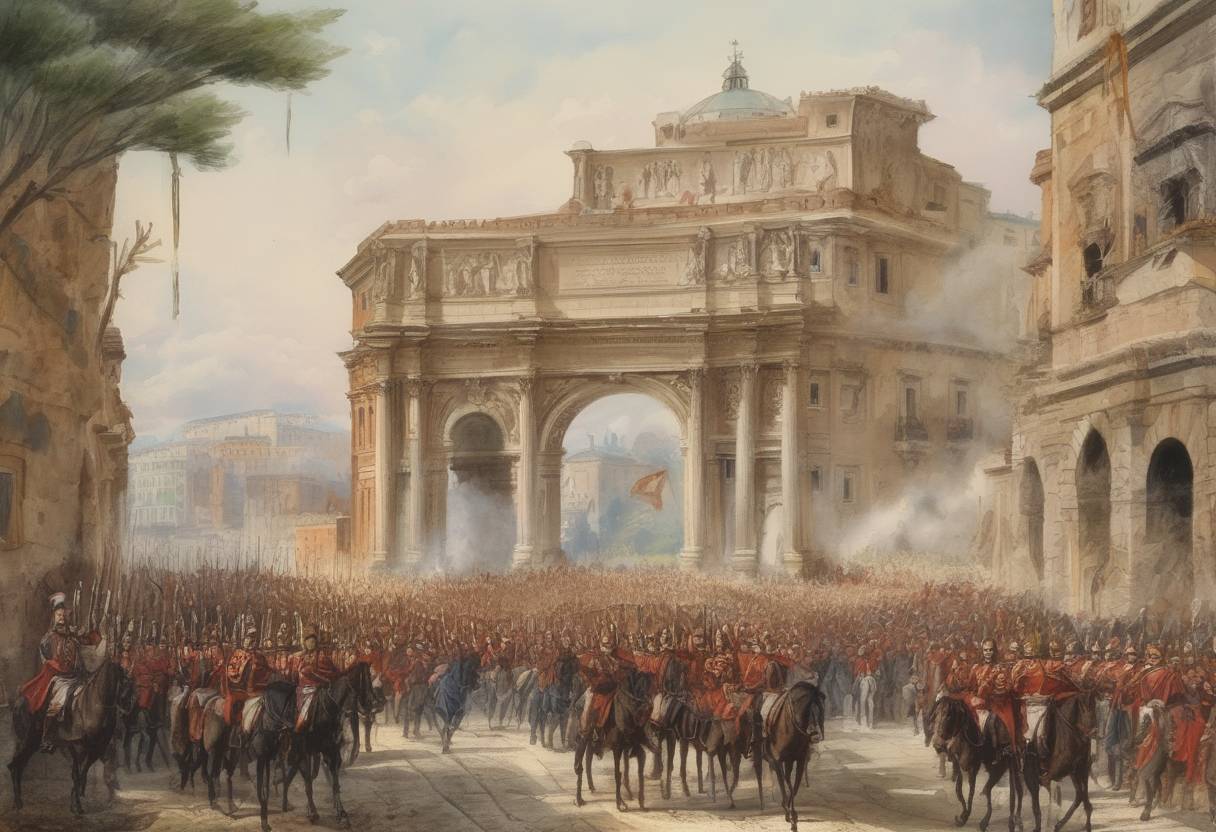
On September 20, 1870, Italian troops entered Rome, marking a pivotal moment in the unification of Italy and the end of the Papal States. This event, often referred to as the “Capture of Rome,” was the culmination of the Risorgimento, the 19th-century movement for Italian unification.
The Risorgimento: The movement for Italian unification began in the early 19th century, driven by a desire to consolidate the numerous independent states and territories on the Italian peninsula into a single nation. Key figures in this movement included Giuseppe Garibaldi, Count Camillo di Cavour, and King Victor Emmanuel II of Sardinia.
The Papal States: Before unification, the Papal States were a series of territories in the Italian Peninsula under the direct sovereign rule of the Pope. These territories were a significant obstacle to unification, as they divided the northern and southern parts of Italy.
Franco-Prussian War: The withdrawal of French troops from Rome, due to the outbreak of the Franco-Prussian War in 1870, left the Papal States vulnerable. France had been a protector of the Papal States, and their departure provided an opportunity for the Kingdom of Italy to take action.
Military Action: On September 11, 1870, Italian forces, led by General Raffaele Cadorna, began their advance towards Rome. By September 19, they had reached the Aurelian Walls, the ancient fortifications surrounding the city.
Breach at Porta Pia: On the morning of September 20, after a brief bombardment, Italian troops breached the walls at Porta Pia. The Papal forces, vastly outnumbered and outgunned, offered only limited resistance.
Surrender and Aftermath: By the afternoon, the Papal forces surrendered, and Italian troops entered the city. Pope Pius IX withdrew to the Vatican, refusing to recognize the authority of the Italian state over Rome.
End of the Papal States: The capture of Rome effectively ended the temporal power of the Papacy, which had lasted for over a thousand years. The Papal States were incorporated into the Kingdom of Italy.
Rome as Capital: In July 1871, Rome was declared the capital of the Kingdom of Italy, symbolizing the completion of Italian unification.
Lateran Treaty: The “Roman Question” regarding the Pope’s status and the Vatican’s sovereignty remained unresolved until the Lateran Treaty of 1929, which established Vatican City as an independent state.
The entry of Italian troops into Rome on September 20, 1870, was a decisive moment in the unification of Italy, reshaping the political landscape of the peninsula and marking the end of centuries of Papal temporal rule.
Source: en.wikipedia.org