The Battle of Vézeronce: June 21, 524
524 · Vézeronce-Curtin, Kingdom of Burgundy
The Battle of Vézeronce takes place between the Franks and the Burgundians, resulting in a Frankish victory.
May 1, 0524
King Sigismund of Burgundy is executed at Orléans after being defeated by the Franks.
Orléans, Frankish Kingdom | Frankish Kingdom
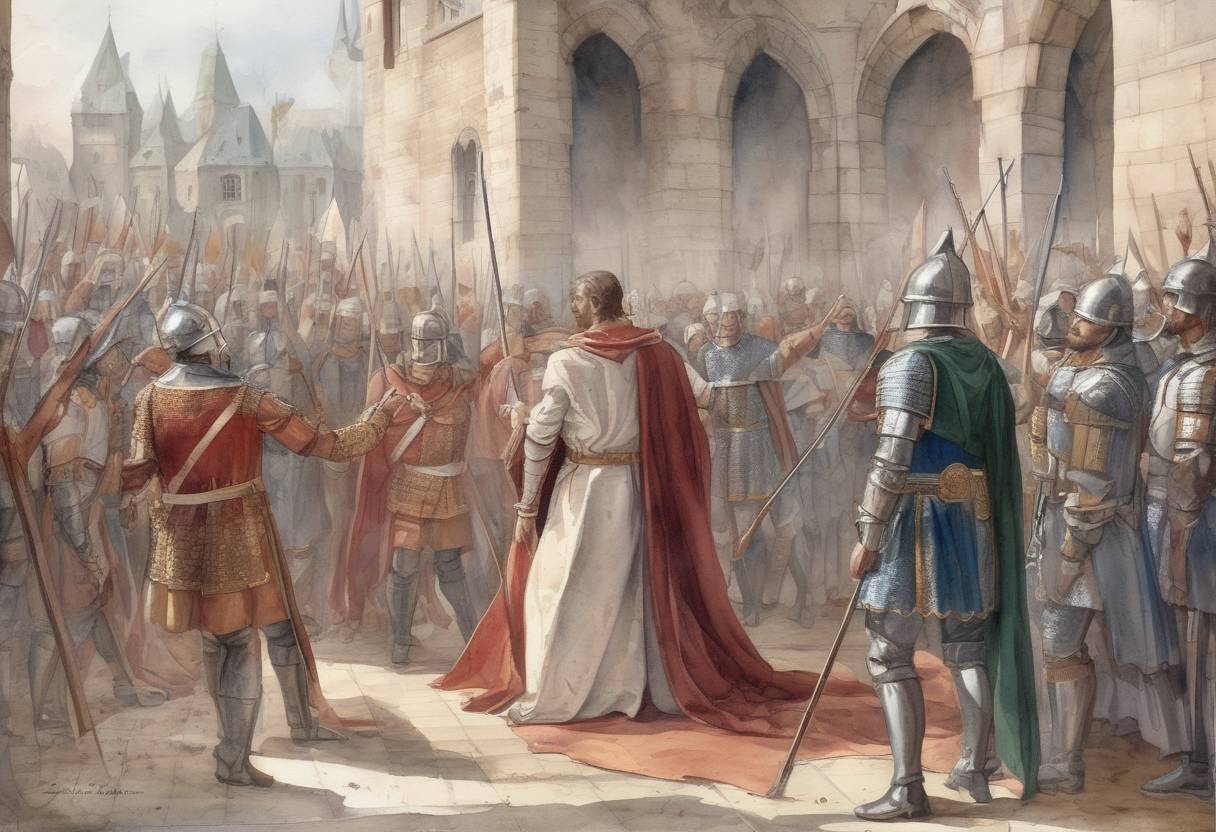
On May 1, 524, King Sigismund of Burgundy was executed at Orléans, marking a significant event in the power struggles of early medieval Europe. This event was a culmination of political and military conflicts involving the Burgundian kingdom and the expanding Frankish realm.
Sigismund was the King of Burgundy from 516 until his downfall in 523. He was the son of King Gundobad and a member of the Burgundian royal family, which had established a powerful kingdom in what is now southeastern France and western Switzerland. Sigismund is noted for his conversion from Arian Christianity to Chalcedonian Christianity, which aligned him more closely with the Roman Catholic Church and the broader Christian community of the time.
The execution of Sigismund was primarily the result of the Frankish kings’ ambitions to expand their territories. The Franks, under the leadership of the sons of Clovis I, sought to consolidate their power across Gaul. The conflict with Burgundy was partly instigated by familial ties and rivalries, as Clotilde, the wife of Clovis I, was a Burgundian princess and had personal grievances against Sigismund’s family.
In 523, the Frankish kings Chlodomer, Childebert I, and Chlothar I launched a campaign against Burgundy. Sigismund was captured during this conflict, and his defeat marked the beginning of the end for the independent Burgundian kingdom.
After his capture, Sigismund was taken to Orléans, where he was executed on May 1, 524. His death was a decisive moment that allowed the Franks to further their control over Burgundy. Following Sigismund’s execution, his brother Godomar attempted to resist the Frankish invasion but was ultimately unsuccessful.
The incorporation of Burgundy into the Frankish realm was a significant step in the consolidation of territories that would eventually form the basis of the medieval Kingdom of France. The execution of Sigismund also underscored the brutal nature of dynastic and territorial conflicts during this period.
The execution of King Sigismund and the subsequent Frankish conquest of Burgundy played a crucial role in shaping the political landscape of medieval Europe. It demonstrated the shifting power dynamics and the rise of the Frankish kingdom as a dominant force in Western Europe. Additionally, Sigismund’s legacy lived on through his canonization as a saint in the Eastern Orthodox Church and the Roman Catholic Church, reflecting his religious significance and the complex interplay between politics and faith during this era.
Source: en.wikipedia.org