Recapture of Seoul: March 14, 1951
1951 · Seoul, South Korea
During the Korean War, United Nations forces recapture Seoul from Chinese and North Korean forces.
September 15, 1950
UN forces, led by General Douglas MacArthur, launched the successful Inchon Landing during the Korean War, which turned the tide in favor of the United Nations Command.
Inchon, South Korea | United Nations Command
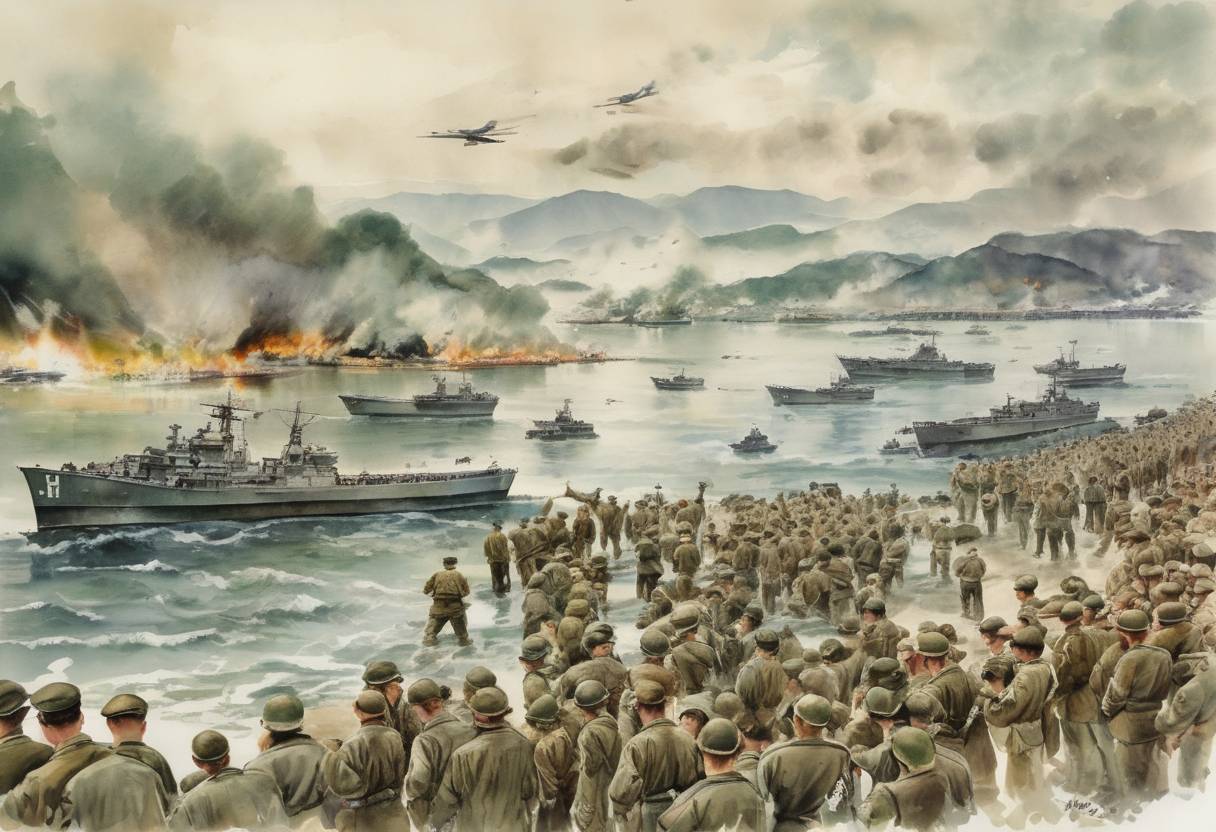
On September 15, 1950, United Nations forces, under the command of General Douglas MacArthur, executed a daring amphibious assault at Inchon, South Korea. This operation, known as the Inchon Landing, was a pivotal moment in the Korean War, significantly altering the course of the conflict in favor of the United Nations Command (UNC).
The Korean War began on June 25, 1950, when North Korean forces, backed by the Soviet Union and China, crossed the 38th parallel and invaded South Korea. The North Korean People’s Army (KPA) quickly advanced southward, capturing Seoul and pushing the South Korean and United Nations forces into a small defensive perimeter around the port city of Pusan, known as the Pusan Perimeter.
Faced with a dire situation, General Douglas MacArthur, the commander of the United Nations Command, proposed an audacious plan to relieve pressure on the Pusan Perimeter and regain the initiative. His plan involved an amphibious landing at Inchon, a port city located on the western coast of Korea, near Seoul. Despite the operation’s high risk due to Inchon’s challenging tidal conditions and fortified defenses, MacArthur believed it could decisively cut North Korean supply lines and facilitate a counteroffensive.
The operation, codenamed “Operation Chromite,” involved meticulous planning and coordination. Key elements included:
On the morning of September 15, the assault began with naval bombardment and air strikes, followed by the landing of ground forces. Despite initial resistance, the UN forces quickly secured the beachhead and advanced inland. Within days, they captured Inchon and began the liberation of Seoul.
The success of the Inchon Landing had profound implications:
However, the success at Inchon also set the stage for further escalation. Encouraged by the victory, UN forces pursued the retreating North Koreans across the 38th parallel, eventually leading to Chinese intervention in the war.
In conclusion, the Inchon Landing was a masterstroke of military strategy that turned the tide of the Korean War, showcasing the power of decisive action and international collaboration in the face of adversity.
Source: www.britannica.com