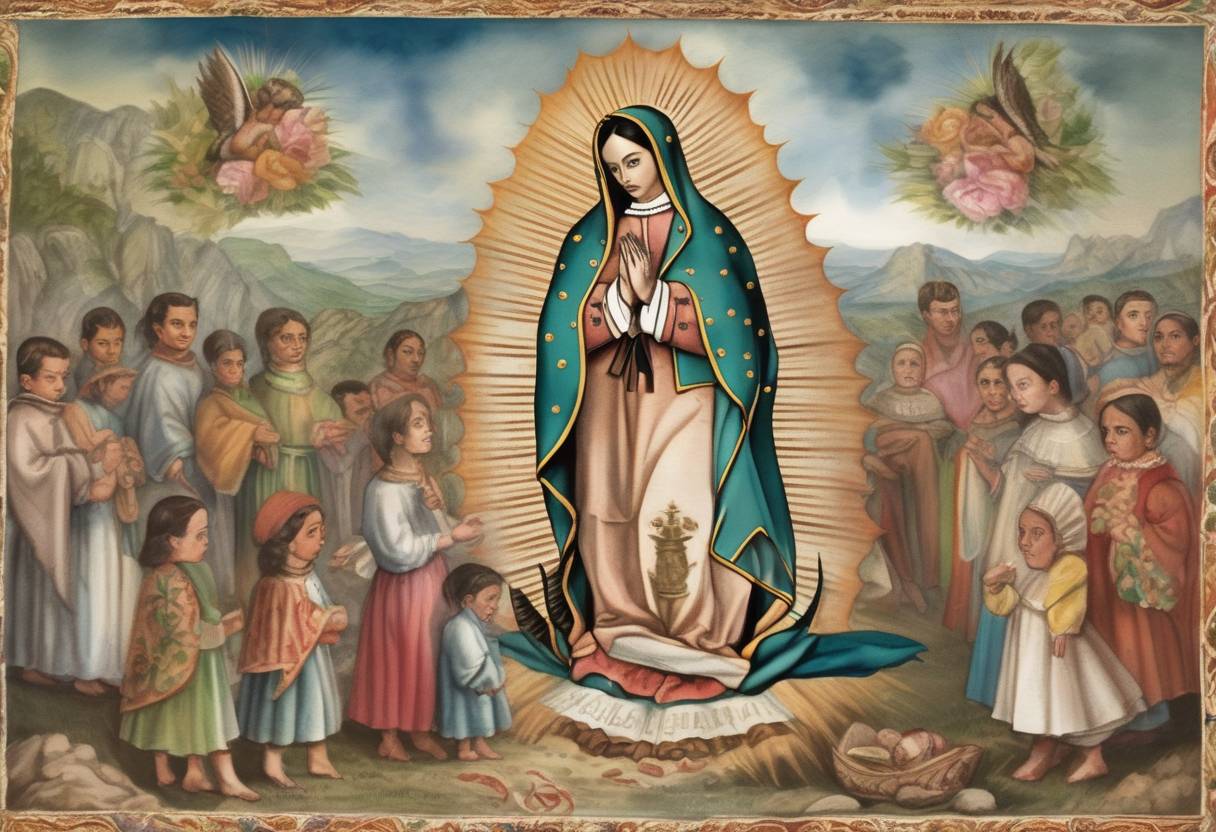
The Apparition of the Virgin of Guadalupe to Juan Diego
On December 9, 1531, a significant event in the history of Mexican Catholicism is said to have occurred: the apparition of the Virgin Mary to an indigenous man named Juan Diego at Tepeyac Hill, near present-day Mexico City. This event has become a cornerstone of Mexican Catholic identity and has had profound cultural and religious implications.
Historical Context
In the early 16th century, Mexico was undergoing significant changes. The Spanish conquest, led by Hernán Cortés, had recently overthrown the Aztec Empire, and the region was experiencing a tumultuous period of cultural and religious transformation. The Catholic Church was actively seeking to convert the indigenous populations to Christianity, often through the establishment of missions and the work of missionaries.
The Apparition
According to tradition, Juan Diego, a recently converted indigenous man, was on his way to attend mass when he encountered a vision of a young woman surrounded by light on Tepeyac Hill. The woman identified herself as the Virgin Mary and requested that a church be built on the site in her honor. Juan Diego reported this vision to the local bishop, Juan de Zumárraga, who was initially skeptical.
The Virgin is said to have appeared to Juan Diego multiple times, and during one of these apparitions, she instructed him to gather Castilian roses from the hilltop, despite it being winter when such flowers would not naturally bloom. Juan Diego collected the roses in his tilma (cloak) and presented them to the bishop. When he opened the tilma, the roses fell to the ground, revealing an image of the Virgin imprinted on the fabric. This miraculous image convinced the bishop of the authenticity of Juan Diego’s experience, leading to the construction of a shrine on Tepeyac Hill.
Significance and Legacy
The image of the Virgin of Guadalupe became a powerful symbol of Mexican identity and faith. It represented a fusion of indigenous and Spanish cultures, as the Virgin’s appearance and the location of the apparition held significant meaning for the native population. The Virgin of Guadalupe is often seen as a symbol of hope and protection, and she plays a central role in Mexican spirituality and national identity.
The Basilica of Our Lady of Guadalupe, built on the site of the apparitions, is one of the most visited Catholic pilgrimage sites in the world. The feast day of Our Lady of Guadalupe is celebrated on December 12, drawing millions of pilgrims each year.
Broader Historical Impact
The story of the Virgin of Guadalupe has had a lasting impact on Mexican culture and Catholicism. It has been a unifying symbol during times of social and political upheaval, including the Mexican War of Independence and the Mexican Revolution. The Virgin of Guadalupe continues to be a source of inspiration and devotion for millions of people, both in Mexico and around the world.
In summary, the apparition of the Virgin of Guadalupe to Juan Diego is a pivotal event in the religious and cultural history of Mexico, symbolizing the blending of indigenous and European traditions and serving as a powerful emblem of faith and identity.