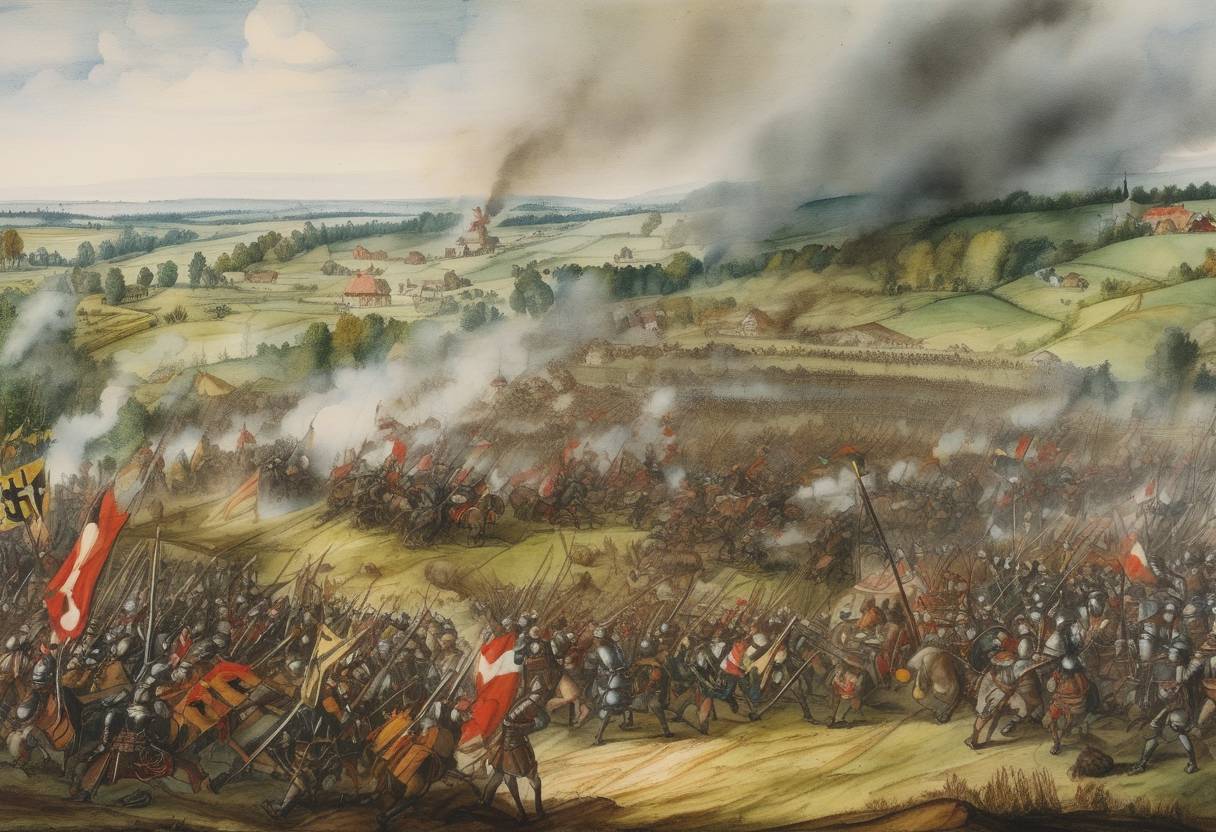
The Battle of Frankenhausen - May 15, 1525
The Battle of Frankenhausen, fought on May 15, 1525, was a pivotal confrontation during the German Peasants’ War, a widespread popular revolt in the Holy Roman Empire. This battle marked a decisive victory for the forces of the Swabian League over the peasant army led by Thomas Müntzer.
Context
The German Peasants’ War (1524–1525) arose from growing economic and social discontent among the peasantry, exacerbated by religious upheaval in the wake of Martin Luther’s Reformation. The revolt, primarily driven by demands for agrarian reforms, fairer taxes, and religious freedom, spread rapidly across Central Europe.
Thomas Müntzer, a radical preacher with revolutionary ideas, emerged as a prominent leader in the uprising. Advocating for a complete overhaul of the feudal system, Müntzer wielded significant influence over the peasant forces.
Lead-Up to Battle
By May 1525, the peasant rebellion had drawn the attention of the Swabian League, a powerful alliance of princes and cities determined to suppress the unrest. Commanded by military leaders such as Philip I, Landgrave of Hesse, and Georg, Truchsess von Waldburg, the League’s army advanced towards Thüringia, home to Frankenhausen.
Müntzer’s forces, though numerous, were poorly equipped and lacked professional military training. Despite these disadvantages, Müntzer settled his troops at Frankenhausen, a strategic position that he believed would allow them to withstand the League’s onslaught.
The Battle
On the morning of May 15, 1525, the forces of the Swabian League attacked the peasant encampment with a mix of cavalry, artillery, and infantry. Müntzer’s army, surrounded and outmaneuvered, struggled to maintain its ground. As panic and disorder spread among the peasants, the military superiority of the League’s forces became apparent.
The battle concluded in a catastrophic defeat for the peasant army. Thousands of rebels were slaughtered in what turned into a massacre. Müntzer himself was captured, subjected to torture, and executed shortly after the battle.
Aftermath
The defeat at Frankenhausen effectively extinguished the flame of the Peasants’ War. The rebellion collapsed in subsequent months, leading to severe reprisals and a reaffirmation of the feudal order. The loss marked a significant setback for the peasantry’s hopes for reform and left a legacy of increased oppression and economic hardship.
Though unsuccessful in their immediate goals, the events and ideas of the Peasants’ War, including those championed by figures like Müntzer, continued to influence subsequent movements for social justice and reform in Europe. The battle highlighted the deep societal divisions of the time and underscored the challenging path toward achieving equality and justice.