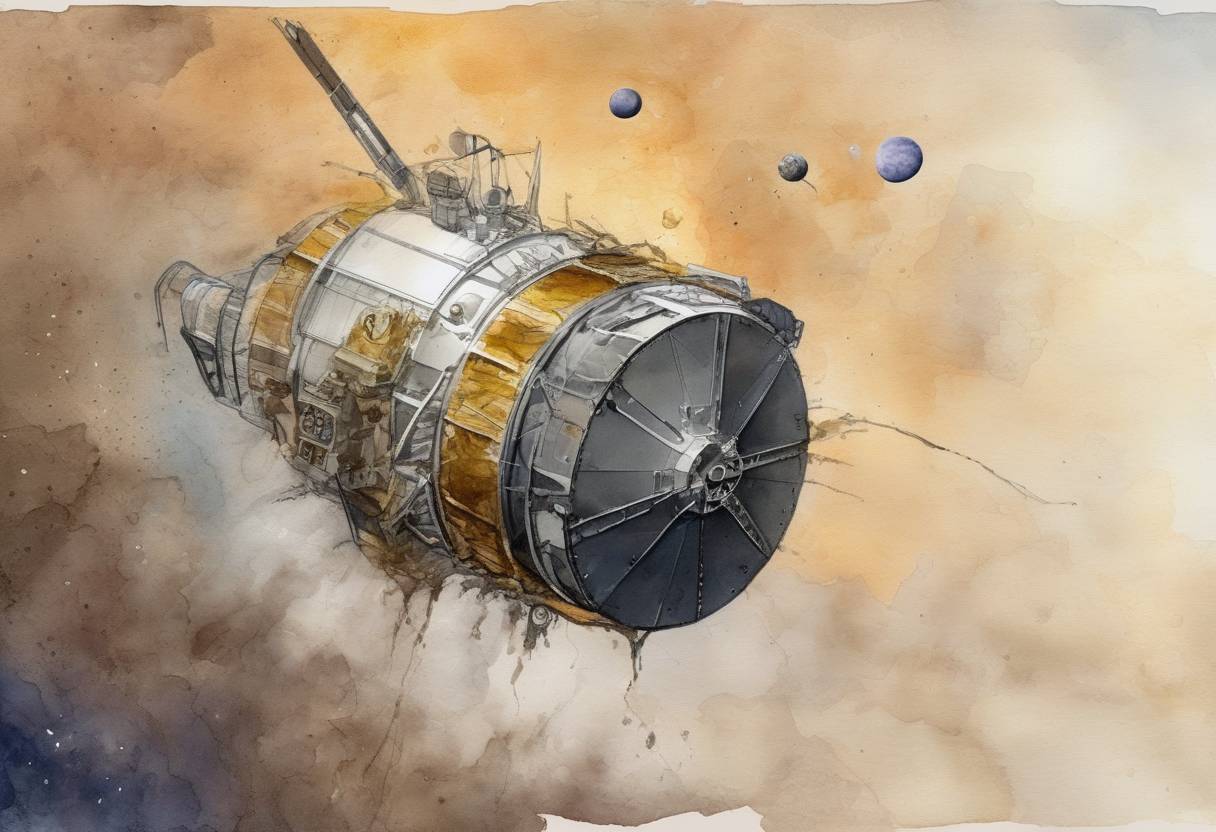
NASA’s MESSENGER Mission Conclusion: April 30, 2015
On April 30, 2015, NASA’s MESSENGER spacecraft concluded its mission by crashing into the surface of Mercury. This event marked the end of a highly successful mission that significantly advanced our understanding of the innermost planet in our solar system.
Background
MESSENGER, which stands for MErcury Surface, Space ENvironment, GEochemistry, and Ranging, was launched on August 3, 2004. It was the first spacecraft to orbit Mercury, following the earlier Mariner 10 flybys in the 1970s. The mission aimed to study Mercury’s chemical composition, geology, and magnetic field, among other objectives.
Key Events Leading to the Conclusion
- Launch and Journey: MESSENGER embarked on a complex trajectory, involving flybys of Earth, Venus, and Mercury itself, to slow down enough to be captured by Mercury’s gravity.
- Orbit Insertion: On March 18, 2011, MESSENGER successfully entered orbit around Mercury, becoming the first spacecraft to do so.
- Extended Mission: Originally planned for a one-year mission, MESSENGER’s mission was extended twice due to its success and the wealth of data it provided.
Achievements and Discoveries
During its four-year orbit around Mercury, MESSENGER made several groundbreaking discoveries:
- Surface Composition: It provided detailed maps of Mercury’s surface composition, revealing high levels of sulfur and other volatile elements.
- Magnetic Field: MESSENGER confirmed that Mercury’s magnetic field is offset from the planet’s center, providing insights into its internal structure.
- Water Ice: The spacecraft detected evidence of water ice and organic compounds in permanently shadowed craters at Mercury’s poles.
- Geological Features: It discovered unusual geological features, such as “hollows,” which are unique to Mercury.
Conclusion of the Mission
After more than four years in orbit and having exhausted its fuel supply, MESSENGER’s mission concluded with a planned impact on Mercury’s surface. The spacecraft crashed at a speed of over 8,750 miles per hour (14,080 kilometers per hour), creating a new crater on the planet’s surface.
Historical Significance
MESSENGER’s mission provided unprecedented insights into Mercury, challenging previous assumptions and enhancing our understanding of planetary formation and evolution. The data collected continues to be analyzed, contributing to ongoing research in planetary science.
In summary, MESSENGER’s mission was a landmark achievement for NASA and the scientific community, offering a wealth of information about one of the least understood planets in our solar system. Its legacy endures through the data it provided and the questions it raised for future exploration.