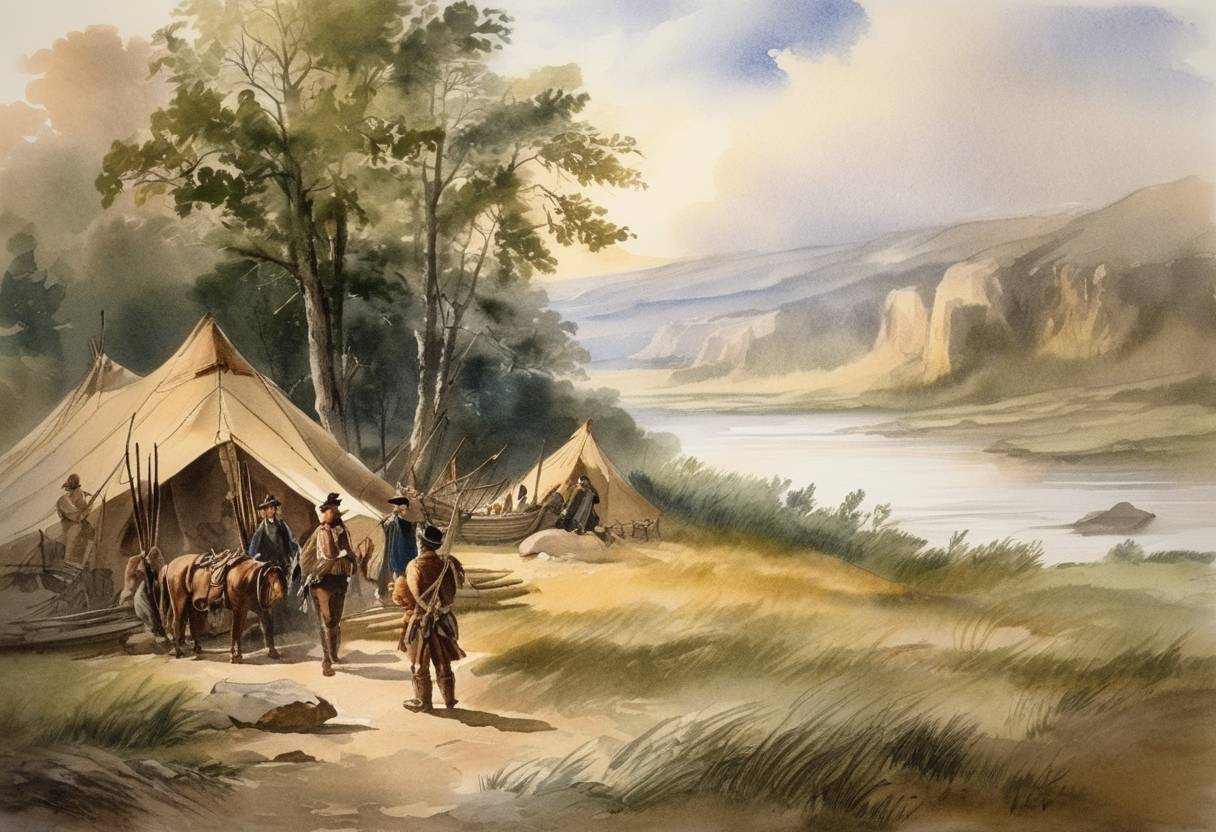
Lewis and Clark Expedition: Departure from Fort Mandan on April 7, 1805
On April 7, 1805, the Lewis and Clark Expedition, known as the Corps of Discovery, resumed its historic journey westward from Fort Mandan. This date marked the continuation of their mission following a winter spent at the fort, located in what is now North Dakota, where they had settled on the banks of the Missouri River.
Context and Preparations
The expedition, commissioned by President Thomas Jefferson and led by Meriwether Lewis and William Clark, aimed to explore the newly acquired Louisiana Territory and to find a practical route across the western half of the continent. The journey also sought to establish American presence and commerce with native tribes and to gather scientific information about the region’s geography, flora, and fauna.
During their time at Fort Mandan from November 1804 to April 1805, the Corps prepared extensively for the next phase of their expedition. They had constructed Fort Mandan as a winter encampment where they could rest, resupply, and make necessary preparations before proceeding. This period at the fort enabled them to gather invaluable information about the terrain ahead, through interactions with the local Mandan and Hidatsa tribes, and to finalize their logistical preparations for the arduous journey that awaited them.
Key Developments on April 7, 1805
- Departure from Fort Mandan: On April 7, 1805, the Corps of Discovery departed in six dugout canoes and two pirogues, headed upriver in pursuit of their goal to reach the Pacific Ocean.
- Leadership and Composition: The group, led by Lewis and Clark, consisted of approximately 33 explorers, including officers, enlisted men, and civilians. Among the notable members were Sacagawea, a Shoshone interpreter and guide, and her husband, Toussaint Charbonneau.
- Mission Resumption: Setting off after months of preparation, they were equipped with better supplies, improved boats, and a refined sense of their exploratory duties and scientific interests.
Broader Historical Significance
The Lewis and Clark Expedition’s departure from Fort Mandan signaled a bold step into the largely unmapped territories west of the Mississippi River. The successful completion of their mission in 1806 would help lay the groundwork for westward expansion in the United States and open up new pathways for explorers, traders, and settlers. This day, April 7, 1805, stands as a pivotal moment in North American exploration, characterized by international collaboration, the spirit of discovery, and the complex interactions between American explorers and Indigenous peoples.