The First Automobile Race: Paris to Bordeaux and Back - June 11, 1895
1895 · Paris, France
Paris hosted the first automobile race from Paris to Bordeaux and back, marking a significant event in the history of motor racing.
July 15, 1898
Gaston de Chasseloup-Laubat sets a new land speed record of 39.24 miles per hour (63.14 kilometers per hour) in Paris, becoming the first recorded automobile land speed champion.
Paris, France | Automobile Club de France
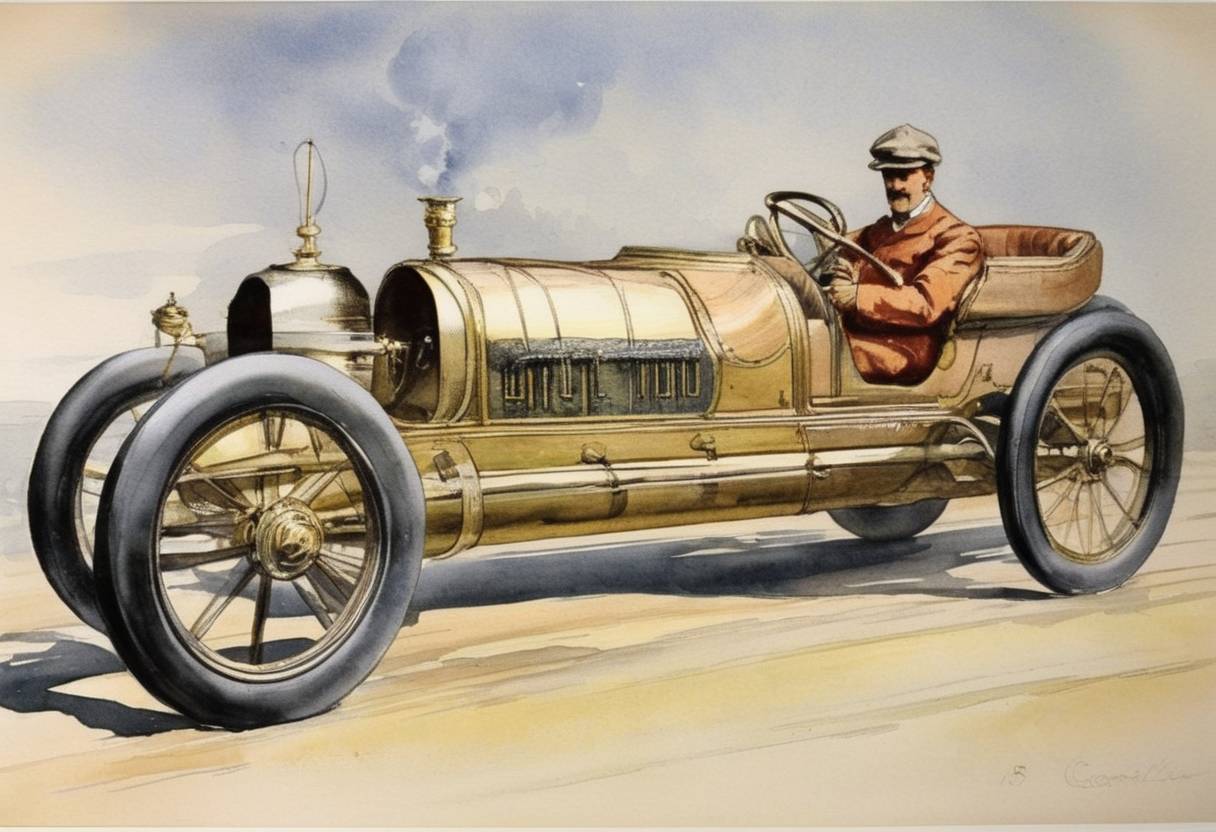
On July 15, 1898, in the outskirts of Paris, France, Gaston de Chasseloup-Laubat set a historic precedent by establishing a land speed record, reaching a velocity of 39.24 miles per hour (63.14 kilometers per hour). This achievement marked a significant moment in the annals of automotive history as the first officially documented land speed record for an automobile.
The late 19th century was an era of rapid innovation and experimentation in automobile technology. Automotive enthusiasts and inventors were continuously pushing the boundaries of speed and engineering. The emergence of electric vehicles, alongside their gasoline and steam counterparts, played a crucial role during this period of automotive infancy.
Gaston de Chasseloup-Laubat, a French aristocrat and automobile enthusiast, piloted an electric vehicle manufactured by Jeantaud, known for its innovative design and electric propulsion system. The record-setting run was conducted on a straight stretch of road, where Chasseloup-Laubat’s performance was meticulously measured and timed to ensure accuracy and authenticity.
This event signified a pivotal moment not only as the first recognized automobile land speed record but also as an indicator of the burgeoning interest in automobile technology and its capabilities. It underscored the potential of the automobile, an invention that was rapidly evolving into a practical means of transportation and a field of competitive innovation.
Furthermore, this achievement by Gaston de Chasseloup-Laubat paved the way for a new era of speed records and competitions, inspiring subsequent endeavors to push automotive speeds ever higher. It marked the beginning of an ongoing quest for speed that has continued to captivate engineers and enthusiasts to this day.
The land speed record set by Chasseloup-Laubat was soon contested, leading to a series of competitive speed trials that further fueled advancements in vehicle technology. Within merely a month, the record was broken by Camille Jenatzy, illustrating the rapid pace of development in automotive engineering.
The record set on July 15, 1898, remains a celebrated milestone, representing the dawn of competitive auto racing and the endless pursuit of speed and technological excellence.
Source: en.wikipedia.org