Battle of Ain Jalut - September 3, 1260
1260 · Ain Jalut, Israel
The famous Battle of Ain Jalut was fought between the Mamluks of Egypt and the Mongol Empire, resulting in a decisive Mamluk victory.
September 4, 1260
The Battle of Ain Jalut took place, marking the first substantial defeat of the Mongol army by the Mamluks of Egypt, preventing the Mongol Empire from expanding into the Middle East.
Ain Jalut, modern-day Israel | Mamluk Sultanate
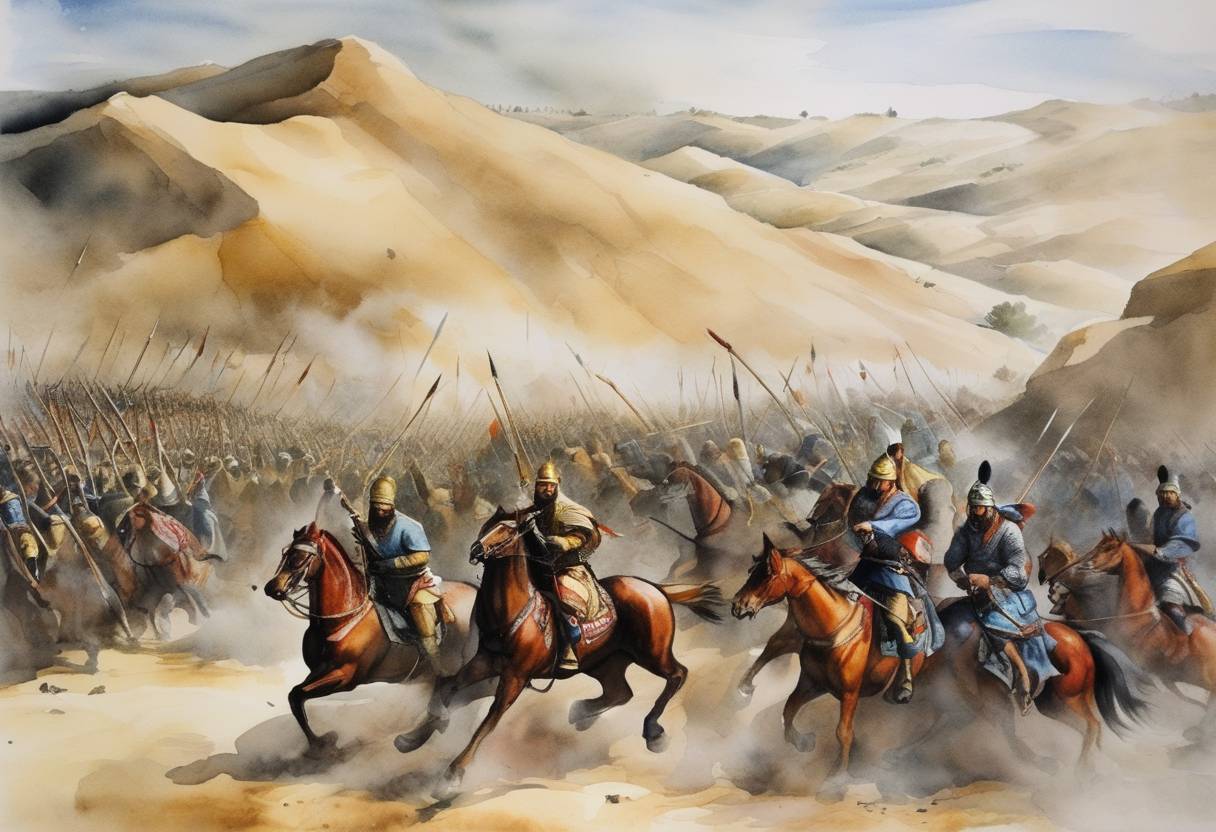
On September 4, 1260, the Battle of Ain Jalut occurred in southeastern Galilee, near the springs of Ain Jalut, marking a significant turning point in Middle Eastern history. This battle saw the Mongol Empire, which had previously seemed invincible under the command of Genghis Khan and his successors, suffer its first substantial defeat at the hands of the Mamluk Sultanate of Egypt.
The Mongol Empire had rapidly expanded across Asia and into Europe by the mid-13th century, largely due to its superior horse-riding tactics and fierce military strategy. Kublai Khan, the grandson of Genghis Khan, led the empire’s campaigns, which had already conquered vast regions including parts of China and Persia.
Prior to the Battle of Ain Jalut, the Mongols had advanced into the Middle East, capturing Baghdad in 1258 and subsequently overthrowing the Abbasid Caliphate. They then set their sights on Syria and Palestine, continuing their westward expansion under the command of Hulagu Khan, another grandson of Genghis Khan.
However, Hulagu’s withdrawal of a large portion of his forces in 1259 to tend to internal affairs following the death of Mongke Khan left a reduced Mongol military presence. This provided a critical opportunity for the Mamluks, who had risen to power in Egypt and were eager to defend the Middle East from the Mongol advance.
The Mamluks, led by Sultan Qutuz and his prominent general Baybars, faced the Mongol army led by Kitbuqa, a trusted general of Hulagu Khan. The Mamluks utilized the terrain effectively, employing hit-and-run tactics and feigned retreats—a hallmark of Mongol warfare that Kitbuqa did not anticipate the Mamluks would use against them.
The decisive moment of the battle came when the Mamluks, having drawn the Mongols into a vulnerable position, launched a counterattack. The Mamluk forces, well-versed in handling the Mongol-rebuilt Chinese siege engines and cavalry charges under hostile conditions, ultimately overwhelmed the Mongols.
The victory at Ain Jalut had profound implications for the region and beyond. It halted the Mongol advance into the Islamic heartlands, preserving the Mamluk dominance in Egypt and allowing them to reclaim territories previously lost in Syria. The battle not only demonstrated the vulnerabilities of the Mongols but also established the Mamluks as a formidable power in the region.
Moreover, Ain Jalut served as a significant morale booster for the Islamic world, proving that the Mongols could be defeated. The tactics used by the Mamluks further influenced military strategies in subsequent encounters with Mongol forces.
The defeat at Ain Jalut marked the limit of Mongol expansion westward, establishing a new geopolitical balance in the region and securing the preservation of Islamic culture and political structures in the Middle East during a critical period of history.
Source: en.wikipedia.org