Establishment of the Anglo-Egyptian Sudan
1899 · Khartoum, Sudan
The Anglo-Egyptian Sudan is established as a result of the Anglo-Egyptian Agreement, marking the beginning of joint British and Egyptian rule over Sudan.
September 2, 1898
The Battle of Omdurman takes place in Sudan, where British and Egyptian troops under Major General Sir Herbert Kitchener defeat Sudanese Mahdist forces, securing British control over Sudan.
Omdurman, Sudan | British Army
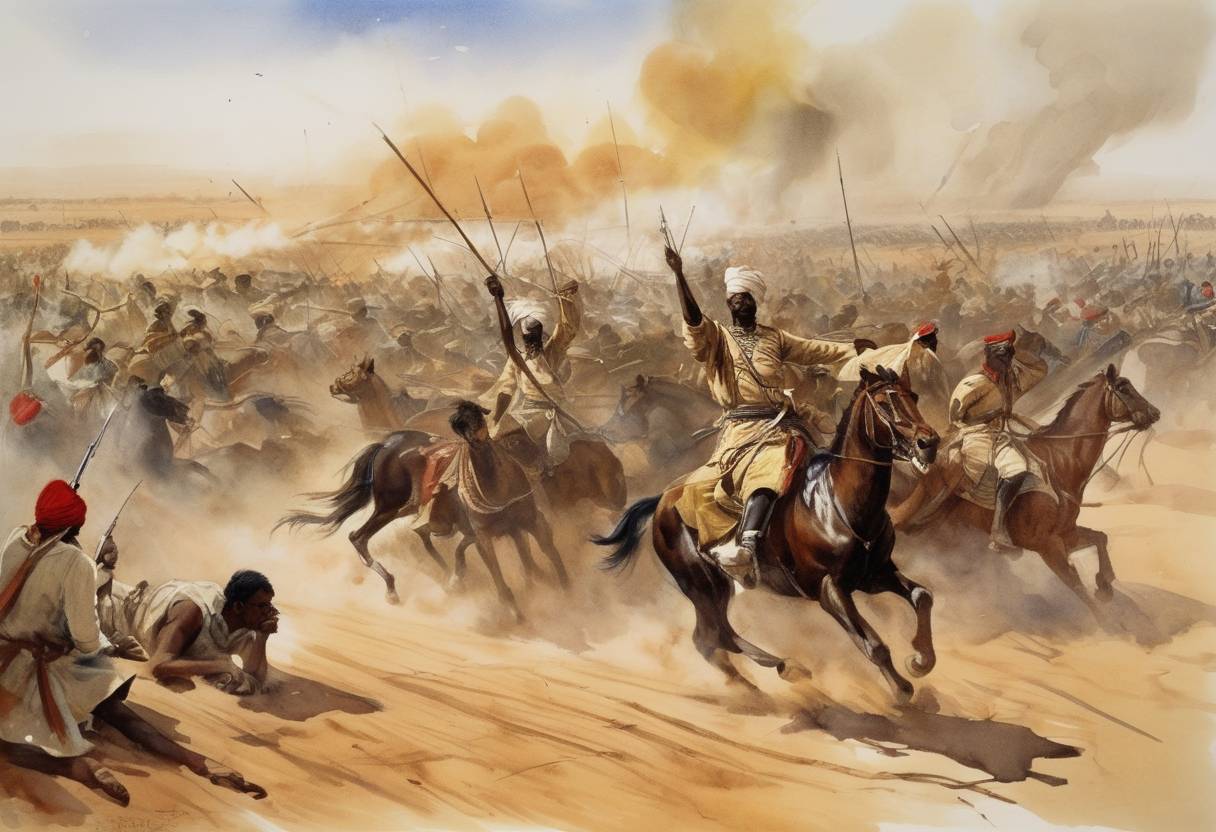
In the late 19th century, the Sudan was under the rule of the Mahdist State, led by the Khalifa Abdallahi, following the Mahdist Revolt against Egyptian rule, which had begun in 1881. The British sought to reclaim control over the Sudan primarily to safeguard their colonial interests in Egypt and control the Nile waters, a vital route to the British Empire’s holdings in East Africa and India. The Anglo-Egyptian forces were commanded by Major General Sir Herbert Kitchener, who had been given the task of re-conquering Sudan and suppressing the Mahdist forces.
On September 2, 1898, the decisive confrontation known as the Battle of Omdurman took place near the twin cities of Omdurman and Khartoum along the banks of the Nile in Sudan. Kitchener’s army, consisting of approximately 25,000 British and Egyptian troops, faced a Mahdist force numbering around 50,000, led by the Khalifa Abdallahi ibn Muhammad.
Before the battle, Kitchner had advanced cautiously along the Nile, supported by a railway line constructed to facilitate logistics and resupply his forces. On the battlefield, he utilized modern weaponry, including Maxim machine guns and artillery, which provided the Anglo-Egyptian forces with a significant technological advantage over the Mahdist army, which was largely equipped with spears and older firearms.
The battle commenced in the early morning. The Mahdist forces launched concentrated infantry assaults against Kitchener’s positions. Despite their numerical superiority, the Mahdist warriors were decimated by the withering machine-gun and artillery fire from the entrenched Anglo-Egyptian army. Over a few hours, the Mahdist formations were shattered, suffering heavy casualties.
By midday, Kitchener launched a cavalry charge led by the 21st Lancers, famously known for the charge at Omdurman, which cut through the remnants of the Mahdist forces, solidifying the defeat. By the end of the battle, approximately 10,000 Mahdists had been killed, and a further 13,000 wounded. In contrast, Kitchener’s forces suffered relatively minor casualties, with just over 400 killed or wounded.
The Battle of Omdurman was a decisive victory for the British Empire, leading to the establishment of British dominance over Sudan and marking the effective end of the Mahdist State. Its success was attributed to Kitchener’s careful planning and the effective use of modern military technology.
This battle exemplified the power imbalance between European forces and indigenous armies during the period of colonial expansion. It also secured Kitchener’s reputation as a prominent military leader. The victory facilitated the establishment of the Anglo-Egyptian Condominium in 1899, under which Sudan was jointly governed by Britain and Egypt, a situation that persisted until Sudan’s eventual independence in 1956. The battle remains a significant event in the colonial history of Africa, symbolizing both the might and the controversies of imperial conquest.
Source: en.wikipedia.org