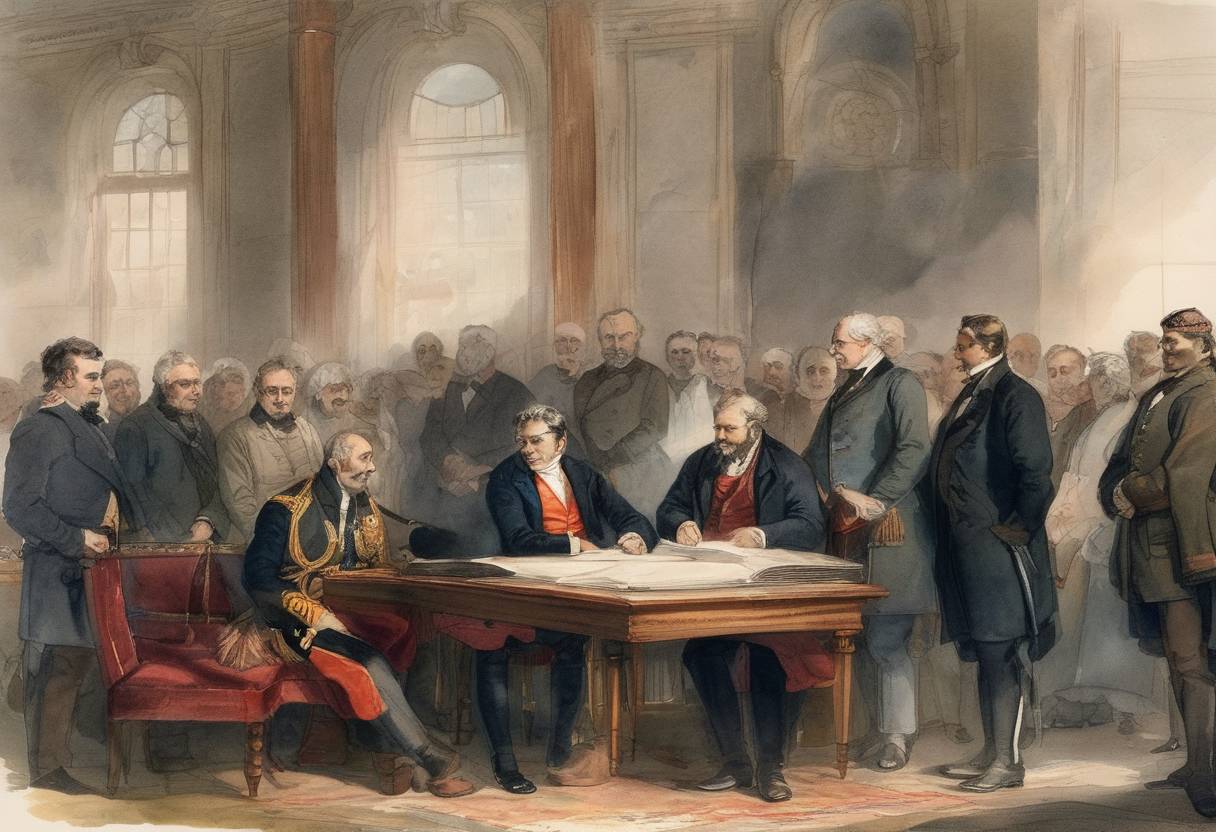
The Treaty of Navarino, as described, does not exist as a historical event; rather, the confusion arises with the well-documented Battle of Navarino, which took place on October 20, 1827. This naval battle effectively supported Greek independence by defeating the Ottoman-Egyptian fleet. No treaty specifically named “The Treaty of Navarino” as a final peace agreement is recognized in historical records on this date.
Background
In the early 19th century, the Greek War of Independence against the Ottoman Empire had set the stage for international intervention. The European powers—Britain, France, and Russia—were concerned by the prolonged conflict and its human cost, as well as by their strategic and economic interests in the region.
Events Leading to the Battle
Treaty of London (July 6, 1827): Prior to the Battle of Navarino, the Treaty of London was signed by Britain, France, and Russia. It called for an armistice between the Ottoman Empire and the Greek rebels.
Failure of Diplomacy: The Ottomans rejected the calls for a truce, and the allied European powers decided military action was necessary to enforce their diplomatic efforts.
The Battle of Navarino
- On October 20, 1827, the allied naval forces under the command of Admiral Sir Edward Codrington engaged the Ottoman-Egyptian fleet in Navarino Bay, located off the southwestern coast of the Peloponnese peninsula in Greece.
- The battle was an overwhelming victory for the European allies, resulting in the destruction of the Ottoman-Egyptian fleet.
- This engagement significantly weakened Ottoman control over Greece and altered the course of the Greek War of Independence.
Aftermath and Significance
- The Battle of Navarino marked a turning point in the Greek struggle for independence, signaling an eventual decline in Ottoman influence over Greece.
- It underscored the power of combined European intervention and established a precedent for future collective actions on humanitarian grounds.
- Subsequently, the Treaty of Adrianople (1829) and the declaration of the London Protocol in 1830 further cemented Greek independence.
Further, the battle highlighted the shift in naval tactics, demonstrating the effectiveness of concentrated firepower and steam-powered vessels in naval warfare, setting new standards in military engagements.