Switzerland Adopts its First Federal Constitution: September 29, 1848
1848 · Bern, Switzerland
Switzerland adopts its first federal constitution, formally becoming a federal republic.
May 15, 1848
The first German National Assembly met in Frankfurt to begin drafting a constitution for a unified Germany.
Frankfurt, Germany | Frankfurt Parliament
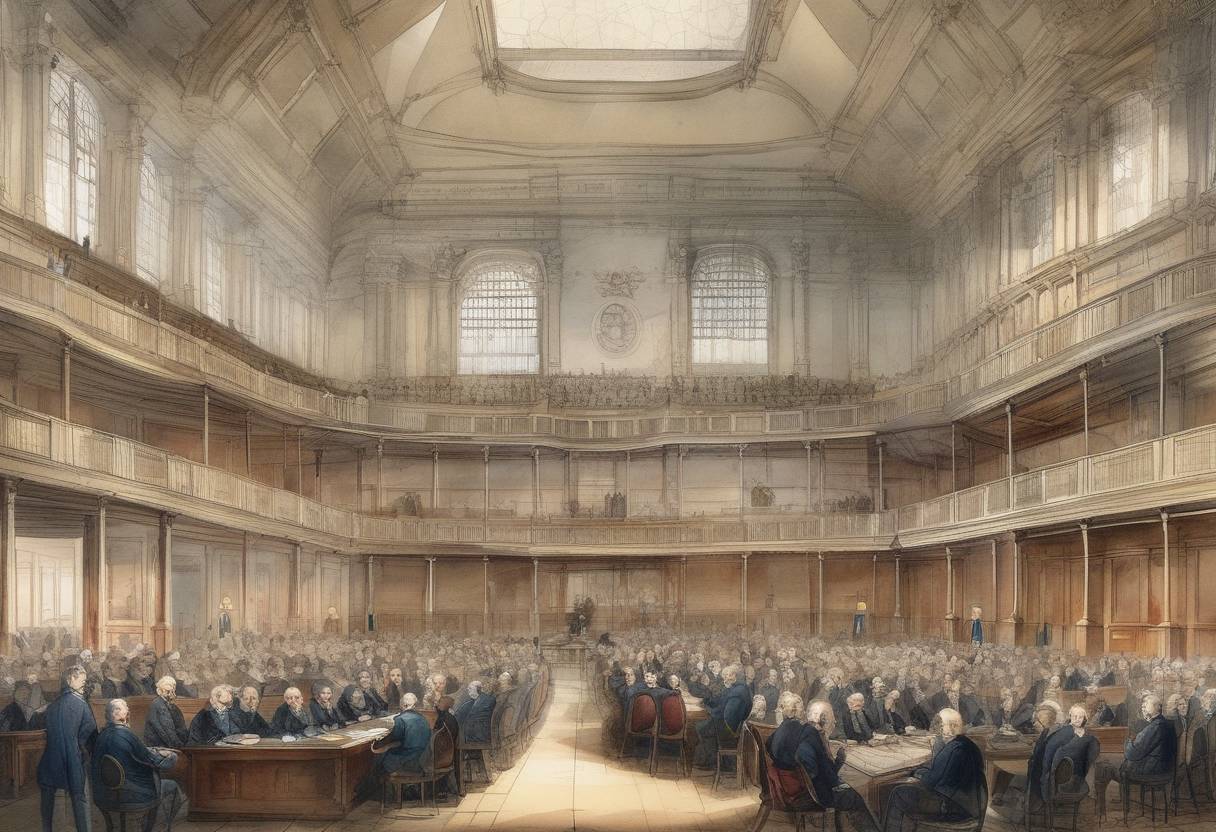
On May 15, 1848, the first German National Assembly convened in the city of Frankfurt am Main, marking a pivotal moment in the history of Germany. This assembly, often referred to as the Frankfurt Parliament, was a significant step towards the unification of the various German states into a single nation-state.
The mid-19th century was a period of significant political and social upheaval across Europe, known as the Revolutions of 1848. These revolutions were driven by a combination of economic hardship, demands for political reform, and rising nationalist sentiments. In the German states, there was a growing desire for national unity and liberal reforms, which culminated in widespread demonstrations and uprisings.
The Frankfurt Parliament was formed in response to these revolutionary pressures. It was the first freely elected parliament for all of Germany, consisting of representatives from various German states. The assembly met at the Paulskirche (St. Paul’s Church) in Frankfurt, a symbolic location chosen for its central position within the German Confederation.
The primary goal of the Frankfurt Assembly was to draft a constitution that would unify the German states under a single national government. This task was fraught with challenges, including:
During its sessions, the Frankfurt Parliament made several important decisions:
The Frankfurt Parliament ultimately failed to achieve its goal of unifying Germany. By 1849, the assembly had lost much of its influence, and many of its members were forced to flee or were arrested as conservative forces regained control. Despite its failure, the Frankfurt Assembly was significant for several reasons:
The Frankfurt Parliament remains a symbol of the struggle for democracy and national unity in Germany’s history, reflecting the broader European movements of the 19th century.
Source: en.wikipedia.org