Alexander Graham Bell's First Successful Telephone Call
1876 · Boston, United States
Alexander Graham Bell makes the first successful telephone call, saying 'Mr. Watson, come here, I want to see you.'
March 27, 1884
The first long-distance telephone call was made between Boston and New York City by Alexander Graham Bell and Thomas Watson.
Boston, United States | Bell Telephone Company
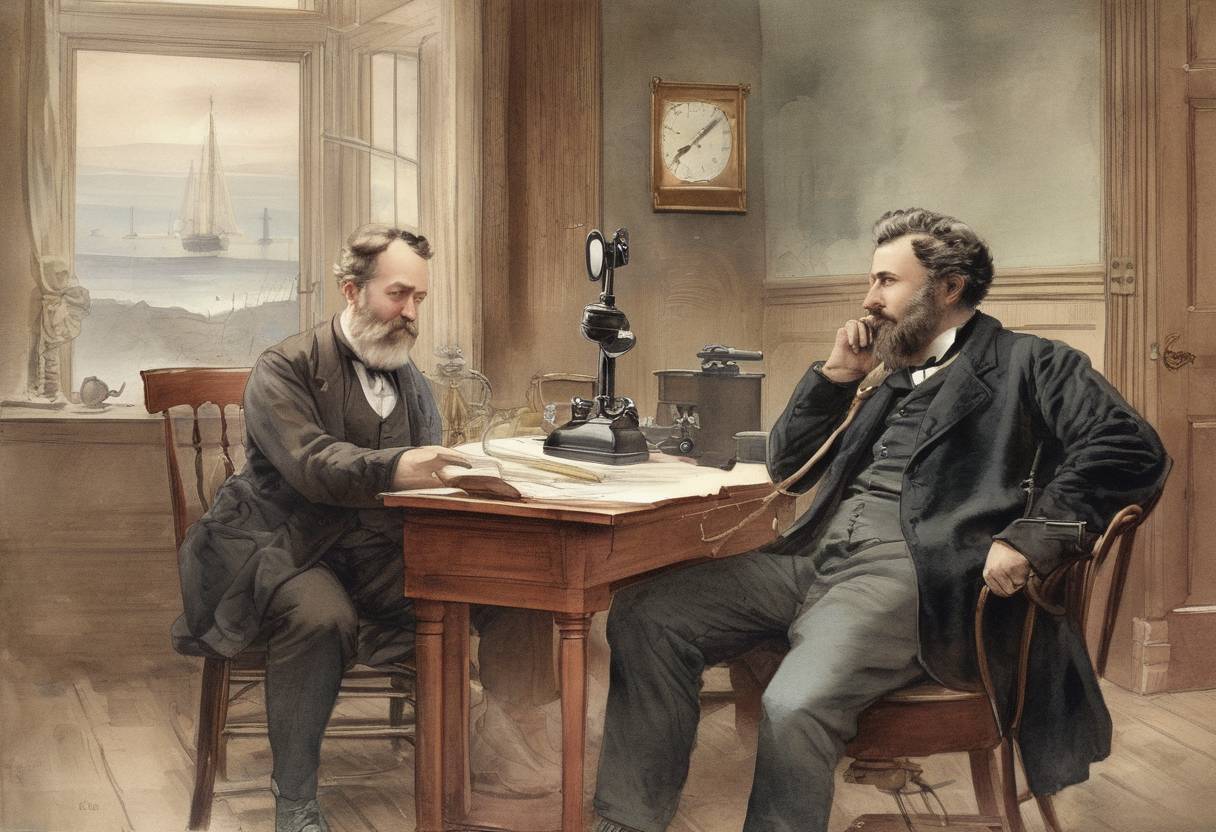
On March 27, 1884, a significant milestone in communication history was achieved when Alexander Graham Bell and his assistant, Thomas Watson, successfully made the first long-distance telephone call between Boston, Massachusetts, and New York City. This event marked a pivotal moment in the evolution of telecommunications, demonstrating the potential of the telephone to connect people over vast distances.
Alexander Graham Bell: An inventor and scientist, Bell is best known for his invention of the telephone. He was deeply interested in the science of sound and communication, which led to his groundbreaking work in telephony.
Thomas Watson: Bell’s assistant and collaborator, Watson played a crucial role in the development and refinement of the telephone. His technical skills complemented Bell’s visionary ideas.
The Telephone: Bell was awarded the patent for the telephone in 1876, and the first successful voice transmission occurred on March 10 of that year. However, early telephones were limited to short distances due to technical constraints.
The Call: On March 27, 1884, Bell and Watson conducted the first long-distance telephone call. The call connected Boston and New York City, covering a distance of approximately 235 miles. This was a remarkable achievement at the time, showcasing the potential for telephones to revolutionize communication.
Technical Challenges: Achieving long-distance communication required overcoming significant technical hurdles, including signal degradation over long wires. Innovations in electrical engineering and the use of better materials for telephone lines were crucial to this success.
Impact on Communication: The successful long-distance call demonstrated the feasibility of using the telephone for communication across cities and eventually across countries. This breakthrough laid the groundwork for the expansion of telephone networks worldwide.
Economic and Social Implications: The ability to communicate over long distances had profound implications for business, government, and personal communication. It facilitated faster decision-making and helped to shrink perceived distances between people and places.
Legacy: The success of the long-distance call spurred further innovations in telecommunications, leading to the development of more advanced technologies and the eventual creation of a global communication network.
In conclusion, the first long-distance telephone call on March 27, 1884, was a landmark event that underscored the transformative power of the telephone. It set the stage for the modern era of instant communication, fundamentally altering how people interact and conduct business across the globe.
Source: en.wikipedia.org