The Carolingian Renaissance and Charlemagne's Coronation
800 · Rome, Roman Empire
The Carolingian Renaissance, a period of cultural and intellectual revival in Europe, was symbolically marked by Charlemagne's coronation as Emperor.
May 19, 0804
Death of Alcuin of York, an English scholar, clergyman, and teacher who was a leading figure in the Carolingian Renaissance.
Tours, France | Carolingian Empire
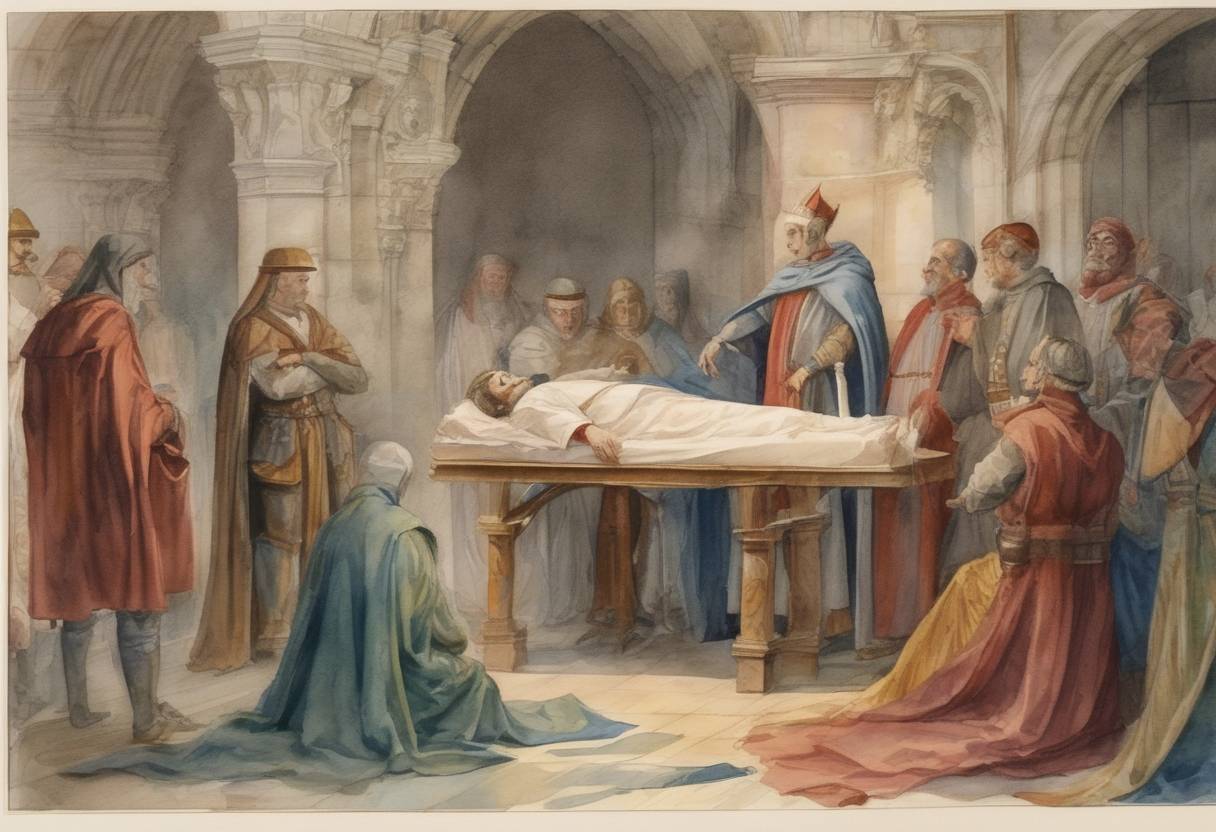
Alcuin of York, a distinguished English scholar, clergyman, and teacher, passed away on May 19, 804. His death marked the end of a significant era in the Carolingian Renaissance, a period of cultural and intellectual revival in the Carolingian Empire.
Early Life and Education: Alcuin was born around 735 in Northumbria, England. He was educated at the cathedral school in York, where he later became the headmaster. His education was rooted in the classical tradition, and he excelled in subjects such as grammar, rhetoric, and theology.
Role in the Carolingian Renaissance: Alcuin was invited by Charlemagne to join his court in 781. He became a leading figure in the Carolingian Renaissance, contributing to the revival of learning and education. Alcuin’s work focused on the standardization of educational practices and the preservation of classical texts.
Educational Reforms: Alcuin played a crucial role in reforming the educational system within the Carolingian Empire. He established a curriculum that emphasized the liberal arts, which included the trivium (grammar, rhetoric, and logic) and the quadrivium (arithmetic, geometry, music, and astronomy).
Literary and Theological Works: Alcuin was a prolific writer, producing numerous theological treatises, poems, and letters. His works were instrumental in shaping the intellectual landscape of medieval Europe.
Script Reform: He was influential in the development of the Carolingian minuscule, a clear and legible script that improved the copying and dissemination of texts.
Final Years: Alcuin spent his final years as the abbot of the Abbey of Saint Martin at Tours, where he continued his scholarly work and mentored future generations of scholars.
Impact: Alcuin’s death on May 19, 804, marked the loss of a pivotal figure in medieval scholarship. His contributions to education and the preservation of knowledge had a lasting impact on European intellectual history.
Historical Significance: Alcuin’s efforts laid the groundwork for the Carolingian Renaissance, which played a crucial role in the cultural and intellectual development of Europe during the Middle Ages. His legacy is evident in the continued emphasis on classical learning and the liberal arts in Western education.
Alcuin of York remains a celebrated figure in history for his dedication to learning and his role in the revival of classical knowledge during a transformative period in European history.
Source: en.wikipedia.org