The First Successful Transatlantic Radio Broadcast by Reginald Fessenden
1907 · Brant Rock, United States
The first successful transatlantic radio broadcast from the United States to the United Kingdom was made by Reginald Fessenden.
December 12, 1901
Guglielmo Marconi receives the first transatlantic radio signal in St. John's, Newfoundland, marking a significant milestone in wireless communication.
St. John's, Canada | Marconi Company
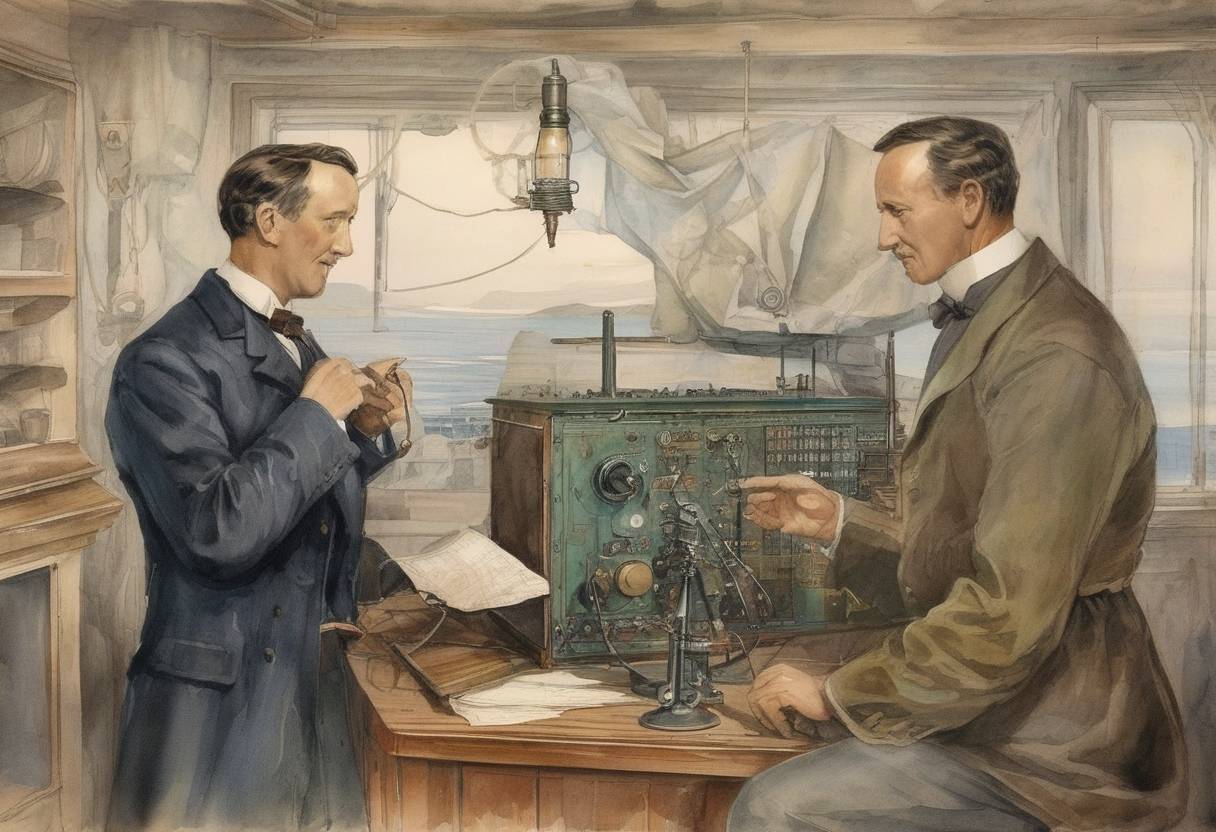
On December 12, 1901, Guglielmo Marconi achieved a groundbreaking milestone in the field of wireless communication by successfully receiving the first transatlantic radio signal. This event took place in St. John’s, Newfoundland, and marked a pivotal moment in the history of communication technology.
Guglielmo Marconi, an Italian inventor and electrical engineer, had been experimenting with wireless telegraphy since the late 19th century. His work was driven by the potential to transmit messages over long distances without the need for physical connections like telegraph wires. By the turn of the century, Marconi had already made significant strides, including successful transmissions over the English Channel.
The transatlantic experiment was a bold endeavor, as many scientists of the time believed that radio waves could not travel beyond the horizon due to the curvature of the Earth. Marconi, however, was determined to prove otherwise. He set up a receiving station on Signal Hill in St. John’s, Newfoundland, while the transmitting station was located in Poldhu, Cornwall, England.
On December 12, 1901, Marconi and his assistant, George Kemp, used a kite to lift a 500-foot antenna into the air. At approximately 12:30 PM local time, they successfully received the faint Morse code signal for the letter “S” (three short dots) transmitted from Poldhu, over 2,000 miles away.
Marconi’s successful reception of the transatlantic signal demonstrated the feasibility of long-distance wireless communication, challenging existing scientific assumptions and paving the way for future developments in radio technology. This achievement had profound implications, leading to the eventual establishment of global wireless communication networks.
Following this success, Marconi continued to refine and expand his wireless technology. He founded the Marconi Wireless Telegraph Company, which played a crucial role in the development of radio communication, including its use in maritime safety and during World War I. Marconi’s work laid the foundation for modern radio, broadcasting, and even the development of radar and other wireless technologies.
In recognition of his contributions to wireless telegraphy, Marconi was awarded the Nobel Prize in Physics in 1909, which he shared with Karl Ferdinand Braun for their contributions to the development of wireless telegraphy.
The reception of the first transatlantic radio signal by Guglielmo Marconi on December 12, 1901, was a landmark event that transformed the landscape of communication. It demonstrated the potential of wireless technology to connect the world, influencing countless technological advancements and shaping the modern era of global communication.
Source: en.wikipedia.org