The Coup Against Julius Nepos: August 28, 475
475 · Ravenna, Italy
The Western Roman Emperor Julius Nepos was forced to flee Ravenna after a coup led by the Roman general Orestes, who declared his own son, Romulus Augustulus, as emperor.
September 4, 0476
Romulus Augustulus, the last Western Roman Emperor, was deposed by the Germanic chieftain Odoacer, marking the traditional end of the Western Roman Empire.
Ravenna, Italy | Western Roman Empire
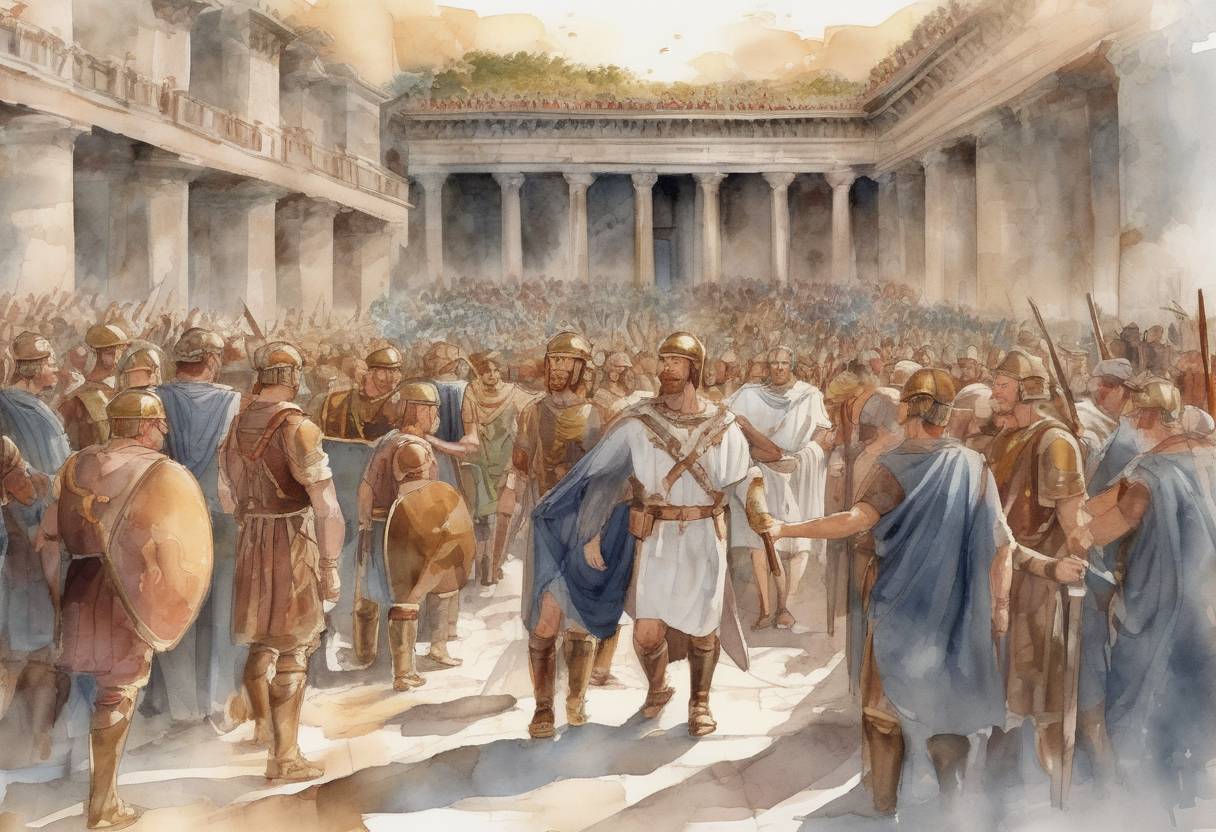
On September 4, 476 CE, a significant event marked the traditional end of the Western Roman Empire: the deposition of Romulus Augustulus by the Germanic chieftain Odoacer. This moment is often cited as the fall of the Western Roman Empire, a pivotal point in European history.
By the 5th century, the Western Roman Empire was in a state of decline. Political instability, economic troubles, and repeated invasions by various barbarian tribes had weakened the empire significantly. The once-mighty Roman military was no longer able to effectively defend its borders, and internal strife further eroded the power of the central government.
Romulus Augustulus, often referred to as the “last Roman emperor,” was a young and relatively insignificant figure in the grand scheme of Roman history. He ascended to the throne in 475 CE, largely as a puppet ruler under the influence of his father, Orestes, a Roman general who had seized power. Romulus’s reign was short-lived and largely ineffectual, as he lacked the authority and resources to address the empire’s myriad problems.
Odoacer was a chieftain of the Germanic tribes, specifically the Heruli, who had served as a mercenary in the Roman army. Recognizing the weakness of the Roman leadership, Odoacer capitalized on the discontent among the troops and the general populace. In 476 CE, he led a revolt against Orestes, capturing and executing him.
Following the defeat of Orestes, Odoacer turned his attention to Romulus Augustulus. On September 4, 476, Odoacer deposed the young emperor, effectively ending his reign. Unlike many of his predecessors, Romulus was spared execution; instead, he was sent into exile at the Castellum Lucullanum in Campania, where he lived out his days in relative obscurity.
The deposition of Romulus Augustulus is traditionally marked as the end of the Western Roman Empire. Odoacer declared himself the ruler of Italy, assuming the title of “King” rather than “Emperor.” He sent the imperial regalia to the Eastern Roman Emperor, Zeno, symbolically acknowledging the end of the Western imperial line.
The fall of the Western Roman Empire ushered in a new era in European history, commonly referred to as the Middle Ages or the Medieval period. The power vacuum left by the collapse of Roman authority led to the rise of various barbarian kingdoms across Europe, setting the stage for the development of medieval European culture and society.
While the Eastern Roman Empire, known as the Byzantine Empire, continued to thrive for nearly another thousand years, the fall of the Western Roman Empire marked a significant transformation in the political and cultural landscape of Europe. The deposition of Romulus Augustulus symbolizes the transition from antiquity to the medieval world, a period characterized by the fusion of Roman, Christian, and Germanic traditions.
In summary, the deposition of Romulus Augustulus by Odoacer on September 4, 476, represents a watershed moment in history, signifying the end of the Western Roman Empire and the beginning of a new era in European history.
Source: en.wikipedia.org