The Surrey Iron Railway: A Pioneering Public Railway
1803 · London, England
The Surrey Iron Railway, arguably the world's first public railway, opened in south London, England.
February 21, 1804
The first self-propelling steam locomotive made its outing at the Pen-y-Darren Ironworks in Wales.
Merthyr Tydfil, Wales | Pen-y-Darren Ironworks
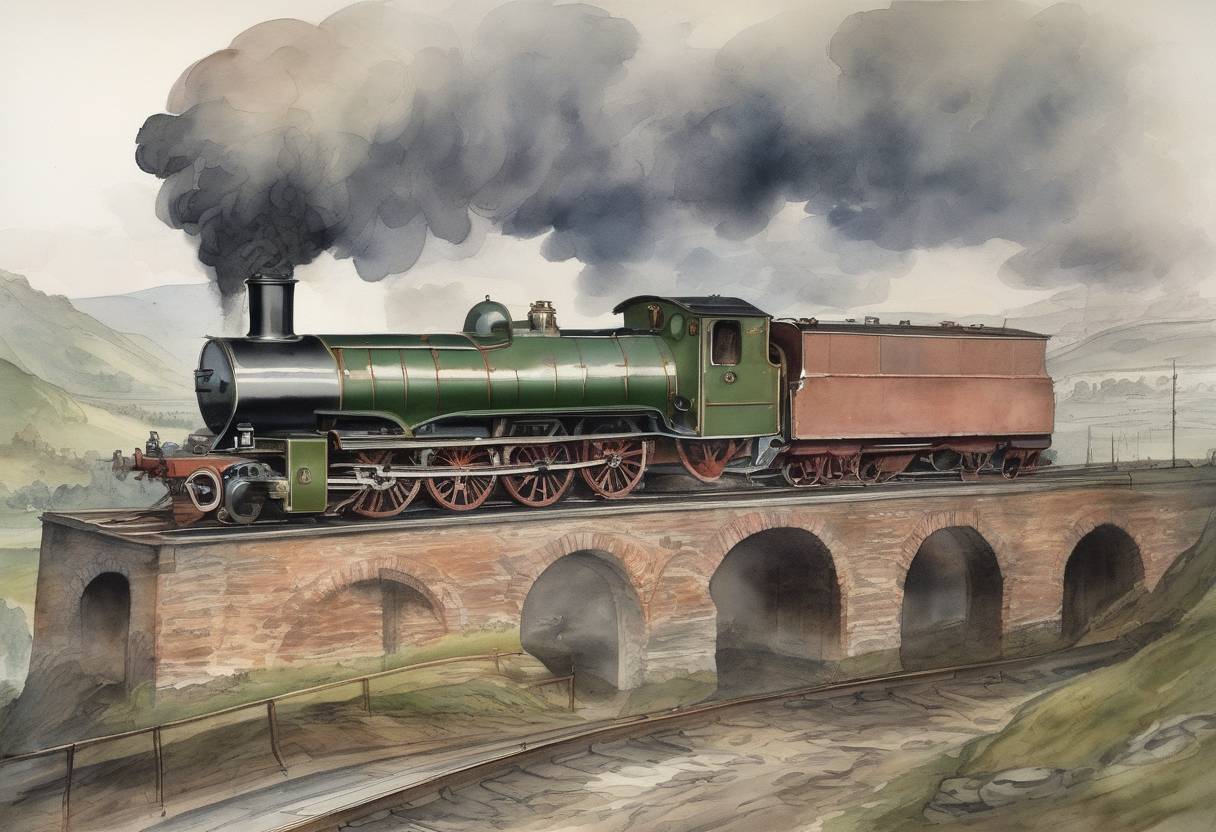
On February 21, 1804, a groundbreaking event in the history of transportation took place at the Pen-y-Darren Ironworks in Merthyr Tydfil, Wales. This date marks the first successful outing of a self-propelling steam locomotive, designed by the innovative engineer Richard Trevithick.
The early 19th century was a period of rapid industrial advancement, with steam power at the forefront of technological innovation. Richard Trevithick, a British engineer and inventor, was a pioneer in the development of high-pressure steam engines. Unlike the low-pressure steam engines of his predecessors, Trevithick’s engines were more compact and powerful, making them suitable for a variety of applications, including transportation.
Trevithick’s locomotive, often referred to as the “Pen-y-Darren locomotive,” was built to demonstrate the potential of steam-powered rail transport. On February 21, 1804, the locomotive made its historic journey, hauling a load of 10 tons of iron, 70 passengers, and five wagons over a distance of approximately 9 miles from Pen-y-Darren to Abercynon.
The journey took about four hours, and despite some mechanical challenges, it was a significant success. The locomotive managed to reach speeds of up to 5 mph, proving that steam-powered rail transport was feasible.
This event marked a pivotal moment in the history of transportation. Trevithick’s successful demonstration laid the groundwork for the development of the railway industry, which would revolutionize travel and commerce in the 19th century and beyond. The use of steam locomotives facilitated the rapid movement of goods and people, contributing to the Industrial Revolution’s expansion.
Despite the success of the Pen-y-Darren locomotive, Trevithick faced numerous challenges, including financial difficulties and a lack of immediate commercial interest. However, his pioneering work inspired future engineers and inventors, such as George Stephenson, who would go on to develop more advanced and commercially viable steam locomotives.
Trevithick’s contribution to engineering and transportation is now widely recognized, and his work is celebrated as a foundational moment in the history of railways.
The outing of the first self-propelling steam locomotive at Pen-y-Darren Ironworks on February 21, 1804, represents a landmark achievement in engineering and transportation. Richard Trevithick’s innovation not only demonstrated the potential of steam power but also set the stage for the development of the modern railway system, profoundly impacting industrial society.
Source: en.wikipedia.org