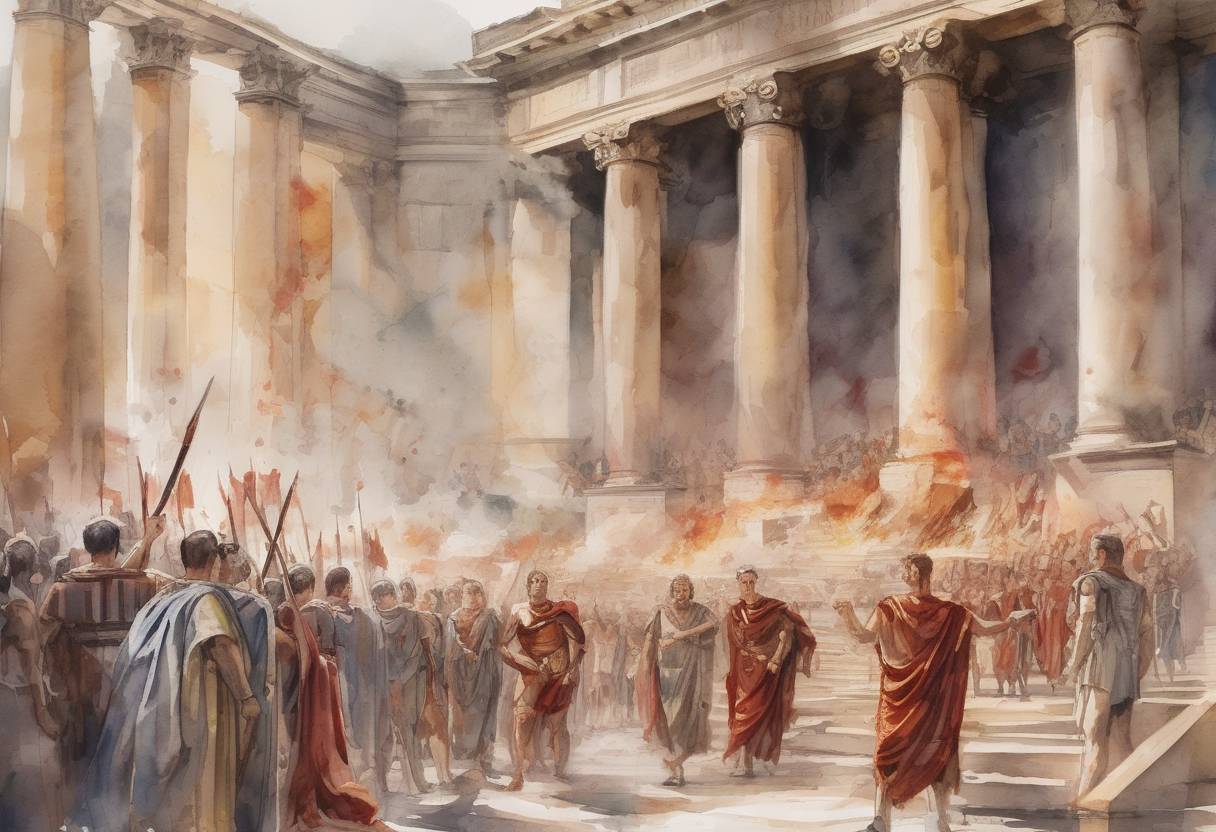
The Assassination of Julius Caesar: March 15, 44 BCE
The assassination of Julius Caesar on March 15, 44 BCE, known as the Ides of March, is one of the most significant events in Roman history. This pivotal moment marked the transition from the Roman Republic to the Roman Empire, setting off a chain of events that would reshape the ancient world.
Context Leading to the Assassination
Julius Caesar, a military general and statesman, had risen to unprecedented power in Rome. After a series of successful military campaigns, notably in Gaul, Caesar crossed the Rubicon River in 49 BCE, igniting a civil war against the Roman Senate and his rival, Pompey. Emerging victorious, Caesar was appointed dictator perpetuo, or dictator for life, in 44 BCE. This concentration of power alarmed many senators who feared the end of the Republic and the establishment of a monarchy.
Gaius Cassius Longinus: A senator and former supporter of Pompey, Cassius was one of the leading conspirators. He harbored deep resentment towards Caesar and played a crucial role in orchestrating the assassination plot.
Marcus Junius Brutus: A senator and close friend of Caesar, Brutus was persuaded to join the conspiracy due to his republican ideals and the influence of Cassius. His involvement was particularly shocking due to his personal relationship with Caesar.
The Assassination
On the Ides of March, Caesar was scheduled to attend a session of the Senate at the Theatre of Pompey. Despite warnings and omens, he proceeded to the Senate meeting. As he entered, he was surrounded by the conspirators, who numbered around 60. They attacked him with daggers, inflicting 23 stab wounds. According to historical accounts, Caesar’s last words were “Et tu, Brute?” expressing his shock at Brutus’s betrayal.
Aftermath and Historical Significance
The assassination did not restore the Republic as the conspirators had hoped. Instead, it plunged Rome into a series of civil wars. The power vacuum left by Caesar’s death led to the rise of the Second Triumvirate, composed of Mark Antony, Octavian (later Augustus), and Lepidus. Eventually, Octavian emerged as the sole ruler, becoming the first Roman Emperor and marking the end of the Roman Republic.
The assassination of Julius Caesar is a critical turning point in Roman history. It highlights the tensions between autocracy and republicanism and sets the stage for the transformation of Rome from a republic to an empire. This event has been immortalized in literature and art, symbolizing the complex interplay of power, loyalty, and betrayal.