Apollo 17: The Final Mission of NASA's Apollo Program
1972 · Pacific Ocean, United States
Apollo 17, the final mission of NASA's Apollo program, returned to Earth after the last manned moon landing.
April 17, 1970
The crew of Apollo 13 safely returned to Earth after an oxygen tank explosion aborted their mission to the Moon.
Pacific Ocean, United States | NASA
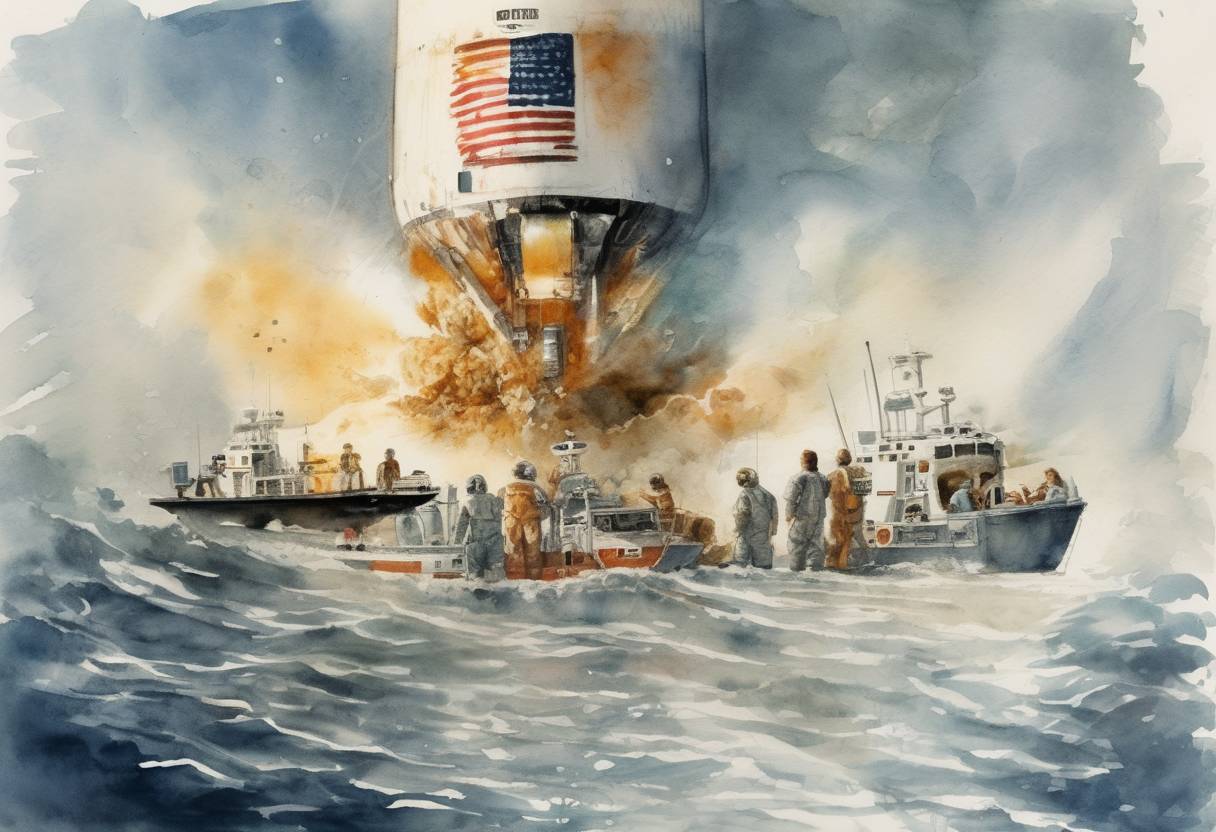
On April 17, 1970, the crew of Apollo 13 safely returned to Earth, concluding a harrowing mission that had captured the world’s attention. This mission, originally intended to be NASA’s third manned lunar landing, became a dramatic rescue operation after an in-flight emergency.
Apollo 13 was launched on April 11, 1970, from Kennedy Space Center, Florida. The crew consisted of Commander James A. Lovell Jr., Command Module Pilot John L. Swigert Jr., and Lunar Module Pilot Fred W. Haise Jr. Their mission was to explore the Fra Mauro region of the Moon.
On April 13, 1970, approximately 56 hours into the mission, an oxygen tank in the Service Module exploded. The explosion severely damaged the spacecraft, causing a loss of electrical power and a critical drop in the supply of oxygen. This incident led to the famous transmission from Swigert: “Houston, we’ve had a problem.”
With the lunar landing aborted, the primary goal became the safe return of the crew. The Lunar Module, Aquarius, originally intended for landing on the Moon, was repurposed as a “lifeboat” to provide life support and propulsion. The crew and mission control worked tirelessly to devise and execute a plan to bring the astronauts home safely.
On April 17, 1970, after a tense re-entry, Apollo 13 splashed down safely in the Pacific Ocean, near Samoa. The crew was recovered by the USS Iwo Jima, marking the successful conclusion of a mission that had transformed from a potential disaster into a testament to human ingenuity and teamwork.
The Apollo 13 mission is often cited as a “successful failure.” It demonstrated the resilience and problem-solving capabilities of NASA and its astronauts. The incident led to significant changes in spacecraft design and procedures to enhance safety for future missions. Apollo 13 remains a powerful example of crisis management and the spirit of exploration.
The mission’s story has been immortalized in books, documentaries, and the 1995 film “Apollo 13,” which further popularized the phrase “Houston, we have a problem.”
Source: en.wikipedia.org