Hungary's Withdrawal from the Warsaw Pact
1956 · Budapest, Hungary
Hungary withdraws from the Warsaw Pact during the Hungarian Revolution of 1956.
March 31, 1991
The Warsaw Pact, a collective defense treaty established by the Soviet Union and seven other Eastern Bloc socialist republics in Central and Eastern Europe during the Cold War, was formally dissolved.
Budapest, Hungary | Warsaw Pact
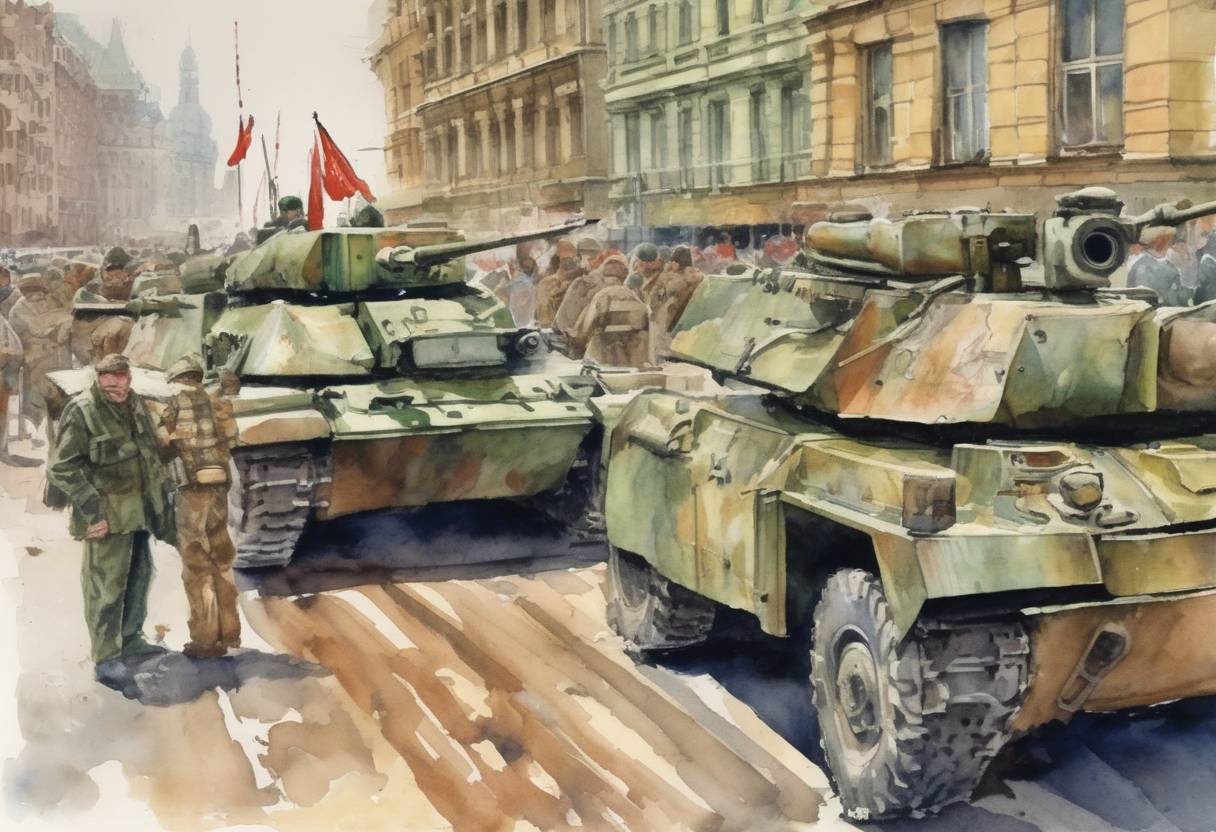
The Warsaw Pact, officially known as the “Treaty of Friendship, Cooperation, and Mutual Assistance,” was a collective defense treaty established on May 14, 1955, by the Soviet Union and seven other Eastern Bloc socialist republics in Central and Eastern Europe. It was created in response to the integration of West Germany into NATO, serving as a counterbalance to Western military alliances during the Cold War.
Formation: The Warsaw Pact was formed as a military alliance among the Soviet Union, Albania (which withdrew in 1968), Bulgaria, Czechoslovakia, East Germany, Hungary, Poland, and Romania. It was primarily a tool for the Soviet Union to maintain control over military forces in Eastern Europe and to counter the perceived threat from NATO.
Function: The Pact provided for a unified military command and the stationing of Soviet troops in member countries. It was used to justify Soviet intervention in member states, most notably during the Hungarian Revolution of 1956 and the Prague Spring in 1968.
Political Changes: The late 1980s saw significant political changes across Eastern Europe, with the rise of reform movements and the weakening of communist governments. The fall of the Berlin Wall in 1989 and the subsequent reunification of Germany were pivotal moments that signaled the decline of Soviet influence.
Soviet Reforms: Under Mikhail Gorbachev, the Soviet Union adopted policies of glasnost (openness) and perestroika (restructuring), which encouraged more liberal governance and economic reforms. These policies inadvertently accelerated the dissolution of Soviet control over Eastern Europe.
End of the Cold War: The Cold War’s conclusion, marked by the reduction of tensions between the East and West, diminished the need for such military alliances.
Formal Dissolution: On March 31, 1991, the Warsaw Pact was formally dissolved. The decision was made during a meeting in Budapest, Hungary, where representatives from the member states agreed to disband the alliance.
Significance: The dissolution of the Warsaw Pact marked the end of the military division of Europe that had persisted since the end of World War II. It symbolized the collapse of Soviet hegemony in Eastern Europe and the shift towards democratic governance and market economies in the region.
Transition: Former Warsaw Pact countries transitioned towards democracy and market economies, with many eventually joining NATO and the European Union.
Legacy: The dissolution of the Warsaw Pact is seen as a significant step in the peaceful resolution of the Cold War. It paved the way for greater European integration and cooperation.
In conclusion, the dissolution of the Warsaw Pact on March 31, 1991, was a landmark event in the history of the 20th century, representing the end of an era of ideological and military confrontation in Europe.
Source: en.wikipedia.org