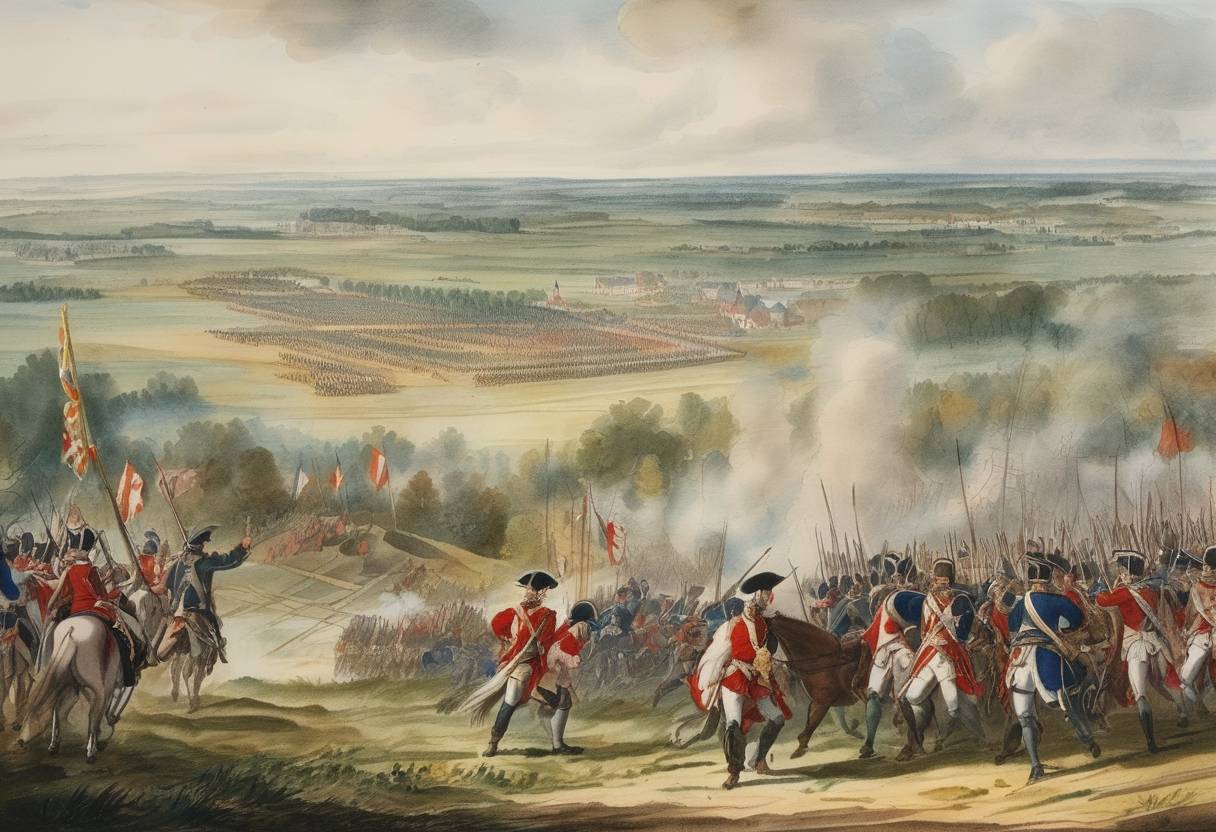
The Battle of Fontenoy - May 11, 1745
The Battle of Fontenoy, fought on May 11, 1745, was a significant engagement during the War of the Austrian Succession (1740-1748). It saw French forces under King Louis XV and the renowned Marshal Maurice de Saxe defeat the Anglo-Dutch-Hanoverian army commanded by the Duke of Cumberland. The battle occurred near the village of Fontenoy, present-day Belgium, and was part of a broader campaign aimed at controlling the Austrian Netherlands.
Context
The War of the Austrian Succession was triggered by the death of Emperor Charles VI and the subsequent ascension of his daughter, Maria Theresa, to the Habsburg throne. Numerous European powers contested her right to rule, leading to widespread conflict. The Battle of Fontenoy was part of France’s strategy to assert dominance in the Low Countries, a region of critical importance for commerce and military positioning in Europe.
The Battle
Combatants: The French forces numbered approximately 50,000, commanded by Marshal Maurice de Saxe, who was ill at the time but still directed his troops with significant skill. Opposing them was an alliance of British, Dutch, Hanoverian, and Austrian forces totaling around 52,000 men, led by the Duke of Cumberland.
Strategy: The French adopted defensive tactics, using natural terrain to strengthen their positions. They prepared robust defensive works with redoubts and artillery placements along potential attack paths. The Anglo-Allied forces attempted a frontal assault, structured in traditional dense infantry formations.
Key Events:
- The French artillery, skillfully deployed by de Saxe, proved highly effective in repelling the initial assault by the Allies.
- A notable point of engagement occurred at the French center, where the British guards brigades succeeded in temporarily breaching French lines before encountering stiff resistance.
- The famed “Advance of the Boys” saw British troops exchange musket volleys with French defenders in highly disciplined fashion.
Climax: The battle reached its turning point when French reserves, including the Irish Brigade, known for their fierce combat capability, counterattacked the advancing Allies and contributed significantly to reversing their gains.
Outcome
The French were victorious after several hours of intense combat. The Allied forces, depleted and unable to sustain their positions, ultimately retreated. French casualties were estimated at around 7,000, while the Allied losses were considerably higher, around 12,000 killed, wounded, or captured.
Aftermath
- The victory at Fontenoy solidified French control over much of the Austrian Netherlands, contributing to France’s temporary dominance in the region.
- The success boosted French morale and prestige, while demoralizing their opponents.
- Fontenoy was pivotal in demonstrating the importance of artillery in modern warfare and the effective use of defensive tactics against superior numbers.
Significance
The Battle of Fontenoy exemplified the military prowess and strategic acumen of Marshal Maurice de Saxe and underscored France’s role as a dominant military power in mid-18th century Europe. It also highlighted the complexities of coalition warfare and the challenges of joint command in multinational forces.
The battle is often remembered for its dramatic elements and the chivalry displayed by both sides in an era where such traditions were beginning to wane amidst the evolving nature of warfare.