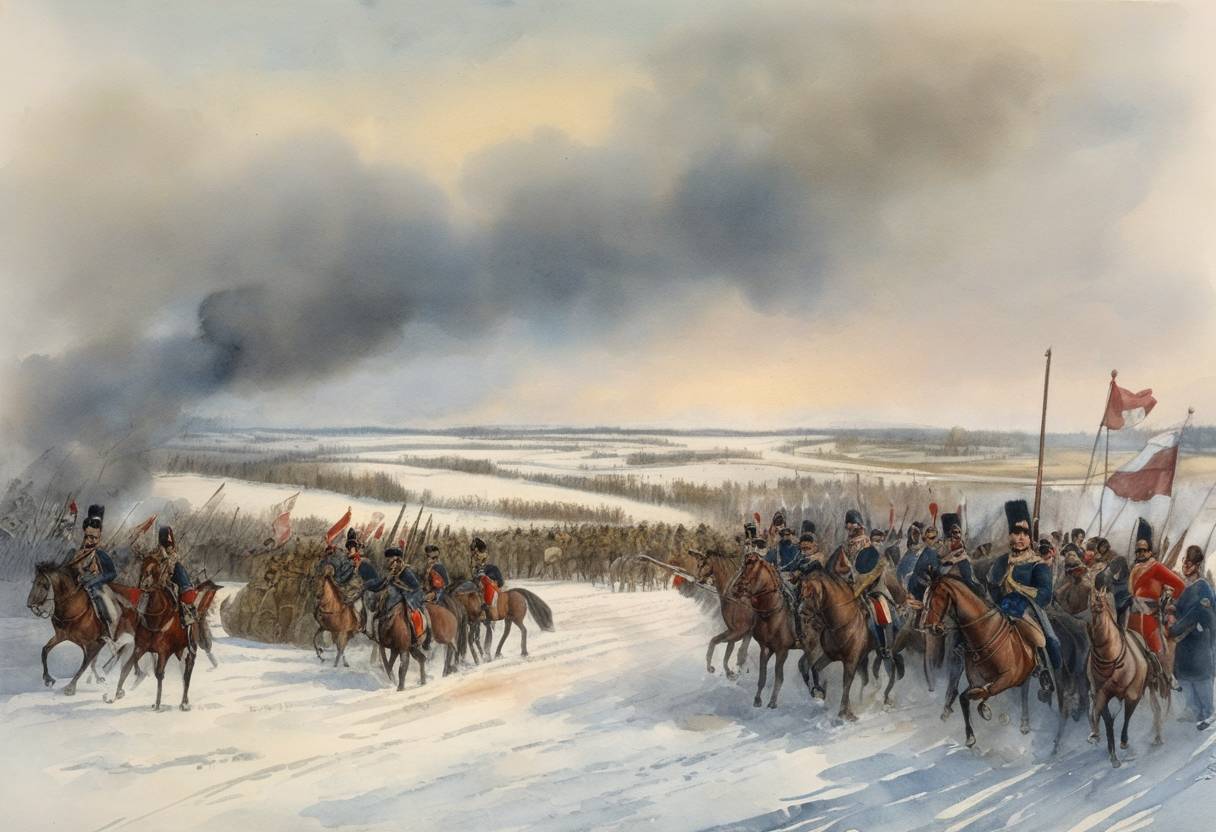
Battle of the Berezina: November 26, 1812
The Battle of the Berezina occurred during Napoleon Bonaparte’s infamous retreat from Moscow, marking one of the most challenging phases of the French Empire’s military campaign in Russia. On November 26, 1812, French forces engaged Russian armies at the Berezina River, a vital crossing point.
Context and Background
Napoleon’s Grande Armée, initially numbering over 600,000 troops, had been severely diminished by the harsh Russian winter, logistical struggles, and ongoing skirmishes with Russian forces. By the time of the Berezina, only a fraction, approximately 40,000 soldiers, remained as effective fighting units. Napoleon sought to retreat westward and return to France before the full onset of winter. The Berezina River, however, posed a formidable natural barrier, complicated further by pursuing Russian forces eager to encircle and decimate the retreating army.
Key Events of the Battle
Strategic Situation: On November 26, 1812, Napoleon’s forces approached the Berezina near Studianka. Russian forces under Field Marshal Mikhail Kutuzov and other generals, including Admiral Pavel Chichagov and General Peter Wittgenstein, aimed to trap the French between their forces and the river.
Engineering Feat: To facilitate the crossing, Napoleon’s engineers, led by General Jean-Baptiste Eblé, worked under extreme conditions to construct two bridges across the icy waters. Despite shortages and freezing temperatures, they managed to erect these critical structures, allowing the army to attempt their escape.
Battle and Crossing: As French troops crossed the Berezina, intense fighting broke out. Russian forces attacked from both the east and west banks, attempting to destroy the bridges and trap the French on the riverbanks. The French rear guard engaged Russian units to protect the crossing efforts.
Completion of the Crossing: Over three days, the French forces managed to transport a significant portion of their troops and materiel across the river. However, the crossing was chaotic, with many soldiers and civilians, including baggage train followers, suffering due to the cold and ensuing combat.
Aftermath and Consequences
While approximately 22,000 French soldiers successfully crossed the Berezina, thousands perished during the conflict and subsequent retreat. The battle stands as a pyrrhic victory for Napoleon; although successful in escaping total encirclement, the remnants of the Grande Armée were in disarray, severely undermined, and continued to face hardship on the path back to France.
The Berezina encounter encapsulates the broader failure of the Russian campaign, symbolizing the devastating losses and ultimate decline of Napoleon’s empire. This defeat emboldened Napoleon’s adversaries across Europe, leading to the War of the Sixth Coalition against France. The battle is remembered both for the ingenuity and desperation displayed by the French forces and as a symbol of the broader catastrophe of Napoleon’s Russian campaign.