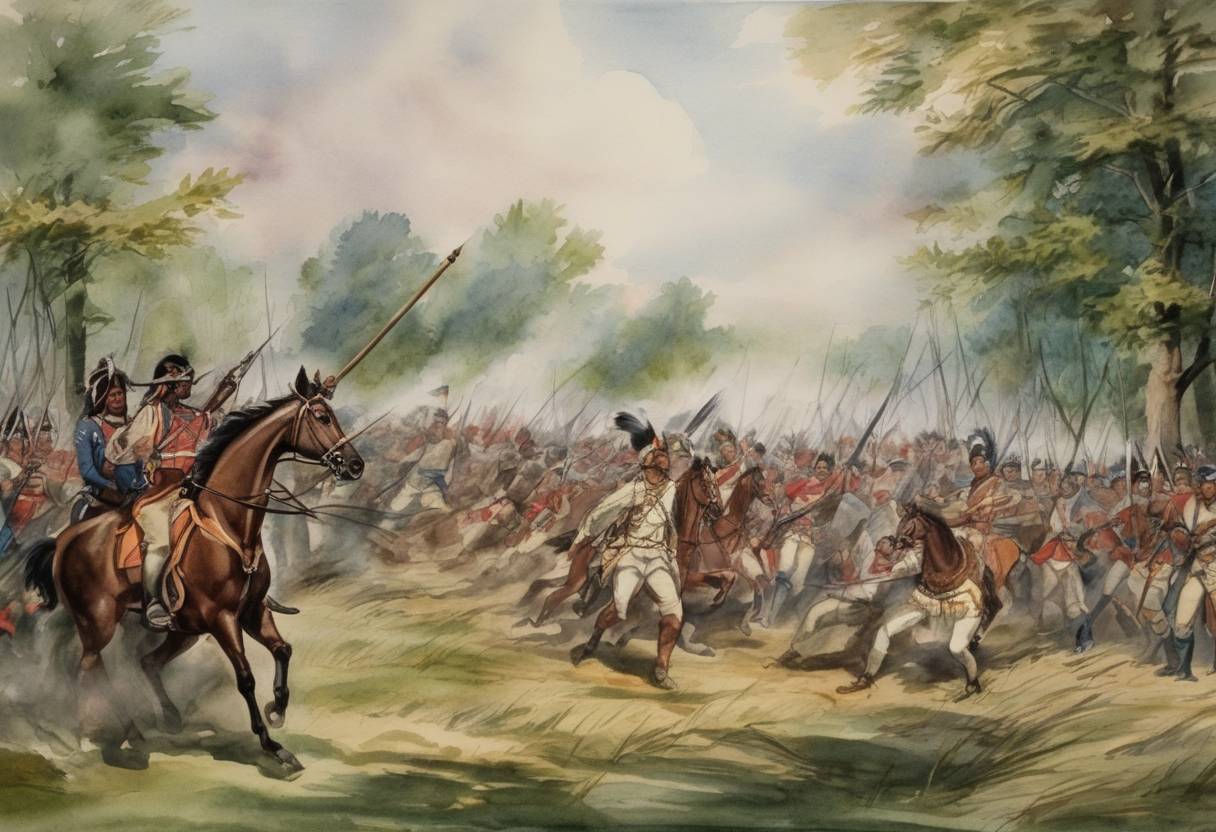
The Battle of Fallen Timbers: A Pivotal Clash
Context and Prelude
In the late 18th century, tensions between the United States and Native American tribes over territory in the Northwest Territory (present-day Ohio) were escalating. Settlers were encroaching on land that the Native American confederacy, an alliance of various tribes, considered theirs. This coalition, led by figures such as Little Turtle of the Miami and Blue Jacket of the Shawnee, sought to resist U.S. expansion.
The U.S. government, under President George Washington, was determined to assert control over the region and secure its western frontier. Previous attempts to do so, such as the disastrous campaigns led by Generals Josiah Harmar and Arthur St. Clair, had failed. In response, Washington appointed General “Mad” Anthony Wayne to command a new army primarily composed of regular troops rather than untrained militia.
The Battle
On August 20, 1794, General Wayne’s forces, known as the Legion of the United States, encountered the Native American confederation near present-day Maumee, Ohio. The battle site, known as “Fallen Timbers” due to trees felled by recent storms, provided a chaotic and challenging landscape.
Wayne’s troops, consisting of around 3,000 soldiers, engaged 1,000 Native American warriors under Blue Jacket’s command. The engagement lasted less than two hours, with Wayne employing aggressive tactics and disciplined formations that effectively countered the Native American’s skirmish-style fighting.
Outcome and Aftermath
The immediate result was a decisive victory for the United States. The Native American forces were driven from the field, suffering significant casualties and losing further organized resistance capability in the region.
The battle’s aftermath led to the 1795 Treaty of Greenville. Under this treaty, Native American leaders ceded large parts of present-day Ohio, Indiana, Illinois, and Michigan to the United States, paving the way for American westward expansion. In return, they received goods worth $20,000 and recognition of their remaining territory rights, although these were often not respected in subsequent years.
Historical Significance
The Battle of Fallen Timbers was a crucial turning point in the struggle for control over the Northwest Territory. It effectively ended major Native American resistance in the region and solidified U.S. claims in the area. The victory and subsequent treaty led to a decade of relative peace on the frontier. However, it also set a precedent for further displacement of Native American tribes as American expansion continued unabated westward, fostering long-term consequences for indigenous peoples.