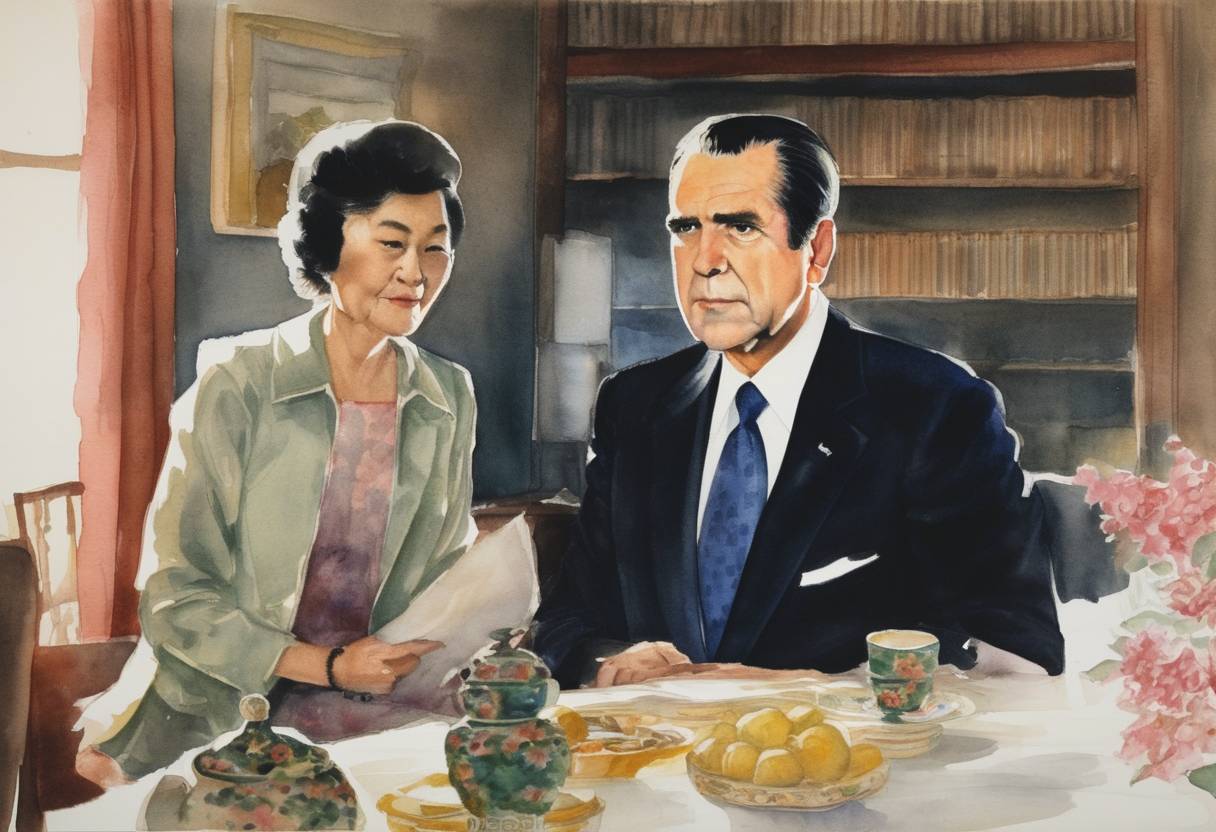
Nixon’s Announcement of His Visit to China - July 15, 1971
On July 15, 1971, U.S. President Richard Nixon made a landmark announcement that signaled a significant shift in international relations during the Cold War era. In a live television broadcast, Nixon stated his intentions to visit the People’s Republic of China at the invitation of the Chinese government. This announcement marked the beginning of a thaw in relations between the United States and China, two countries that had been isolated from one another since the communist takeover of China in 1949.
Context and Background
The relationship between the United States and the People’s Republic of China had been fraught due to ideological and military tensions. Following the Chinese Communist Revolution in 1949, the U.S. had refused to recognize the PRC, instead maintaining diplomatic relations with the Republic of China in Taiwan. The Korean War from 1950 to 1953 further entrenched hostilities, as Chinese forces directly engaged U.N. forces led by the United States.
Throughout the 1960s, both nations stood on opposite sides of the Cold War divide: China aligned with the Soviet Union initially, while the U.S. championed containment of communism globally. However, by the late 1960s, the Sino-Soviet split and increasing economic pressures on China created an opportunity for diplomatic engagement.
The Announcement
Nixon described the planned visit as an effort “to seek the normalization of relations between the two countries.” He articulated the strategic importance of opening dialogues with China in order to promote peace and stability in Asia and the wider international community. The announcement caught many by surprise, given the longstanding enmity and the ongoing U.S. involvement in Vietnam, a conflict partly characterized by its anti-communist stance.
Key figures involved in paving the way for this rapprochement included Henry Kissinger, Nixon’s National Security Advisor, who had conducted secret negotiations with Chinese officials earlier that year. His clandestine trip to China in July 1971, known as the “Kissinger trip,” laid the groundwork for Nixon’s future visit and was critical in smoothing diplomatic channels.
Significance and Aftermath
Nixon’s announcement heralded the re-establishment of contact between two of the world’s superpowers, altering the geopolitical landscape. His subsequent visit in February 1972, famously broadcasted as the “week that changed the world,” resulted in the Shanghai Communiqué, a joint statement that outlined the steps towards improving bilateral relations.
This diplomatic breakthrough had several major consequences:
Sino-American Relations: It led to the eventual normalization of relations and the official U.S. recognition of the People’s Republic of China in 1979.
Cold War Dynamics: The rapprochement with China altered the balance of power and applied pressure on the Soviet Union, contributing to a strategic realignment.
Economic and Cultural Exchange: Over time, rekindled ties facilitated economic and cultural exchanges, laying a foundation for the extensive economic interdependence that followed in subsequent decades.
Nixon’s overture to China remains one of the most significant foreign policy shifts of the 20th century, demonstrating the potential of diplomacy to transform adversarial relations and reshape international paradigms.