The Sealing of the Magna Carta: June 15, 1215
1215 · Runnymede, England
King John of England put his seal on the Magna Carta, a document that limited the powers of the monarchy and laid the foundation for modern democracy.
November 1, 1210
King John of England expels Isabella of Angoulême's first husband, Hugues IX le Brun, from England, amidst conflict over territories and alliances.
unknown, England | English monarchy
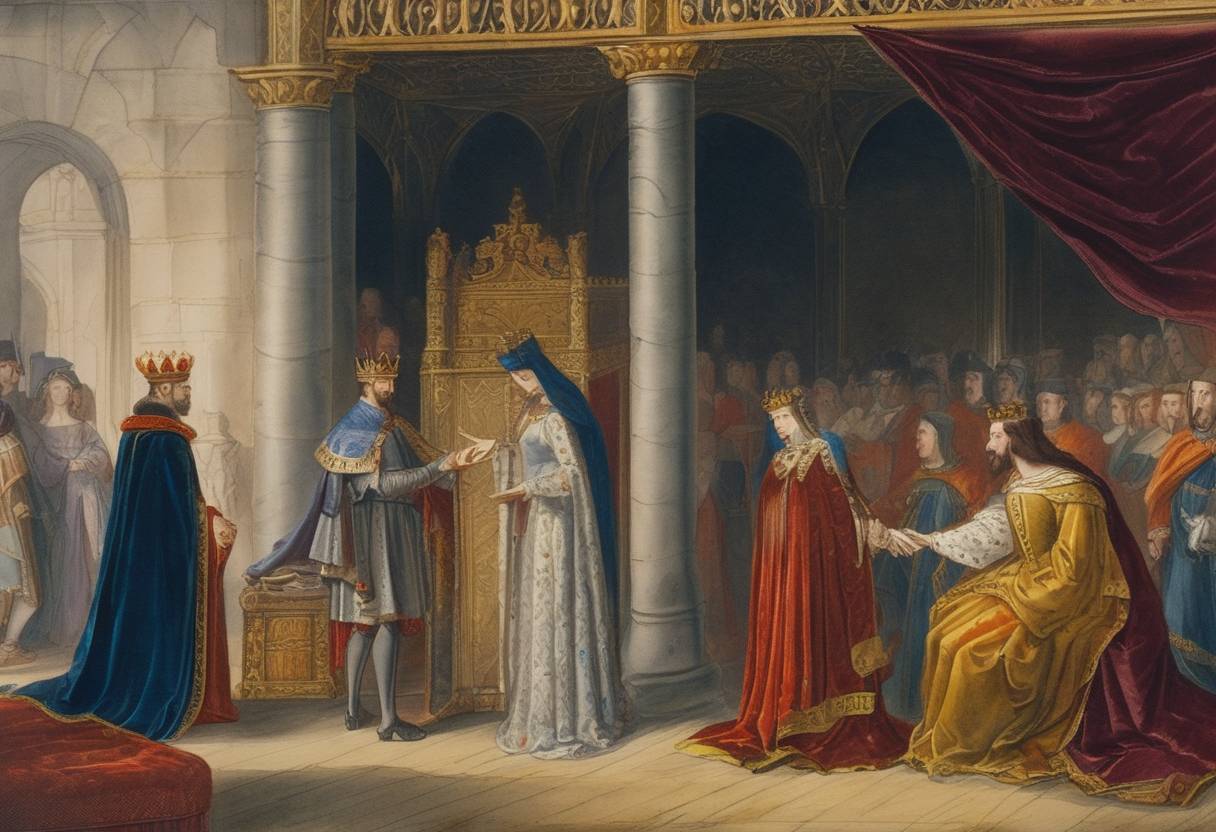
On November 1, 1210, King John of England took decisive action against Hugues IX le Brun, the first husband of Isabella of Angoulême, by expelling him from England. This event occurred amid a backdrop of territorial conflicts and complex alliances that characterized John’s reign.
The expulsion of Hugues IX le Brun is deeply entwined with the political intrigues of the time. Isabella of Angoulême’s marriage to King John in 1200 was a pivotal moment, as she was originally betrothed to Hugues IX. This marriage not only angered Hugues but also exacerbated tensions because it represented a strategic move by John to solidify his control in both England and his Angevin territories in France.
Hugues IX le Brun was a powerful member of the Lusignan family, a noble house with significant holdings in the region. The marriage to Isabella, and thereby the annulment of her betrothal to Hugues, destabilized the political landscape, spurring animosities between John and the Lusignans.
King John’s expulsion of Hugues IX was not an isolated decision. It followed various acts of defiance and opposition by the Lusignans against John’s rule. The Lusignans, especially Hugues IX, were involved in continuous struggles over John’s policies and his handling of land rights and local governance.
John’s decision to expel Hugues from England was likely a move to suppress dissent and reinforce his authority over the Angevin domains. By removing influential figures opposing him, John aimed to consolidate his power amidst a period where his hold over his territories, particularly in France, was increasingly tenuous.
Hugues IX’s expulsion further strained relations but did not quell the broader discontent. The tensions between John and his barons, including figures like Hugues, eventually contributed to the growing dissatisfaction that culminated in the rebellion of the English barons and the signing of the Magna Carta in 1215.
This conflict also echoed in John’s struggles to maintain his French territories, underscoring the fragile nature of feudal allegiances and the volatility of medieval European politics. The expulsion is a notable instance of John’s increasingly autocratic measures that alienated many of his former allies and nobility.
The expulsion of Hugues IX le Brun highlights the intricate web of feudal loyalties, territorial ambitions, and royal authority in early 13th-century England and France, setting the stage for significant historical developments in the following years.
Source: en.wikipedia.org