King Juan Carlos I Announces Abdication
2014 · Madrid, Spain
King Juan Carlos I of Spain announced his intention to abdicate the throne in favor of his son, Felipe VI.
February 11, 1873
King Amadeo I of Spain abdicated the Spanish throne, leading to the proclamation of the First Spanish Republic.
Madrid, Spain
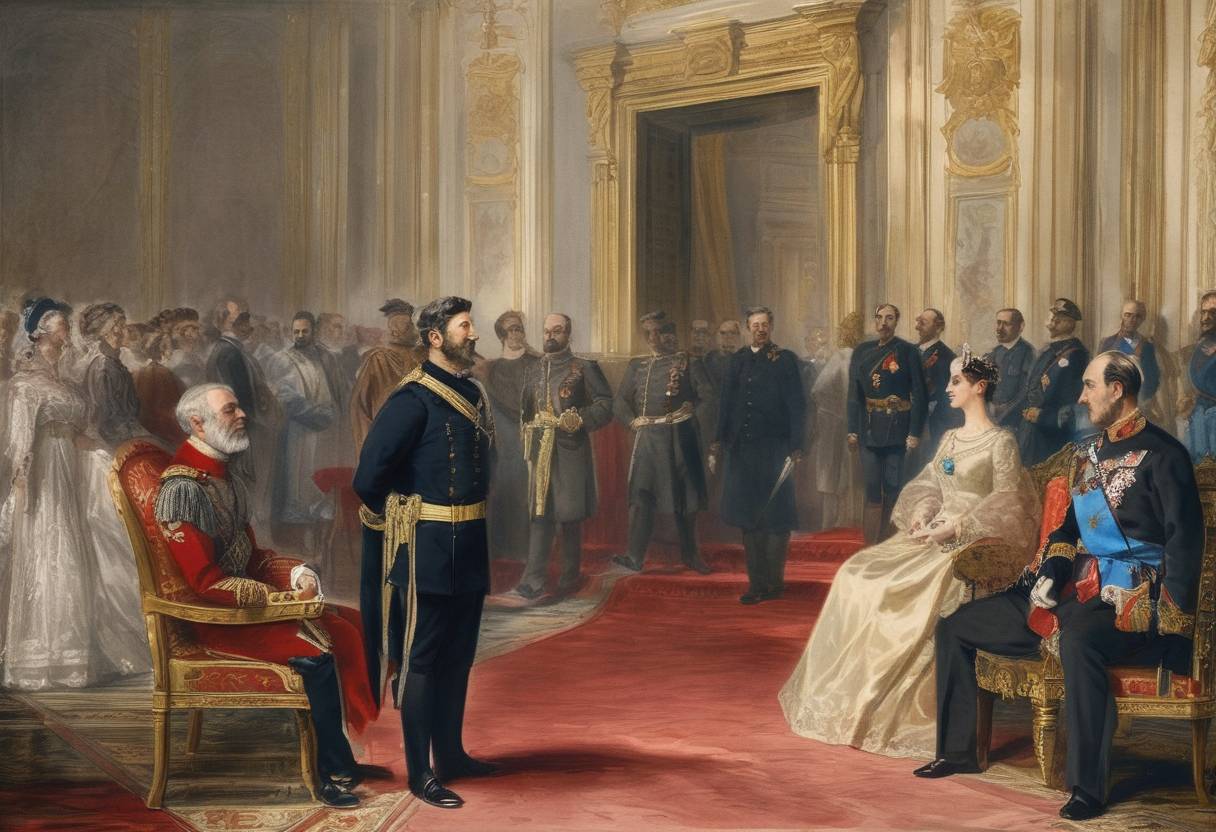
On February 11, 1873, King Amadeo I of Spain abdicated the throne, an event which precipitated the proclamation of the First Spanish Republic. This was a significant turning point in Spanish history, marking the transition from monarchy to a brief republican period.
Amadeo I, originally from Italy, was elected King of Spain in 1870 following the deposition of Queen Isabella II. His ascent to the throne came after the Glorious Revolution of 1868, which aimed to replace the monarchy with more progressive and democratic systems. The Spanish Cortes selected Amadeo, then Duke of Aosta and second son of King Victor Emmanuel II of Italy, largely due to his liberal beliefs and perceived neutrality amidst European conflicts.
Despite his intentions to be a unifying figure, Amadeo I’s reign was fraught with difficulties. Spain was beset by numerous challenges, including political instability, persistent regional conflicts, such as the Carlist Wars, and opposition from both monarchists and republicans. His efforts to implement liberal reforms were frustrated by constant government changes and widespread unrest. The royal court was also plagued by divisions, and Amadeo’s foreign origins left him undermined by nationalistic factions within Spain.
The murder of the Prime Minister, Juan Prim, who had been a strong advocate and supporter of Amadeo’s kingship, significantly weakened his authority. By early 1873, the political situation further deteriorated, with escalating violence and strikes demonstrating the inability of the monarchy to maintain order. Recognizing his untenable position, Amadeo I decided to abdicate the throne on February 11, 1873, citing the impossibility of governing a country as fractious as Spain had become.
Immediately following his abdication, the Spanish Cortes declared the establishment of the First Spanish Republic on the same day. It marked Spain’s shift towards republicanism, although this period was short-lived and marred by political turmoil. The Republic faced many challenges, including internal divisions and external threats, and it lasted only until December 1874, when Alfonso XII was restored to the throne.
The abdication of Amadeo I and the proclamation of the First Spanish Republic underscore a turbulent phase in Spain’s 19th-century history. It reflected the struggles between progressive and conservative forces within the country and exhibited the broader European trends of liberalization and democratization during this era. Despite its brevity, the First Republic laid some groundwork for future republican ideals in Spain.
This event remains a poignant reminder of the complexities inherent in the governance of a nation amid deep-seated social and political divides.
Source: www.britannica.com