Rosetta Spacecraft and Comet 67P Magnetic Oscillations
2016 · , outer space
The European Space Agency’s Rosetta spacecraft identifies mysterious magnetic oscillations emanating from Comet 67P/Churyumov-Gerasimenko.
November 12, 2014
The European Space Agency's Rosetta mission successfully lands its Philae probe on the surface of Comet 67P/Churyumov-Gerasimenko, marking the first time a spacecraft has landed on a comet.
Darmstadt, Germany | European Space Agency
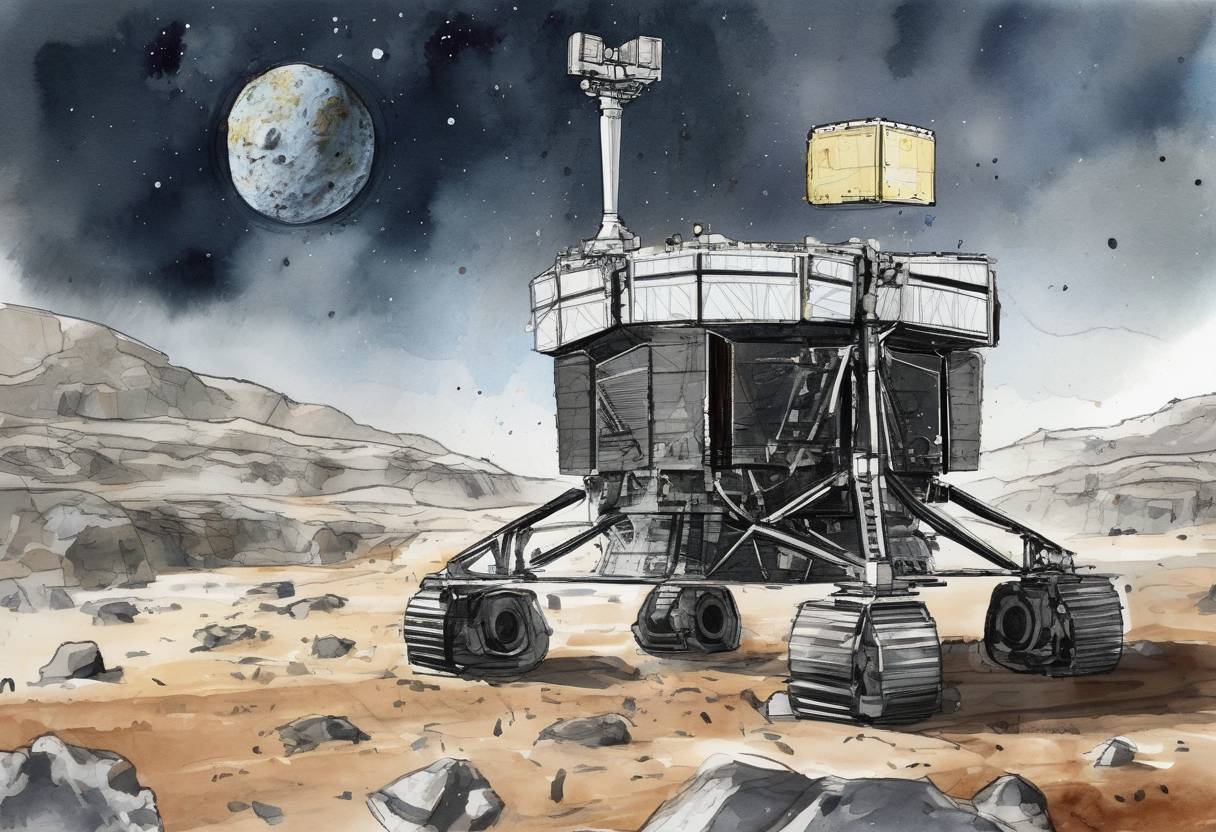
On November 12, 2014, the European Space Agency (ESA) achieved a groundbreaking milestone in space exploration with the successful landing of the Philae probe on the surface of Comet 67P/Churyumov-Gerasimenko. This event marked the first time in history that a spacecraft had landed on a comet, representing a significant achievement in our understanding of these celestial bodies.
The Rosetta mission was launched by the ESA on March 2, 2004, with the primary objective of studying Comet 67P/Churyumov-Gerasimenko. The mission aimed to gather detailed data on the comet’s nucleus and its environment, providing insights into the early solar system. The spacecraft was named after the Rosetta Stone, symbolizing the mission’s goal of unlocking the secrets of comets.
Rosetta’s journey to the comet was a complex and lengthy one, involving several gravity-assist maneuvers around Earth and Mars to gain the necessary velocity to reach its target. After a decade-long voyage covering approximately 6.4 billion kilometers, Rosetta finally arrived at the comet in August 2014.
The Philae lander, named after the Philae obelisk, was designed to detach from the Rosetta orbiter and descend to the comet’s surface. On November 12, 2014, Philae successfully separated from Rosetta and began its descent. The landing was not without challenges; Philae’s harpoons, intended to anchor it to the comet’s surface, failed to deploy, causing the lander to bounce twice before settling in a shaded area.
Despite the landing complications, Philae managed to conduct several scientific experiments during its initial 57-hour battery life. It transmitted valuable data back to Earth, including images and measurements of the comet’s surface composition, structure, and magnetic field. These findings have contributed significantly to our understanding of comets and their role in the solar system.
Philae’s landing was a monumental achievement in space exploration, demonstrating the feasibility of landing on and studying comets up close. Although Philae’s operational life was short, the data it collected continues to be analyzed, providing insights into the composition and behavior of comets. The Rosetta mission concluded in September 2016, when the orbiter was deliberately crashed onto the comet’s surface.
The success of the Rosetta mission has paved the way for future comet exploration and has inspired a new generation of scientists and engineers. It stands as a testament to international collaboration and the relentless pursuit of knowledge in the field of space exploration.
Source: www.esa.int