The Crittenden-Johnson Resolution: July 25, 1861
1861 · Washington, D.C., United States
The United States Congress passed the Crittenden-Johnson Resolution, declaring that the Civil War was being fought to preserve the Union and not to end slavery.
March 4, 1877
Rutherford B. Hayes was inaugurated as the 19th President of the United States, ending the disputed 1876 presidential election.
Washington, D.C., United States | United States
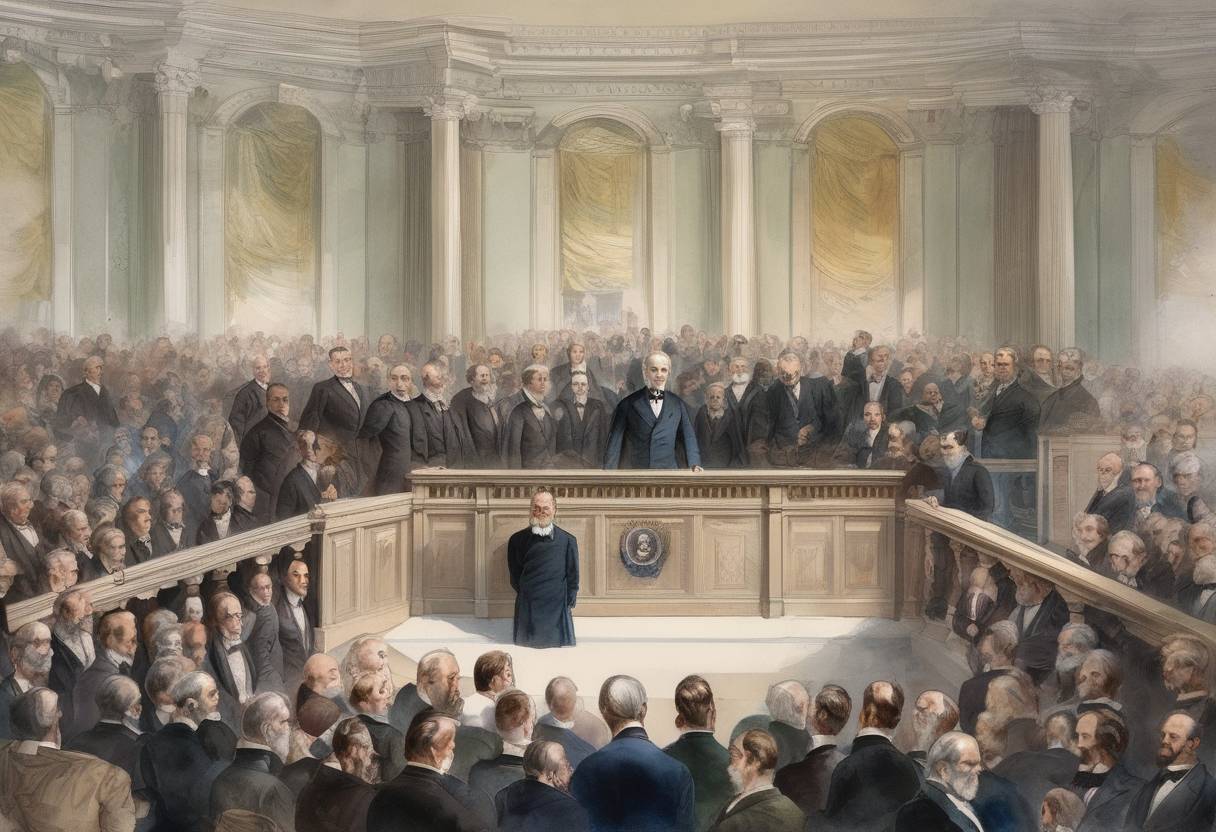
On March 4, 1877, Rutherford B. Hayes was inaugurated as the 19th President of the United States, marking the conclusion of one of the most contentious and disputed presidential elections in American history. This event not only signified a change in leadership but also had profound implications for the political landscape of the United States during the Reconstruction era.
The presidential election of 1876 was highly contentious, pitting Republican Rutherford B. Hayes against Democrat Samuel J. Tilden. The election was marred by widespread allegations of electoral fraud and voter intimidation, particularly in the Southern states. Tilden won the popular vote and initially appeared to have secured the electoral vote as well, but 20 electoral votes from four states—Florida, Louisiana, South Carolina, and Oregon—were disputed.
To resolve the impasse, Congress established the Electoral Commission, a bipartisan body tasked with determining the rightful recipient of the disputed electoral votes. The commission, composed of 15 members from the House, Senate, and Supreme Court, ultimately awarded all 20 disputed votes to Hayes, giving him a narrow victory with 185 electoral votes to Tilden’s 184.
The resolution of the election was part of what became known as the Compromise of 1877. In exchange for conceding the presidency to Hayes, Southern Democrats were assured the withdrawal of federal troops from the South, effectively ending the Reconstruction era. This compromise had significant consequences, leading to the disenfranchisement of African Americans and the establishment of Jim Crow laws in the South.
Rutherford B. Hayes was inaugurated in a private ceremony at the White House on March 3, 1877, followed by a public inauguration the next day. In his inaugural address, Hayes emphasized national unity and reconciliation, promising to serve only one term and to reform the civil service. He also pledged to protect the rights of African Americans, though the Compromise of 1877 had already set the stage for their rights to be severely curtailed.
Hayes’ presidency is often viewed through the lens of the Compromise of 1877 and its impact on Reconstruction. While he attempted to implement civil service reforms and promote education, his administration was overshadowed by the political and social ramifications of the compromise. The withdrawal of federal troops allowed Southern states to enact laws that institutionalized racial segregation and disenfranchisement, shaping the socio-political landscape of the United States for decades.
In summary, the inauguration of Rutherford B. Hayes on March 4, 1877, marked the end of a disputed election and the beginning of a presidency that would be defined by efforts at reconciliation and reform, as well as the controversial compromise that ended Reconstruction.
Source: en.wikipedia.org