The Assassination of Odoacer: March 15, 493
493 · Ravenna, Italy
Odoacer, the first King of Italy, was killed by Theodoric the Great, the Ostrogothic king, during a banquet.
August 30, 0526
Theodoric the Great, king of the Ostrogoths, dies. His death marks the end of his reign, during which he had established a relatively stable and prosperous kingdom in Italy, blending Roman and Germanic cultures.
Ravenna, Italy | Ostrogothic Kingdom
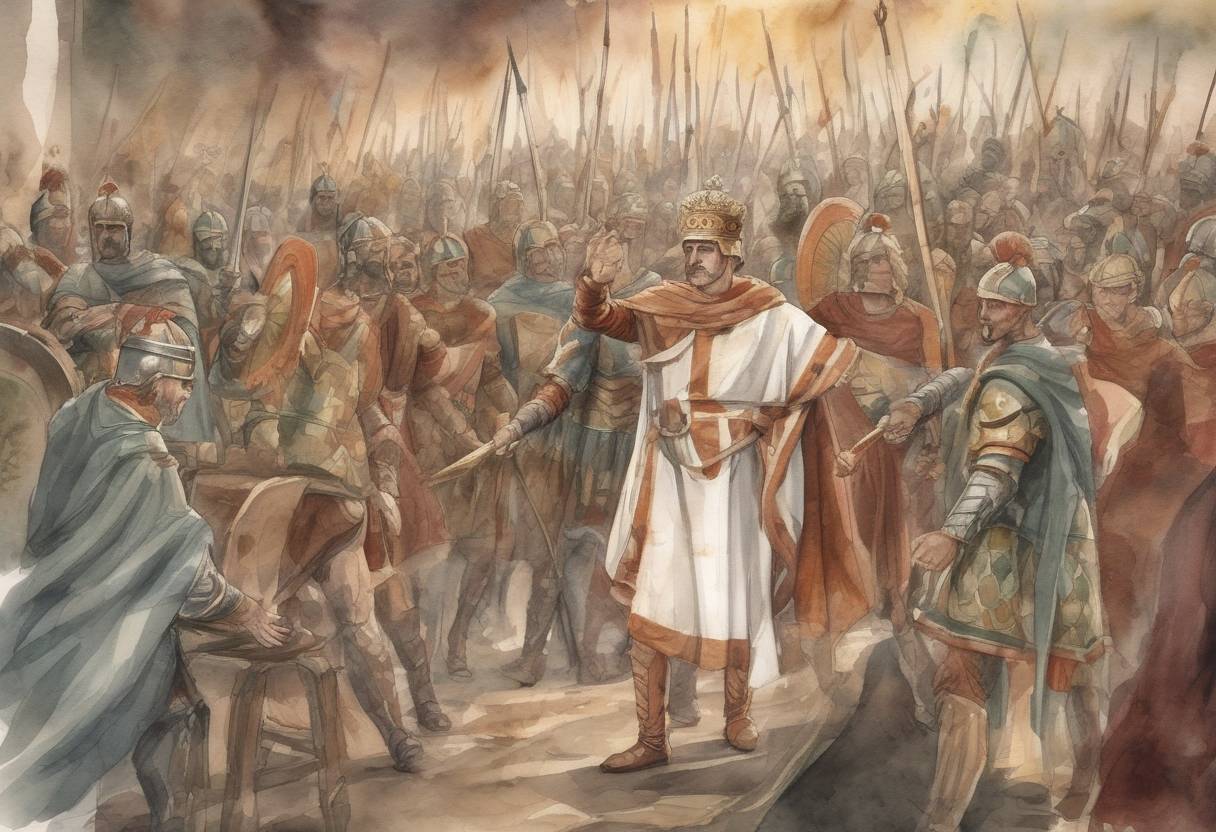
On August 30, 526, Theodoric the Great, the king of the Ostrogoths, passed away, marking the end of a significant era in the history of Italy and the broader Western Roman Empire. His reign was notable for the establishment of a relatively stable and prosperous kingdom that successfully blended Roman and Germanic cultures.
Theodoric was born around 454 AD into the royal family of the Ostrogoths, a Germanic tribe. He spent part of his youth as a hostage in Constantinople, where he received a Roman education. This experience profoundly influenced his later policies as a ruler. In 488, Theodoric was commissioned by the Eastern Roman Emperor Zeno to invade Italy and depose Odoacer, who had declared himself king after the fall of the Western Roman Empire in 476.
Theodoric’s reign began in 493 after he defeated Odoacer and established himself as the ruler of Italy. His governance was marked by several key achievements:
Cultural Synthesis: Theodoric maintained Roman traditions and administrative systems while integrating Ostrogothic customs. He employed Roman officials and preserved Roman laws, which helped in maintaining stability and continuity.
Religious Tolerance: Although an Arian Christian himself, Theodoric promoted religious tolerance between Arians and the Nicene Christians, which was crucial in maintaining peace in his diverse kingdom.
Economic Prosperity: Under his rule, Italy experienced economic revival. Theodoric invested in infrastructure, including the repair of Roman roads and aqueducts, and promoted agriculture and trade.
Diplomatic Relations: He established diplomatic ties with other Germanic kingdoms and the Eastern Roman Empire, strengthening his position and securing his realm from external threats.
Theodoric died on August 30, 526, in Ravenna, the capital of his kingdom. His death marked the beginning of a period of instability. He was succeeded by his grandson, Athalaric, who was only ten years old at the time. The regency of Athalaric’s mother, Amalasuntha, faced challenges both from within the Ostrogothic nobility and from the Eastern Roman Empire, which sought to reclaim Italy.
Theodoric’s death eventually led to the decline of Ostrogothic power in Italy. The Eastern Roman Emperor Justinian I launched the Gothic War in 535, aiming to restore Roman control over the Italian peninsula. This conflict, lasting until 554, resulted in significant destruction and the eventual absorption of Italy into the Eastern Roman Empire.
Theodoric the Great’s reign is often seen as a model of how Germanic rulers could govern former Roman territories effectively. His efforts to blend Roman and Germanic elements laid the groundwork for the medieval European kingdoms that would follow. His legacy is a testament to the complex cultural and political transformations that characterized the early Middle Ages.
Source: en.wikipedia.org