Declaration of War on Japan by the United States and the United Kingdom
1941 · Washington, D.C., United States
The United States and the United Kingdom declared war on Japan, following the attack on Pearl Harbor.
December 7, 1941
The Imperial Japanese Navy attacks the United States naval base at Pearl Harbor, Hawaii, leading to the United States' entry into World War II.
Pearl Harbor, United States | Imperial Japanese Navy
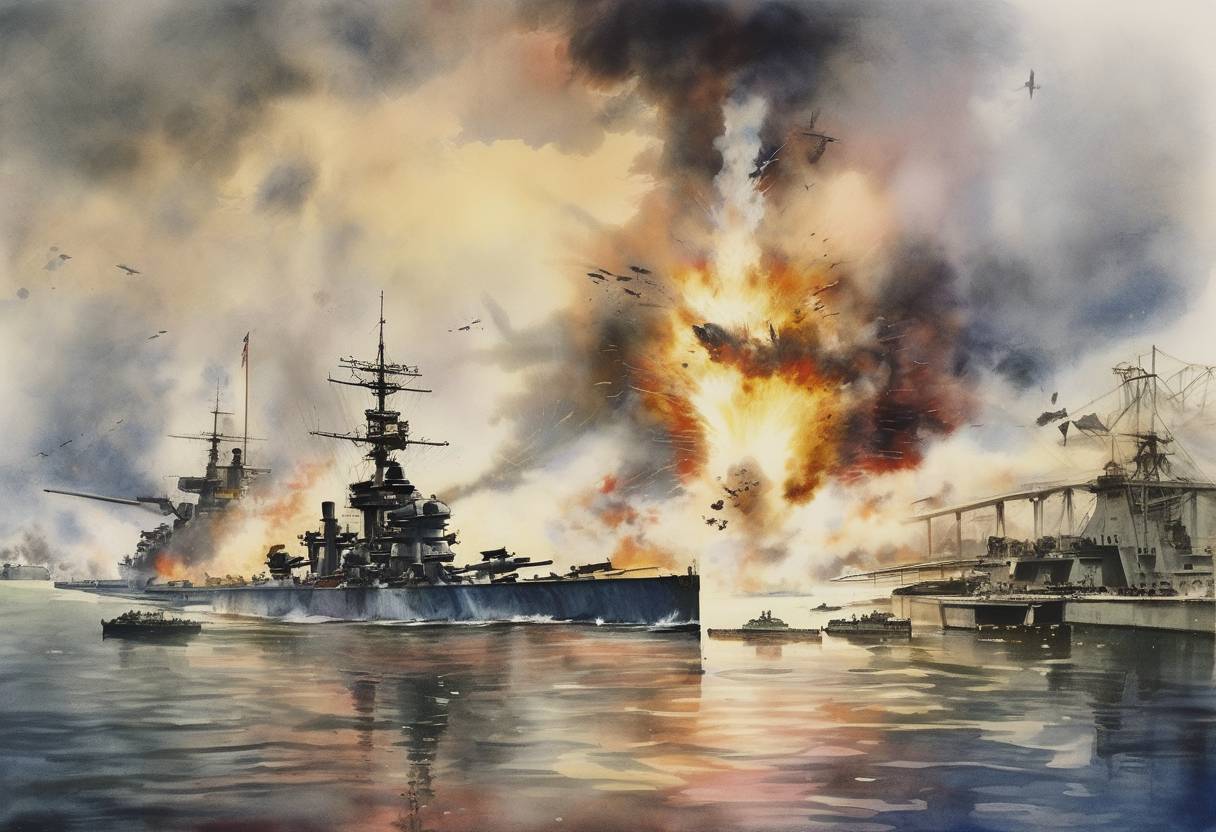
On December 7, 1941, the Imperial Japanese Navy launched a surprise military strike against the United States naval base at Pearl Harbor, Hawaii. This pivotal event led to the United States’ formal entry into World War II and marked a significant turning point in the conflict.
In the years leading up to the attack, tensions between the United States and Japan had been escalating. Japan’s expansionist policies in Asia, particularly its invasion of China and the occupation of French Indochina, were met with increasing resistance from the United States. In response, the U.S. imposed economic sanctions and trade embargoes on Japan, including restrictions on oil exports, which severely threatened Japan’s resource-dependent economy.
Japan, seeking to neutralize the U.S. Pacific Fleet as a means to secure its dominance in the Pacific and to continue its territorial expansion, planned a preemptive strike against the United States.
The attack on Pearl Harbor was meticulously planned by Admiral Isoroku Yamamoto and executed by Vice Admiral Chuichi Nagumo. The assault began at 7:48 a.m. Hawaiian Time and involved two waves of Japanese aircraft, totaling 353 planes, including fighters, bombers, and torpedo planes.
The attack on Pearl Harbor is a defining moment in 20th-century history. It not only marked the United States’ entry into World War II but also shifted the balance of power in the Pacific. The event underscored the vulnerabilities of even the most fortified military installations and highlighted the need for improved intelligence and preparedness.
Pearl Harbor remains a symbol of American resilience and a reminder of the costs of war. The site is now home to the USS Arizona Memorial, which honors those who lost their lives during the attack.
Source: www.history.com