Death of Pepin of Herstal and the Subsequent Power Struggle
714 · Jupille-sur-Meuse, Frankish Kingdom
Pepin of Herstal, the Frankish mayor of the palace of Austrasia, dies. His death leads to a power struggle in the Frankish kingdom.
November 30, 0714
Pippin of Herstal, the Frankish statesman and mayor of the palace of Austrasia, dies, leading to a period of civil war among his descendants over the control of the Frankish territories.
Jupille-sur-Meuse, Frankish Empire | Frankish Kingdom
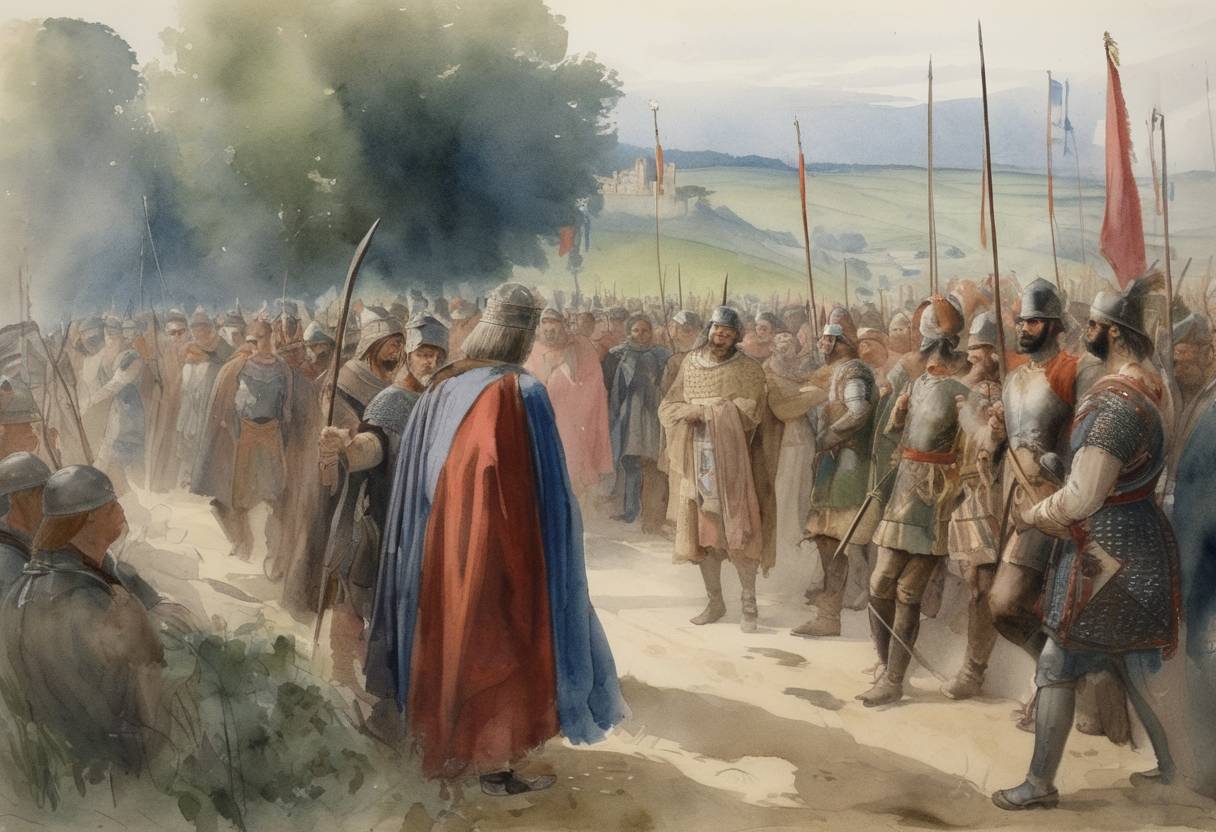
On November 30, 714, Pippin of Herstal, also known as Pippin II, the influential Frankish statesman and mayor of the palace of Austrasia, passed away. This event marked the beginning of a tumultuous period in Frankish history, as it triggered a civil war among his descendants over control of the Frankish territories.
Pippin of Herstal had risen to power as the mayor of the palace of Austrasia, effectively the de facto ruler since the Merovingian kings were largely figureheads by this period. Pippin was instrumental in unifying the Frankish territories and extending Austrasian influence over Neustria and Burgundy through military and diplomatic means.
Under his leadership, Austrasia became the dominant power in the Frankish kingdom, and Pippin’s administration saw a period of relative stability and consolidation.
Pippin’s death left a power vacuum as he died without a clear heir to rule over the expansive territories he controlled. His legitimate sons, Drogo, the Duke of Champagne, and Grimoald II, mayor of the palace of Neustria and Burgundy, had died before him. This situation left his illegitimate son, Charles Martel, and his grandson, Theudoald, as potential successors.
The lack of a strong and universally recognized successor led to a civil war among his descendants and other interested nobles. Pippin’s widow, Plectrude, attempted to secure the succession for her young grandson Theudoald, causing discontent among other factions within the kingdom, notably Charles Martel.
The ensuing conflict after Pippin’s death had a profound impact on the Frankish realms:
Pippin’s death, though a transition full of turmoil, ultimately set in motion significant changes that would shape medieval European history.
Source: en.wikipedia.org