The Battle of Fleurus: June 26, 1794
1794 · Fleurus, Belgium
The Battle of Fleurus was fought during the French Revolutionary Wars, resulting in a victory for the French forces.
November 27, 1382
The Battle of Roosebeke is fought, with the French army defeating the forces of the Flemish rebels.
Roosebeke, Belgium | French Army
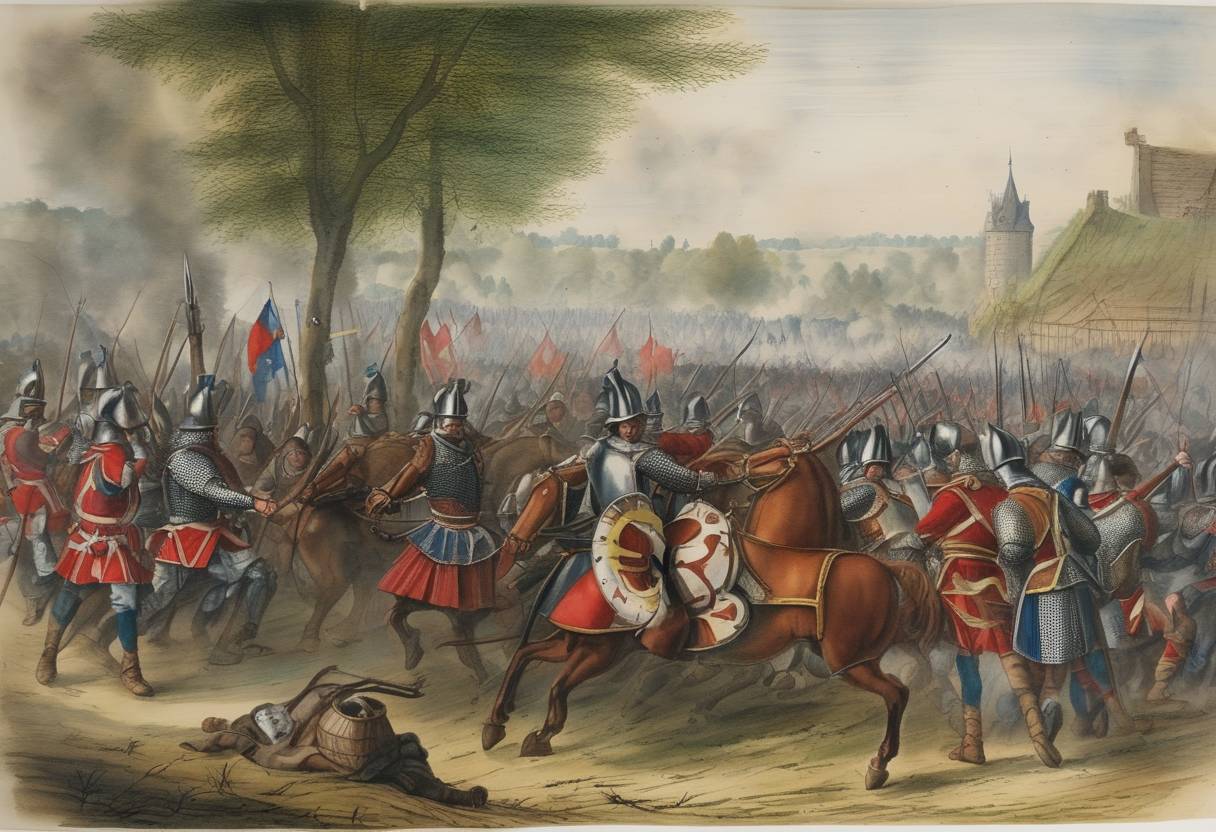
On November 27, 1382, the Battle of Roosebeke (or Battle of Westrozebeke) was fought, resulting in a decisive victory for the French royal army over the Flemish insurgents. This conflict was a significant episode in the broader social and political unrest in the Low Countries during the late 14th century, reflecting the tensions between the authority of the French crown and the Flemish municipalities.
The origins of the battle lay in the revolt of the Flemish cities against the Count of Flanders, Louis II. The Flemish citizens, led by Philip van Artevelde, were dissatisfied with the Count’s governance, particularly his allegiance to France, which clashed with the cities’ commercial interests that were oriented more towards England. This discontent escalated into an open rebellion known as the Ghent Revolt, with the city of Ghent being a pivotal center of defiance against the count.
The conflict drew the attention of the young French King Charles VI and his advisors, who aimed to reassert control over the rebellious territories and support their vassal, the Count of Flanders. Charles gathered a substantial royal army to quell the rebellion.
The confrontation took place near Roosebeke (present-day Westrozebeke, Belgium). The French, under the command of Charles VI and his uncle Philip the Bold, Duke of Burgundy, launched a coordinated campaign against the Flemish forces. Despite being numerically outmatched, the French army, benefiting from better organization and more experienced leadership, engaged the rebels.
The battle was characterized by intensive close combat. The Flemish army, composed mainly of urban militias with limited war experience, was overwhelmed by the disciplined French forces. The engagement swiftly turned into a rout for the Flemish.
The French victory at Roosebeke was crushing and marked the end of the active phase of the Ghent Revolt. Philip van Artevelde was killed during the battle, and many of his followers were either slaughtered or captured. The French reoccupation of key Flemish cities ensued, re-establishing the influence of the Count of Flanders under the auspices of the French crown.
The battle’s outcome had lasting implications for the region. It reinforced the power of the feudal lords and the French monarchy over rebellious territories, while simultaneously weakening the autonomy of the wealthy Flemish cities which were crucial for the textile trade. The suppression of the revolt also temporarily stabilized the political landscape in Flanders, though tensions between economic independence and feudal control would persist.
The Battle of Roosebeke exemplifies the complex dynamics of medieval European politics where local independence clashed with central authority, a theme recurrent in the history of the Low Countries.
Source: www.britannica.com