Perseverance Rover's Successful Landing on Mars
2021 · Mars, N/A
NASA's Perseverance rover successfully landed on Mars, beginning its mission to search for signs of past life and collect samples for future return to Earth.
January 25, 2004
The Opportunity rover lands on Mars as part of NASA's Mars Exploration Rover mission, beginning its exploration of the Martian surface.
Mars, N/A | NASA
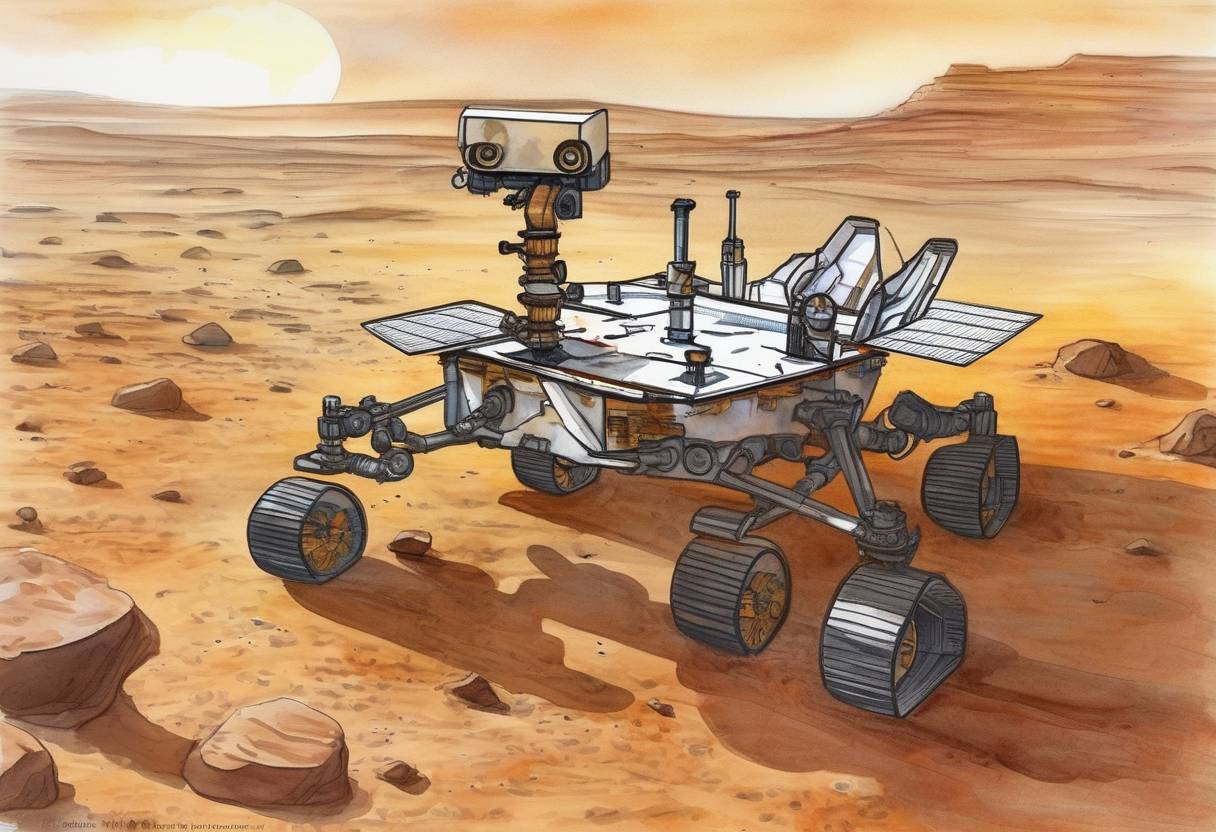
On January 25, 2004, NASA’s Opportunity rover successfully landed on the Martian surface, marking a significant milestone in space exploration. This event was part of NASA’s Mars Exploration Rover mission, which aimed to explore the Martian terrain and gather data to understand the planet’s geology and past environmental conditions.
The Mars Exploration Rover mission consisted of two rovers, Spirit and Opportunity, designed to explore the surface of Mars. The mission’s primary objectives were to search for and characterize a variety of rocks and soils that hold clues to past water activity on Mars. Understanding the history of water on Mars is crucial for assessing the planet’s potential to have supported life.
Opportunity was launched from Cape Canaveral Air Force Station in Florida on July 7, 2003, aboard a Delta II rocket. After a journey of approximately seven months, the rover entered the Martian atmosphere and executed a complex landing sequence. This sequence involved a heat shield, parachute deployment, and airbag cushioning to ensure a safe landing.
Opportunity landed in Meridiani Planum, a flat plain near the Martian equator, at approximately 05:05 UTC on January 25, 2004. This site was chosen because of the presence of hematite, a mineral that typically forms in water, suggesting that the area may have once been wet.
Opportunity far exceeded its planned 90-day mission, operating for nearly 15 years until June 2018. The rover traveled over 28 miles (45 kilometers) on the Martian surface, sending back a wealth of data that has significantly advanced our understanding of Mars.
Opportunity’s mission officially ended on February 13, 2019, after NASA was unable to re-establish contact following a massive dust storm. The rover’s legacy continues to inspire future exploration and the quest to uncover the mysteries of Mars.
Source: mars.nasa.gov