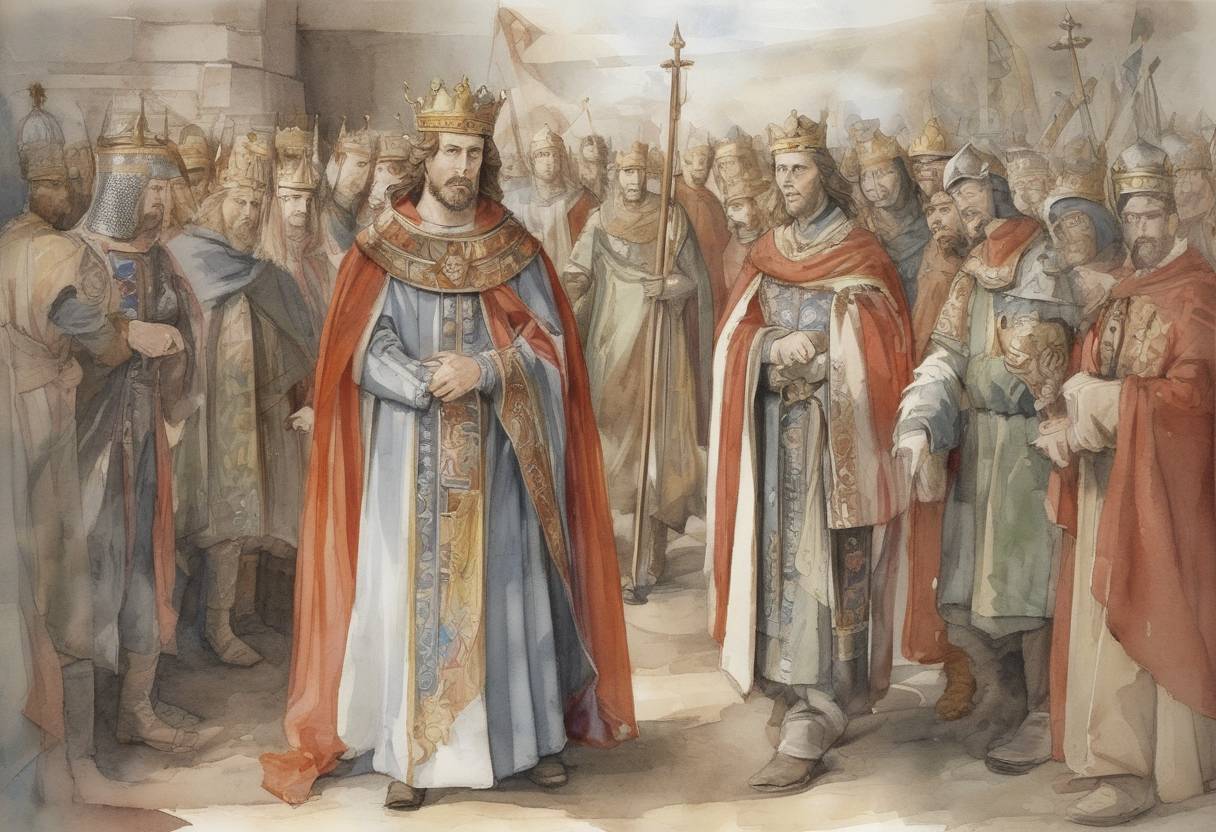
The Death of King Edward the Elder and the Succession of Æthelstan
On July 17, 924, King Edward the Elder, a significant figure in the early history of England, passed away. His death marked a pivotal moment in the consolidation of English territories and the eventual unification of England under his son, Æthelstan.
Background
Edward the Elder was born around 874 and was the son of Alfred the Great, one of England’s most revered monarchs. Edward ascended to the throne in 899 following Alfred’s death. His reign was characterized by efforts to consolidate and expand the territories of Wessex and Mercia, continuing his father’s work in resisting Viking invasions and influence.
Key Achievements
During his reign, Edward the Elder successfully extended his control over much of southern England. He worked closely with his sister, Æthelflæd, the Lady of the Mercians, to fortify and defend their territories against Viking incursions. Together, they captured key Viking strongholds, including Derby and Leicester, significantly weakening Viking power in the region.
Edward’s reign was marked by his strategic use of burhs (fortified towns) to secure his territories and his diplomatic efforts to bring other English kingdoms under his influence. By the time of his death, he had laid the groundwork for a more unified England.
Succession and Æthelstan’s Rise
Edward’s death in 924 led to a brief period of uncertainty regarding the succession. Initially, his son Ælfweard was recognized as king in Wessex, but he died shortly thereafter. This paved the way for Edward’s more prominent son, Æthelstan, to ascend to the throne.
Æthelstan’s reign, beginning in 924, was transformative. He is often credited as the first King of a unified England due to his successful campaigns to bring Northumbria under his control, effectively uniting the various English kingdoms. His victory at the Battle of Brunanburh in 937 was a defining moment, solidifying his power and the concept of a unified English nation.
Historical Significance
The transition from Edward the Elder to Æthelstan marked a critical juncture in English history. Edward’s efforts to consolidate power and Æthelstan’s subsequent unification of England laid the foundation for the development of a centralized English monarchy. Æthelstan’s reign is often seen as the beginning of England as a single, unified kingdom, setting the stage for future developments in English governance and identity.
Edward the Elder’s legacy is thus intertwined with the emergence of a unified England, and his son Æthelstan’s achievements would resonate throughout English history, influencing the nation’s trajectory for centuries to come.