The Battle of Dunsinane: Siward's Invasion of Scotland
1054 · Dunsinane, Scotland
Siward, Earl of Northumbria, invades Scotland and defeats Macbeth, King of Scotland, at the Battle of Dunsinane.
August 15, 1057
King Macbeth of Scotland was killed at the Battle of Lumphanan by the forces of Máel Coluim mac Donnchada (Malcolm III).
Lumphanan, Scotland
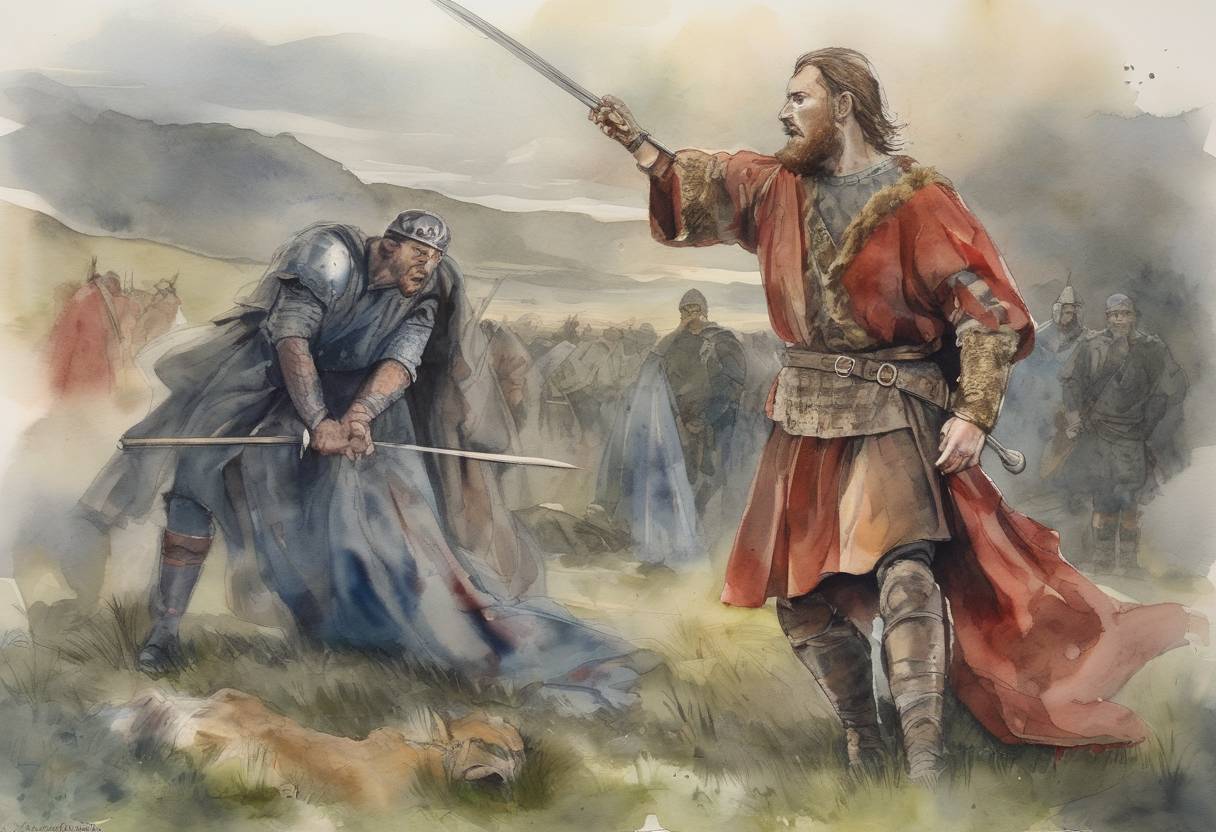
On August 15, 1057, King Macbeth of Scotland was killed at the Battle of Lumphanan by the forces of Máel Coluim mac Donnchada, who would later become known as Malcolm III. This event marked a significant turning point in Scottish history, as it ended Macbeth’s 17-year reign and paved the way for Malcolm III’s ascension to the throne.
Macbeth’s Rise to Power: Macbeth became King of Scotland in 1040 after defeating and killing King Duncan I in battle. His ascent to the throne was not unusual for the time, as succession often involved conflict and power struggles among rival factions.
Reign: Macbeth’s reign was relatively stable and prosperous. He is noted for his efforts to strengthen the monarchy and his pilgrimage to Rome in 1050, which demonstrated his commitment to Christianity and his desire to establish international connections.
Opposition: Despite his achievements, Macbeth faced opposition from those loyal to Duncan I’s lineage. This opposition was primarily led by Duncan’s son, Malcolm, who sought to reclaim the throne for his family.
Location: The battle took place near Lumphanan in Aberdeenshire, Scotland. This location was strategically significant as it was part of the territory that Macbeth controlled.
Forces: Malcolm’s forces were likely composed of supporters from within Scotland and possibly some external allies. The exact size and composition of the armies are not well-documented, but Malcolm’s forces were strong enough to challenge and defeat Macbeth.
Outcome: Macbeth was killed in the battle, effectively ending his reign. His death marked the culmination of Malcolm’s campaign to overthrow him and restore his family’s claim to the Scottish throne.
Succession: After Macbeth’s death, his stepson, Lulach, briefly succeeded him as king. However, Lulach’s reign was short-lived, as Malcolm III defeated and killed him in 1058, solidifying his claim to the throne.
Malcolm III’s Reign: Malcolm III’s reign marked the beginning of a new era in Scottish history. He established the Dunkeld dynasty, which played a crucial role in the unification and consolidation of Scotland.
Legacy: Macbeth’s legacy has been shaped significantly by William Shakespeare’s play “Macbeth,” which, while dramatized, has kept his story alive in popular culture. Historically, Macbeth is remembered as a capable ruler whose reign was ultimately overshadowed by the dynastic struggles of the time.
The Battle of Lumphanan and Macbeth’s death were pivotal in the medieval history of Scotland, influencing the nation’s political landscape and setting the stage for future developments in the Scottish monarchy.
Source: en.wikipedia.org