Election of Guillaume aux Blanches Mains as Archbishop of Reims
1171 · Reims, France
After the assassination of his predecessor, Amalric of Nesle, Guillaume aux Blanches Mains is elected Archbishop of Reims.
December 21, 0882
Hincmar, Archbishop of Reims, dies. He was a significant figure in the Carolingian Renaissance, known for his theological writings and political influence.
Reims, West Francia | Catholic Church
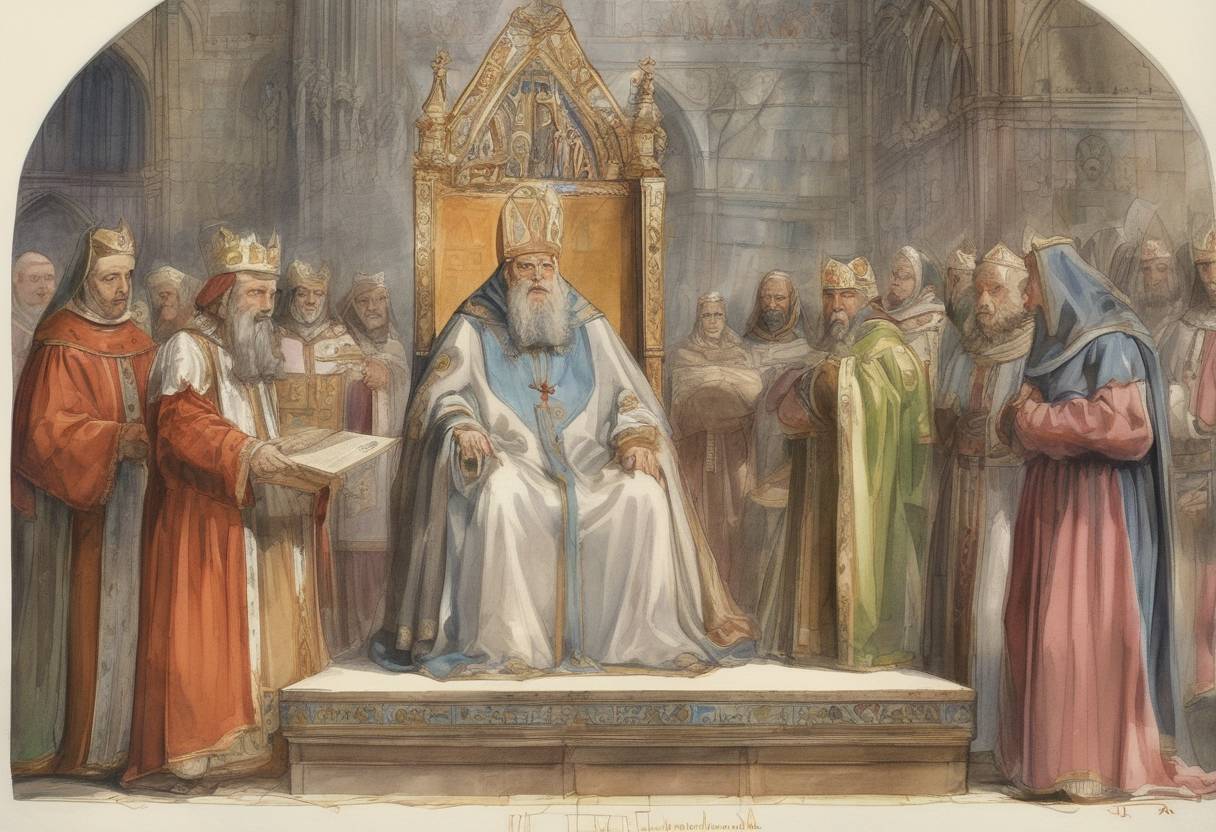
On December 21, 882, Hincmar, the Archbishop of Reims, passed away. He was a pivotal figure during the Carolingian Renaissance, renowned for his theological writings and substantial political influence. His death marked the end of a significant era in the Carolingian Empire, where he played a crucial role in both ecclesiastical and secular affairs.
Hincmar was born around 806 in the region of northern France. He entered the monastery of Saint-Denis, where he was educated and became a protégé of Louis the Pious, the son of Charlemagne. His early career was marked by his involvement in the court of Louis the Pious, where he gained valuable experience in ecclesiastical and political matters.
In 845, Hincmar was appointed as the Archbishop of Reims, a position that he held until his death. His appointment was a testament to his growing influence within the Carolingian Empire, as Reims was one of the most important archbishoprics in the Frankish realm.
Hincmar’s tenure as Archbishop of Reims coincided with the Carolingian Renaissance, a period of cultural and intellectual revival in the Frankish Empire. He was a prolific writer, contributing numerous theological and canonical works that addressed the pressing issues of his time. His writings often dealt with the relationship between the church and the state, the nature of ecclesiastical authority, and the moral responsibilities of rulers.
One of his most notable works was the “De Divortio Lotharii regis et Theutbergae reginae,” a treatise on the controversial divorce case of King Lothair II, which showcased his legal acumen and his ability to navigate complex political situations.
Beyond his theological contributions, Hincmar was a significant political figure. He was deeply involved in the politics of the Carolingian Empire, often acting as an advisor to kings and playing a key role in the administration of the realm. His influence extended to various synods and councils, where he was instrumental in shaping church policy and doctrine.
Hincmar’s political activities were not without controversy. He was known for his staunch defense of ecclesiastical rights and his opposition to secular encroachments on church authority. This sometimes brought him into conflict with secular rulers, but it also solidified his reputation as a defender of the church’s independence.
Hincmar’s death in 882 marked the end of a significant chapter in the history of the Carolingian Empire. His contributions to the Carolingian Renaissance had a lasting impact on the intellectual and cultural development of medieval Europe. His writings continued to influence theological and political thought long after his death.
As a church leader, Hincmar’s efforts to define and defend the role of the church in a rapidly changing political landscape set important precedents for the relationship between church and state in medieval Europe. His legacy is remembered as one of intellectual vigor and steadfast commitment to the principles he believed in.
In summary, Hincmar of Reims was a towering figure of his time, whose death marked the conclusion of a significant era in the Carolingian Empire. His contributions to theology, politics, and the broader cultural revival of the period remain influential in the annals of medieval history.
Source: en.wikipedia.org