Napoleon Bonaparte's Exile to Saint Helena
1815 · Rochefort, France
Napoleon Bonaparte sets sail for exile on Saint Helena aboard the British ship HMS Northumberland.
July 15, 1815
Napoleon Bonaparte surrendered to Captain Frederick Maitland of HMS Bellerophon, marking the end of the Napoleonic Wars.
Rochefort, France | British Royal Navy
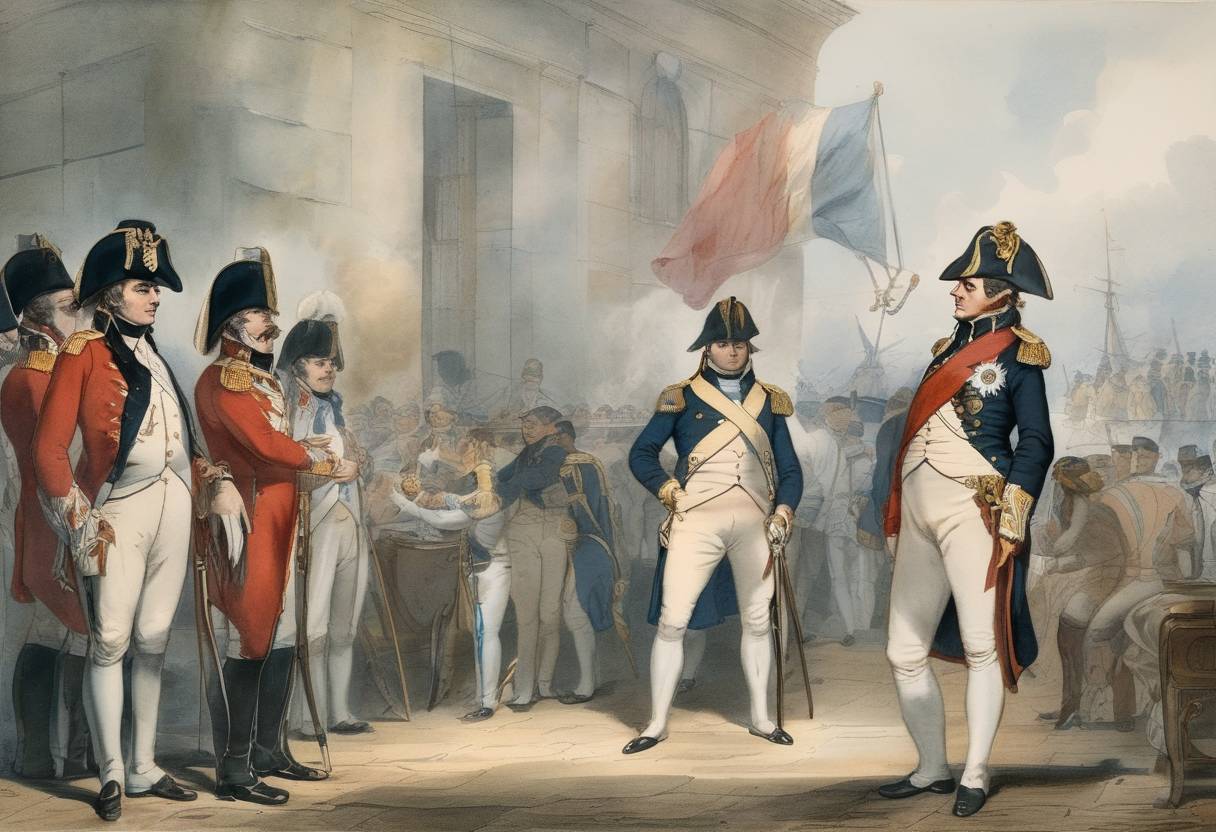
On July 15, 1815, a pivotal moment in European history unfolded as Napoleon Bonaparte surrendered to Captain Frederick Maitland aboard the HMS Bellerophon. This event marked the effective end of the Napoleonic Wars, a series of conflicts that had embroiled much of Europe for over a decade.
The Napoleonic Wars, which spanned from 1803 to 1815, were a continuation of the conflicts sparked by the French Revolution. Napoleon, a brilliant military strategist and leader, rose to power in France and sought to expand his empire across Europe. His campaigns reshaped the continent’s political landscape but also led to widespread devastation and resistance.
The decisive turning point came with the Battle of Waterloo on June 18, 1815. Napoleon’s forces were defeated by the Seventh Coalition, led by the Duke of Wellington and Prussian General Gebhard Leberecht von Blücher. This defeat effectively ended Napoleon’s rule as Emperor of the French.
Following his defeat at Waterloo, Napoleon attempted to escape to the United States but found his options limited. With the British Royal Navy patrolling the Atlantic, escape seemed increasingly unlikely. Realizing his predicament, Napoleon sought asylum with the British, hoping for more favorable treatment than he might receive from his European adversaries.
On July 15, 1815, Napoleon boarded the HMS Bellerophon, a British warship commanded by Captain Frederick Maitland, in the port of Rochefort. He formally surrendered to Maitland, effectively placing himself under British custody. Napoleon’s surrender was a significant moment, symbolizing the end of his ambitions and the conclusion of the Napoleonic Wars.
Napoleon’s surrender led to his exile on the remote island of Saint Helena in the South Atlantic Ocean, where he spent the remaining years of his life until his death in 1821. The Congress of Vienna, which had been convening since 1814, continued its work to restore stability and balance of power in Europe, reshaping national boundaries and establishing a framework for international diplomacy.
The end of the Napoleonic Wars ushered in a period of relative peace in Europe, known as the Concert of Europe, which sought to prevent the rise of another dominant power like Napoleon. This period lasted until the outbreak of World War I in 1914.
Napoleon’s legacy is complex; he is remembered both for his military genius and the widespread impact of his conquests. His legal and administrative reforms, particularly the Napoleonic Code, have had a lasting influence on legal systems worldwide.
In summary, Napoleon’s surrender on July 15, 1815, was a defining moment that brought an end to a turbulent era in European history, setting the stage for a new order in the 19th century.
Source: en.wikipedia.org