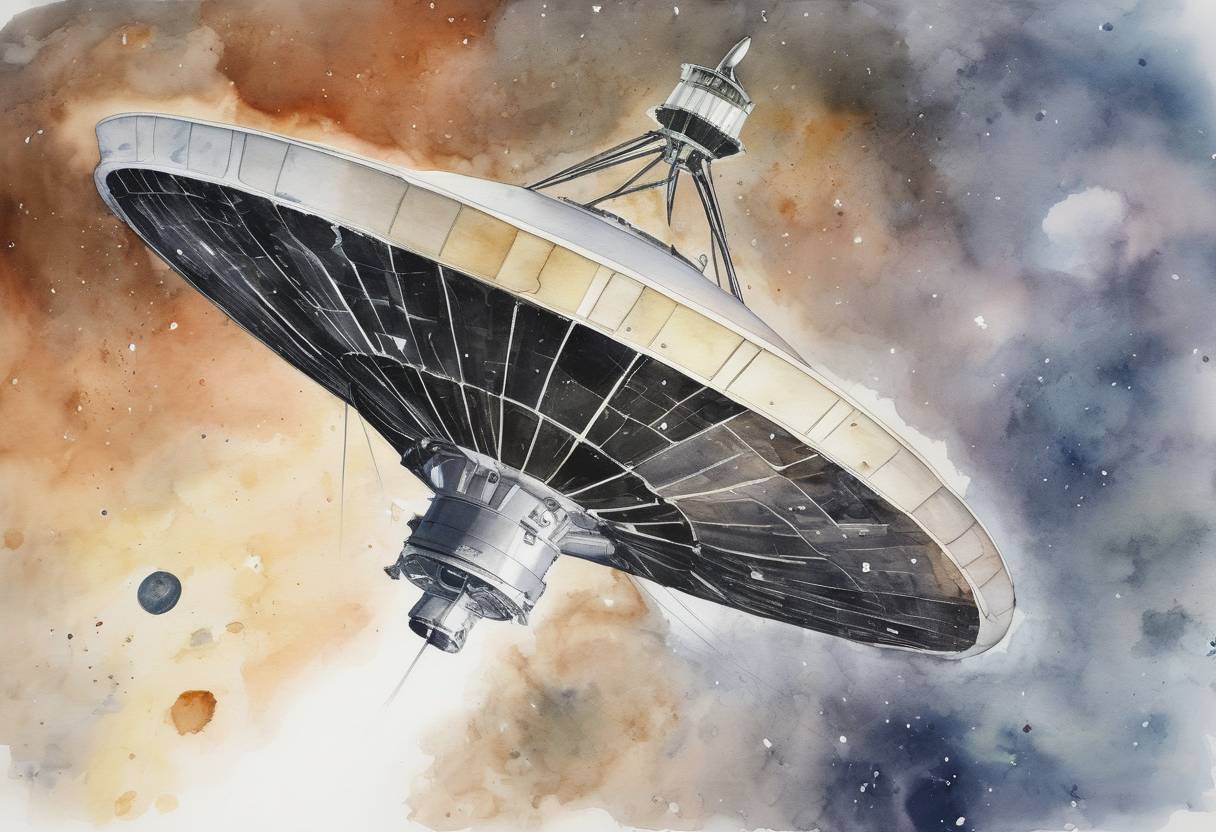
Voyager 1 Enters Interstellar Space
Overview
On August 26, 2012, NASA’s Voyager 1 spacecraft made history by becoming the first human-made object to enter interstellar space. This milestone marked a significant achievement in space exploration, as Voyager 1 ventured beyond the heliosphere, the bubble-like region of space dominated by the solar wind and magnetic field of the Sun.
Background
- Launch Date: Voyager 1 was launched on September 5, 1977, from Cape Canaveral, Florida, aboard a Titan IIIE rocket. It was part of NASA’s Voyager program, which included its twin, Voyager 2.
- Mission Objectives: The primary mission of Voyager 1 was to conduct close-up studies of Jupiter and Saturn, their moons, and their ring systems. After successfully completing its primary mission, Voyager 1 continued its journey toward the outer solar system.
Key Events Leading to Interstellar Entry
- Jupiter Flyby: Voyager 1 made its closest approach to Jupiter on March 5, 1979, providing unprecedented data and images of the planet and its moons.
- Saturn Flyby: On November 12, 1980, Voyager 1 flew by Saturn, offering detailed observations of the planet’s rings and moons, including Titan.
- Grand Tour: After its encounters with Jupiter and Saturn, Voyager 1 embarked on a trajectory that would take it out of the solar system.
Entering Interstellar Space
- Heliosphere Boundary: The heliosphere is the region of space influenced by the solar wind, a stream of charged particles emanating from the Sun. The boundary of the heliosphere, known as the heliopause, is where the solar wind slows down and merges with the interstellar medium.
- Crossing the Heliopause: On August 26, 2012, Voyager 1 crossed the heliopause, entering the interstellar medium. This transition was confirmed by a change in the density of charged particles detected by the spacecraft’s instruments.
Significance
- Scientific Discoveries: Voyager 1’s entry into interstellar space provided valuable data about the nature of the interstellar medium and the heliosphere’s boundary.
- Longevity and Legacy: Voyager 1 continues to send data back to Earth, despite being billions of miles away. Its journey has expanded our understanding of the solar system and beyond, inspiring future generations of space exploration.
Aftermath and Continuing Mission
- Current Status: As of the latest updates, Voyager 1 remains operational, although its power supply is gradually diminishing. NASA continues to receive data from the spacecraft, which helps scientists study the interstellar environment.
- Cultural Impact: Voyager 1 carries the Golden Record, a phonograph record containing sounds and images representing Earth’s diversity. This message to potential extraterrestrial life forms underscores the mission’s enduring legacy as a symbol of human curiosity and exploration.
Voyager 1’s entry into interstellar space is a testament to human ingenuity and the quest for knowledge, marking a new chapter in our understanding of the cosmos.