Vasco da Gama's Second Voyage to India - February 12, 1502
1502 · Lisbon, Portugal
Vasco da Gama sets sail from Lisbon, Portugal, on his second voyage to India, further establishing the sea route around the Cape of Good Hope.
December 16, 1497
Vasco da Gama passes the Great Fish River, where Bartolomeu Dias had previously turned back to Portugal.
Great Fish River, South Africa | Portuguese Exploration
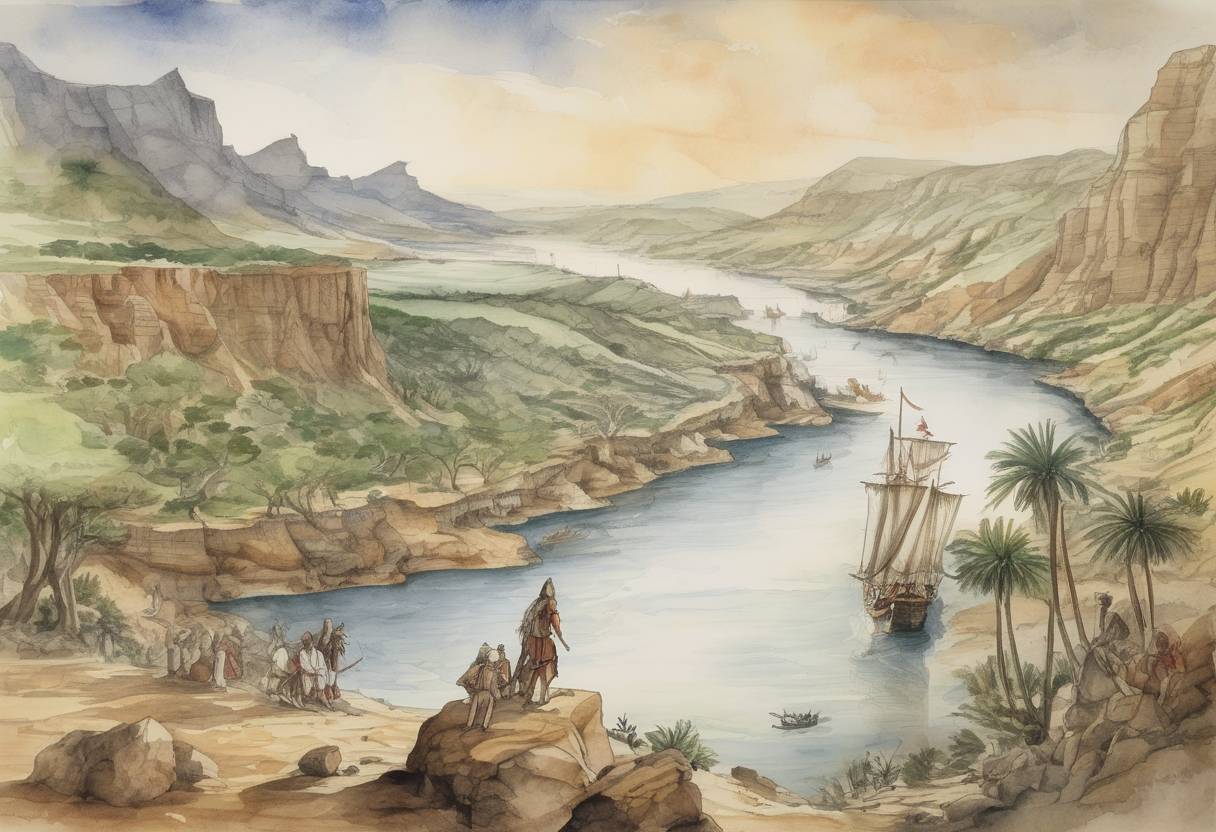
On December 16, 1497, the Portuguese explorer Vasco da Gama achieved a significant milestone in the Age of Exploration by passing the Great Fish River on the southeastern coast of Africa. This event marked a crucial point in his pioneering voyage to find a sea route to India, which would eventually establish a direct maritime link between Europe and Asia.
The quest for a sea route to India was driven by the lucrative spice trade, which was dominated by Middle Eastern and Venetian merchants. Portugal, under the leadership of King Manuel I, sought to bypass these intermediaries by finding a direct route to the source of spices in Asia.
Before Vasco da Gama’s expedition, another Portuguese explorer, Bartolomeu Dias, had made significant progress in this endeavor. In 1488, Dias became the first European to round the southern tip of Africa, which he named the Cape of Good Hope. However, due to adverse conditions and a lack of supplies, Dias turned back after reaching the Great Fish River, approximately 1,200 kilometers east of the Cape.
Vasco da Gama set sail from Lisbon on July 8, 1497, with a fleet of four ships. His mission was to complete the journey that Dias had begun and to establish a sea route to India. The expedition navigated down the west coast of Africa, rounded the Cape of Good Hope in November 1497, and continued along the eastern coast.
On December 16, 1497, da Gama’s fleet passed the Great Fish River, surpassing the point where Dias had turned back. This achievement was a testament to the improved planning and preparation of da Gama’s expedition, which included better provisions and a more determined resolve to reach India.
Vasco da Gama’s successful passage beyond the Great Fish River was a pivotal moment in his journey. It demonstrated the feasibility of a sea route to India and paved the way for the establishment of a Portuguese maritime empire in the Indian Ocean.
Da Gama continued his voyage, reaching the Indian city of Calicut (now Kozhikode) on May 20, 1498. His arrival marked the first time a European fleet had reached India by sea, opening new avenues for trade and cultural exchange.
The establishment of a sea route to India had profound implications for global trade. It allowed Portugal to dominate the spice trade, weakened the economic power of Venice and other Mediterranean states, and initiated an era of European exploration and colonization in Asia.
In summary, Vasco da Gama’s passage of the Great Fish River on December 16, 1497, was a critical step in the successful establishment of a sea route to India, marking a turning point in global history and the Age of Exploration.
Source: en.wikipedia.org