1529 · Vienna, Austria
The Siege of Vienna ends as the Ottoman Empire, led by Suleiman the Magnificent, withdraws after failing to capture the city from the Habsburgs.
September 12, 1683
The Battle of Vienna takes place, marking a turning point in the Ottoman-Habsburg wars.
Vienna, Austria | Holy Roman Empire
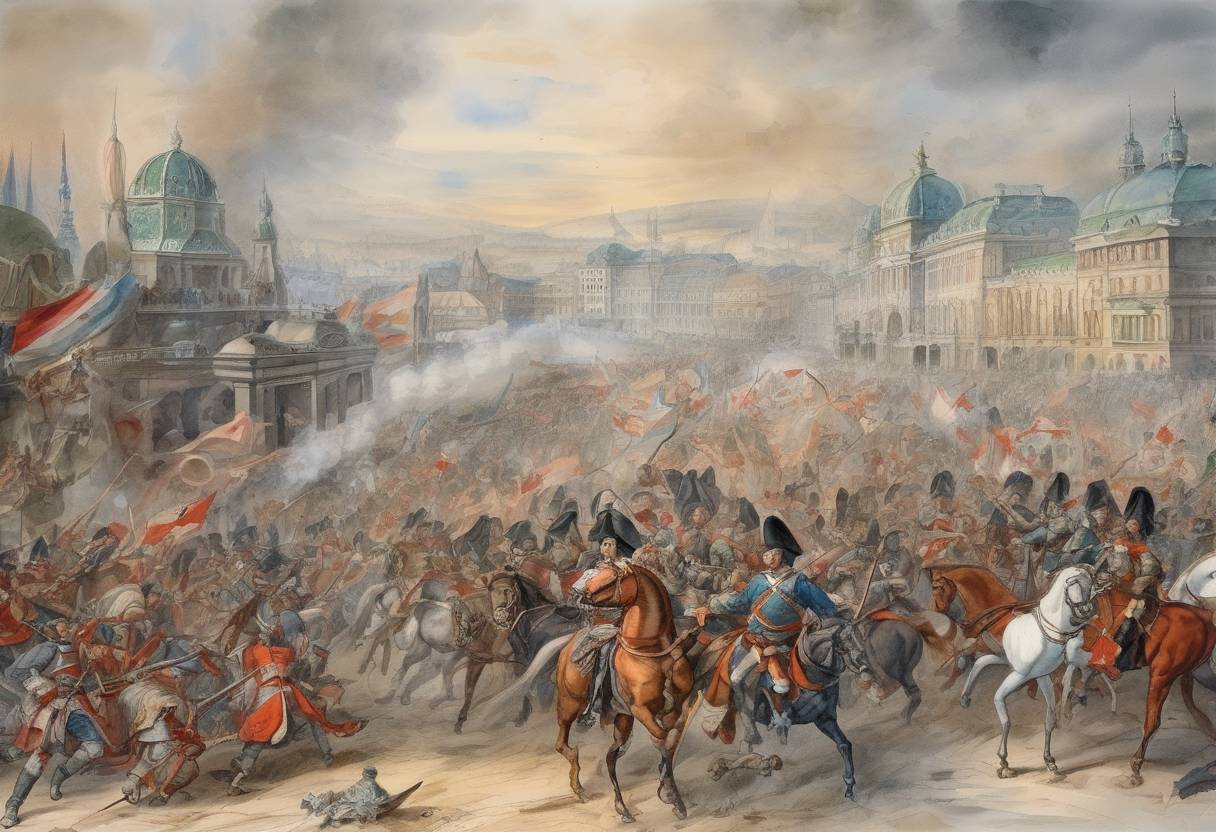
The Battle of Vienna, fought on September 12, 1683, was a pivotal moment in the Ottoman-Habsburg wars and marked a significant turning point in European history. This battle effectively halted the westward expansion of the Ottoman Empire into Europe and set the stage for the eventual decline of Ottoman influence in the region.
The Ottoman Empire, under the leadership of Sultan Mehmed IV, had been expanding its territories into Europe for centuries. By the late 17th century, the Ottomans sought to capture Vienna, the capital of the Habsburg Monarchy, which was a strategic and symbolic target. The siege of Vienna was part of the larger conflict known as the Great Turkish War (1683–1699), which involved various European powers opposing Ottoman expansion.
In 1683, the Ottoman Grand Vizier, Kara Mustafa Pasha, led a massive army estimated to be between 90,000 to 150,000 troops to lay siege to Vienna. The city, defended by a much smaller force of around 15,000 soldiers and civilians, was under significant threat.
The siege began in July 1683, and by September, the situation in Vienna was dire. However, the Holy Roman Empire, led by Emperor Leopold I, had formed a coalition with the Polish-Lithuanian Commonwealth and other European allies, including Bavaria, Saxony, and various smaller German states. This coalition was crucial in organizing a relief force to save Vienna.
The relief army, commanded by the Polish King John III Sobieski, arrived near Vienna in early September. Sobieski’s forces, numbering around 70,000, included the famed Polish Winged Hussars, known for their heavy cavalry charges.
On September 12, the allied forces launched a decisive attack against the Ottoman besiegers. The battle culminated in a massive cavalry charge led by Sobieski himself, which broke the Ottoman lines and forced them into a retreat. The victory was comprehensive, and the Ottoman forces suffered heavy casualties.
The defeat at Vienna marked the beginning of the end for Ottoman dominance in Eastern Europe. The battle was a turning point that shifted the balance of power, leading to the gradual decline of Ottoman influence in the region. In the years following the battle, the Habsburgs and their allies launched a series of successful campaigns that pushed the Ottomans back, culminating in the Treaty of Karlowitz in 1699, which significantly reduced Ottoman territories in Europe.
The Battle of Vienna also had cultural and symbolic significance. It was seen as a triumph of Christian Europe over the Muslim Ottoman Empire, and it reinforced the idea of a united European front against external threats. The victory is celebrated in Poland as a national holiday, and John III Sobieski is remembered as a national hero.
In summary, the Battle of Vienna was a decisive moment in European history that not only halted Ottoman expansion but also paved the way for the rise of the Habsburg Monarchy as a dominant power in Central Europe.
Source: www.britannica.com