Operation Shingle: The Allied Amphibious Landing at Anzio
1944 · Anzio, Italy
Operation Shingle, the Allied amphibious landing at Anzio, Italy, begins during World War II.
September 17, 1944
Operation Market Garden, an Allied military operation during World War II, began with the goal of capturing bridges in the Netherlands.
Netherlands, Netherlands | Allied Forces
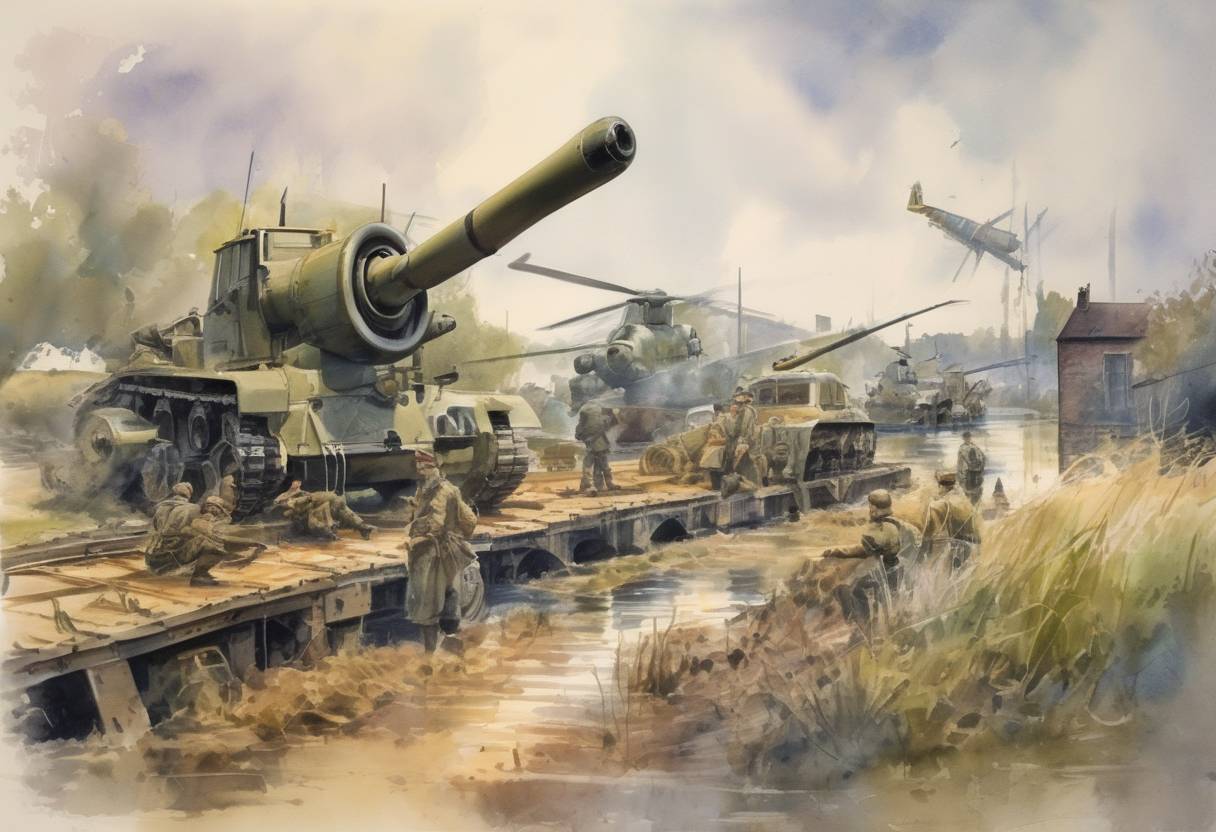
Operation Market Garden was a significant Allied military operation during World War II, initiated on September 17, 1944. It was an ambitious plan devised by British Field Marshal Bernard Montgomery, aiming to expedite the end of the war by securing key bridges in the Netherlands. This operation was notable for its combination of airborne and ground forces, marking one of the largest airborne operations in history.
Following the successful Normandy Invasion (D-Day) and the liberation of Paris, the Allied forces were advancing rapidly through Western Europe. However, logistical challenges and the need to secure a direct route into Germany prompted the Allies to devise a bold plan to bypass the heavily fortified Siegfried Line.
The primary objective of Operation Market Garden was to capture a series of bridges over major rivers in the Netherlands, including the Maas, Waal, and the Lower Rhine. Securing these bridges would allow Allied forces to outflank German defenses and establish a direct route into the heart of Germany. The operation was divided into two components:
Market: The airborne component involved the deployment of three airborne divisions—the U.S. 101st Airborne Division, the U.S. 82nd Airborne Division, and the British 1st Airborne Division—tasked with capturing key bridges and holding them until ground forces arrived.
Garden: The ground component involved the British XXX Corps advancing from the Belgian border to link up with the airborne forces and secure the captured bridges.
September 17, 1944: The operation commenced with a massive airborne assault. Thousands of paratroopers were dropped behind enemy lines to capture the bridges at Eindhoven, Nijmegen, and Arnhem.
Eindhoven and Nijmegen: The U.S. 101st and 82nd Airborne Divisions successfully captured the bridges at Eindhoven and Nijmegen, although the Nijmegen bridge was only secured after a fierce battle.
Arnhem: The British 1st Airborne Division faced significant resistance at Arnhem. The bridge at Arnhem became famously known as “a bridge too far,” as the division was unable to hold it against a strong German counterattack.
Operation Market Garden ultimately failed to achieve its primary objective of securing a bridgehead over the Rhine at Arnhem. The British 1st Airborne Division suffered heavy casualties, with many troops killed or captured. The failure to secure the Arnhem bridge delayed the Allied advance into Germany and prolonged the war in Europe.
Despite its failure, Operation Market Garden demonstrated the potential and limitations of airborne operations. It highlighted the challenges of coordinating complex military operations and underscored the importance of intelligence and logistical support.
Operation Market Garden remains a subject of extensive study and analysis. It exemplifies the high-risk strategies employed during World War II and serves as a reminder of the complexities and uncertainties of warfare. The operation’s legacy is preserved in numerous books, films, and documentaries, contributing to its enduring place in military history.
Source: en.wikipedia.org