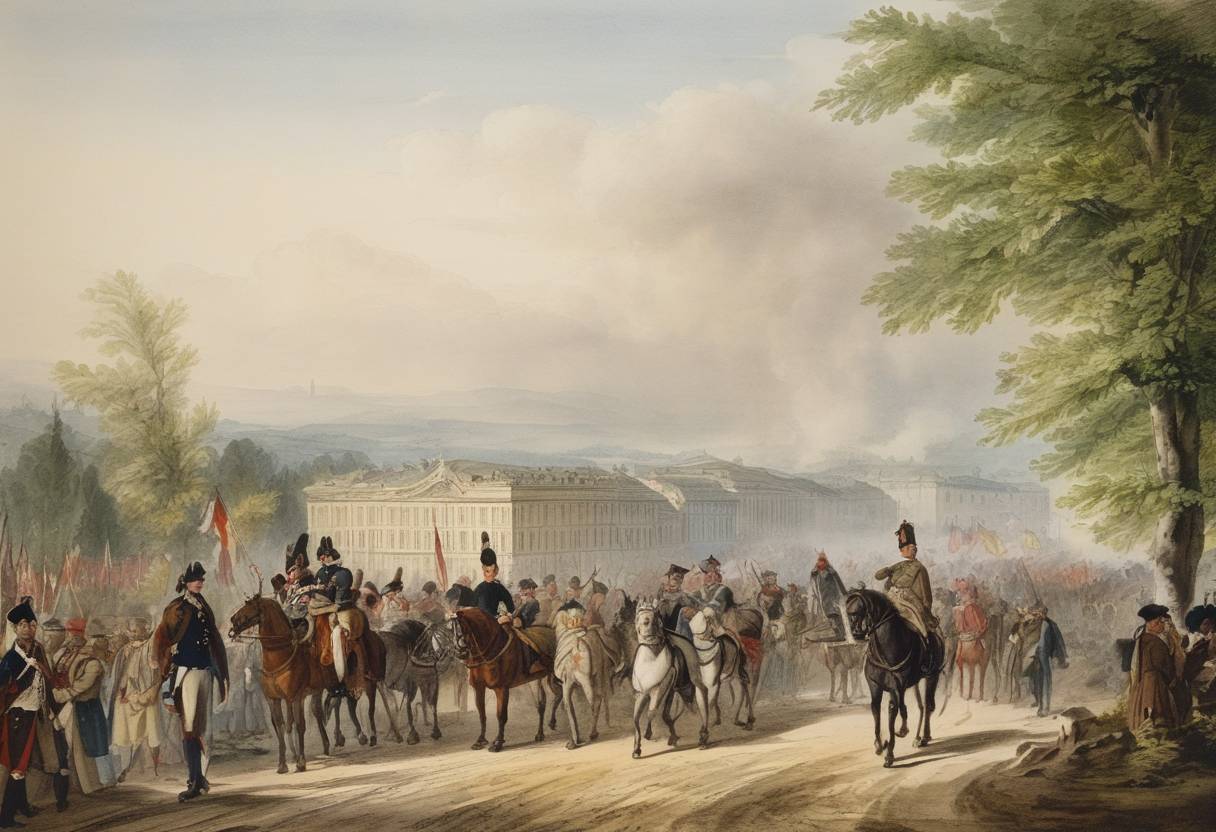
Austria Declares War on France: The Start of the War of the Second Coalition
Background
The War of the Second Coalition was part of the series of conflicts known as the French Revolutionary Wars, which followed the French Revolution of 1789. By the late 1790s, revolutionary France was embroiled in conflict with several European monarchies, anxious about the spread of revolutionary ideas and eager to reverse France’s territorial gains from previous wars.
Events of March 12, 1799
On March 12, 1799, Austria formally declared war on France, marking the beginning of the War of the Second Coalition. The conflict arose from escalating tensions as European powers, led by Great Britain and Austria, formed a coalition aimed at curtailing the influence and territorial expansion of the revolutionary French Republic. The Austrian declaration of war was a significant escalation in the ongoing struggle, mobilizing significant military resources to challenge French dominance.
The Catalyst and Preceding Conditions
The declaration was influenced by several factors, including:
- Territorial and Political Tensions: France had annexed significant territories in Italy and the Rhineland, creating alarm among European monarchies.
- The Balance of Power: The shifting balance of power in Europe, particularly in central and southern Europe, threatened Austria’s influence and territorial integrity.
- The French Directory: The French government, under the Directory, continued to expand its reach, fearing reactionary counter-revolutionary movements across Europe.
Impact and Consequences
The war saw numerous battles and campaigns across Europe, involving key military leaders such as Archduke Charles of Austria, General Masséna of France, and Russian General Suvorov. Noteworthy campaigns occurred in Italy and Switzerland, reshaping borders and political alliances.
- Battle of Stockach: Taking place shortly after the war began, this was among the first significant battles, occurring in March 1799. The Austrian forces secured a victory, highlighting the intense military engagements characterizing this war.
- Russian Involvement: The involvement of Russia added a new dimension to the conflict, with Tsar Paul I eager to impose his influence on European affairs.
Broader Historical Significance
The War of the Second Coalition was pivotal in shaping European geopolitics at the turn of the 19th century. It:
- Reinforced the contentious revolutionary versus counter-revolutionary divide.
- Set the stage for the rise of Napoleon Bonaparte, whose military successes during this period elevated him to positions of significant power, ultimately leading to his appointment as First Consul of France.
- Contributed to the fluctuating territorial alignments and ultimately led to the Treaty of Lunéville in 1801, which ended the war but ceded substantial territories to France.
The declaration and ensuing conflict underscored the complex interplay of revolutionary ideals and traditional monarchical power structures, influencing the course of European history profoundly.