Julius Caesar Crosses the Rubicon River
49 · Rubicon River, Roman Republic
Julius Caesar crosses the Rubicon River, signaling the start of the Roman Civil War.
August 9, 0048
The Battle of Pharsalus was fought during Pompey the Great's civil war. It was a decisive engagement resulting in Julius Caesar's victory over the forces of Pompey.
Pharsalus, Greece
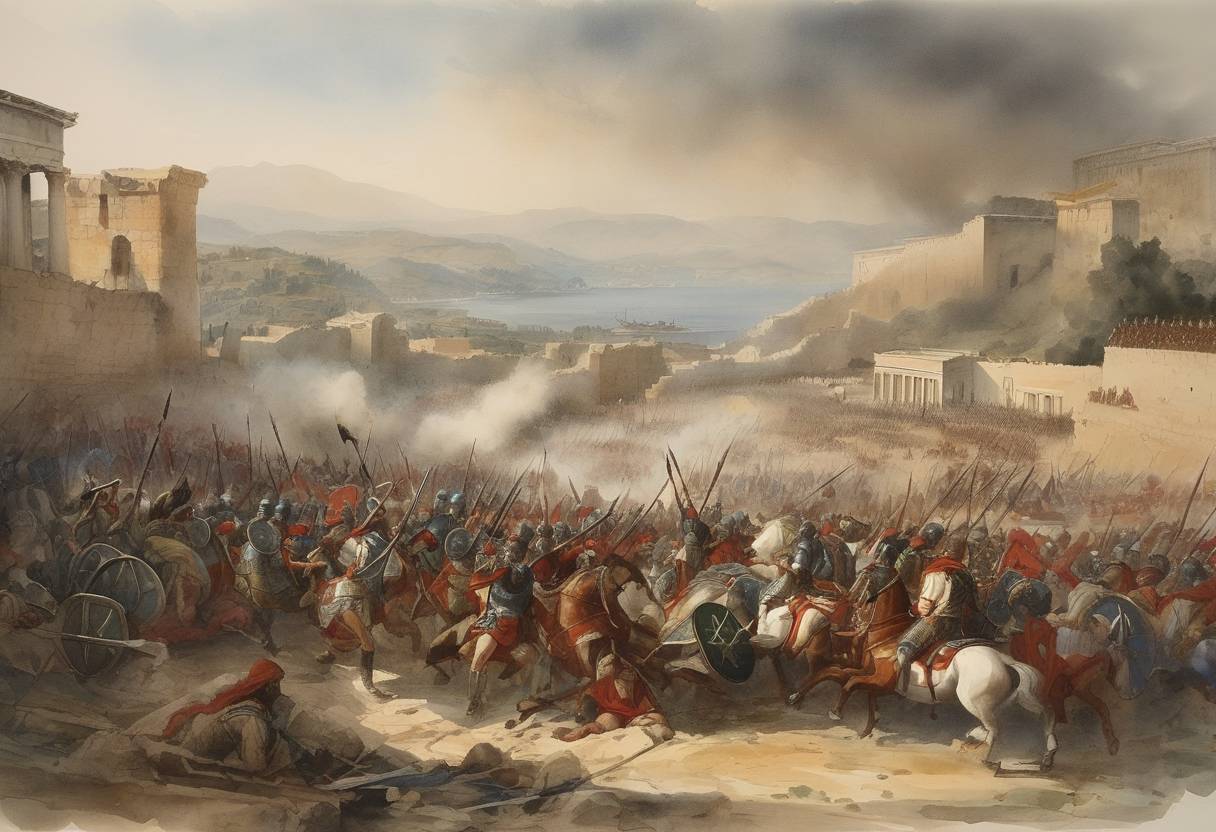
The Battle of Pharsalus, occurring on August 9, 48 BCE, was a pivotal engagement in the Roman Civil War, fought between Julius Caesar and Gnaeus Pompeius Magnus, commonly known as Pompey the Great. This conflict was rooted in the power struggle between the populares, led by Caesar, and the optimates, aligned with the Roman Senate and represented by Pompey.
The Roman Republic was embroiled in a civil war due to escalating tensions between Caesars’ and Pompey’s factions. Caesar, having crossed the Rubicon in 49 BCE—a direct challenge to Pompey’s authority and the Senate—had already secured significant territories in a rapid and bold military campaign. Pompey, regarded as one of Rome’s greatest generals, had been forced to withdraw to Greece to rebuild and strengthen his forces with the aid of the Senate and his allies.
Caesar’s Army: Julius Caesar commanded a smaller, experienced, and loyal force of approximately 22,000 troops composed primarily of seasoned legionaries from his campaigns in Gaul.
Pompey’s Army: In contrast, Pompey fielded a larger army of approximately 45,000 men, comprised of numerous Roman legions bolstered by allied contingents from the East. His force was better provisioned but less cohesive, as many soldiers were hastily recruited.
Pompey’s strategy relied on leveraging his numerical superiority and his position on strong defensive ground. He hoped to wear down Caesar’s forces, who were already stretched thin by a lack of supplies and reinforcements.
The engagement began with both armies drawn up on a plain near Pharsalus in Thessaly, Greece. Caesar’s tactical genius was on display as he innovatively deployed his tired but resolute troops against Pompey’s more extensive lines. Notably, Caesar implemented an additional infantry line to counteract Pompey’s cavalry, which he knew would attempt to outflank his own cavalry.
Tactical Maneuvers: As predicted, Pompey’s cavalry charged Caesar’s flank, but Caesar’s additional infantry line, hidden behind his cavalry, successfully engaged and repelled the cavalry attack.
Turning Point: With Pompey’s cavalry routed, Caesar’s forces could envelop Pompay’s legions. The disciplined assault by Caesar’s troops broke Pompeian ranks, leading to a devastating defeat for Pompey.
The Battle of Pharsalus was decisive, leading to a significant shift in power within the Roman Republic. Pompey fled to Egypt, where he was assassinated, a decision motivated by political intrigue in Egypt and a miscalculation of future Roman favor.
Consequences for Caesar: The victory at Pharsalus solidified Caesar’s control over Rome and its territories, allowing him to return to Rome as a dictator. This moment marked the diminishing of senatorial power and set a course toward the eventual transformation from Republic to Empire under Caesar Augustus.
Broader Implications: The battle demonstrated the effectiveness of military strategy and tactics over sheer numbers. It underscored the end of the traditional Roman political mores and was a significant step in the demise of the Roman Republic.
The Battle of Pharsalus remains a quintessential example of military history and a turning point that shaped the future of Roman governance and its vast empire.
Source: en.wikipedia.org