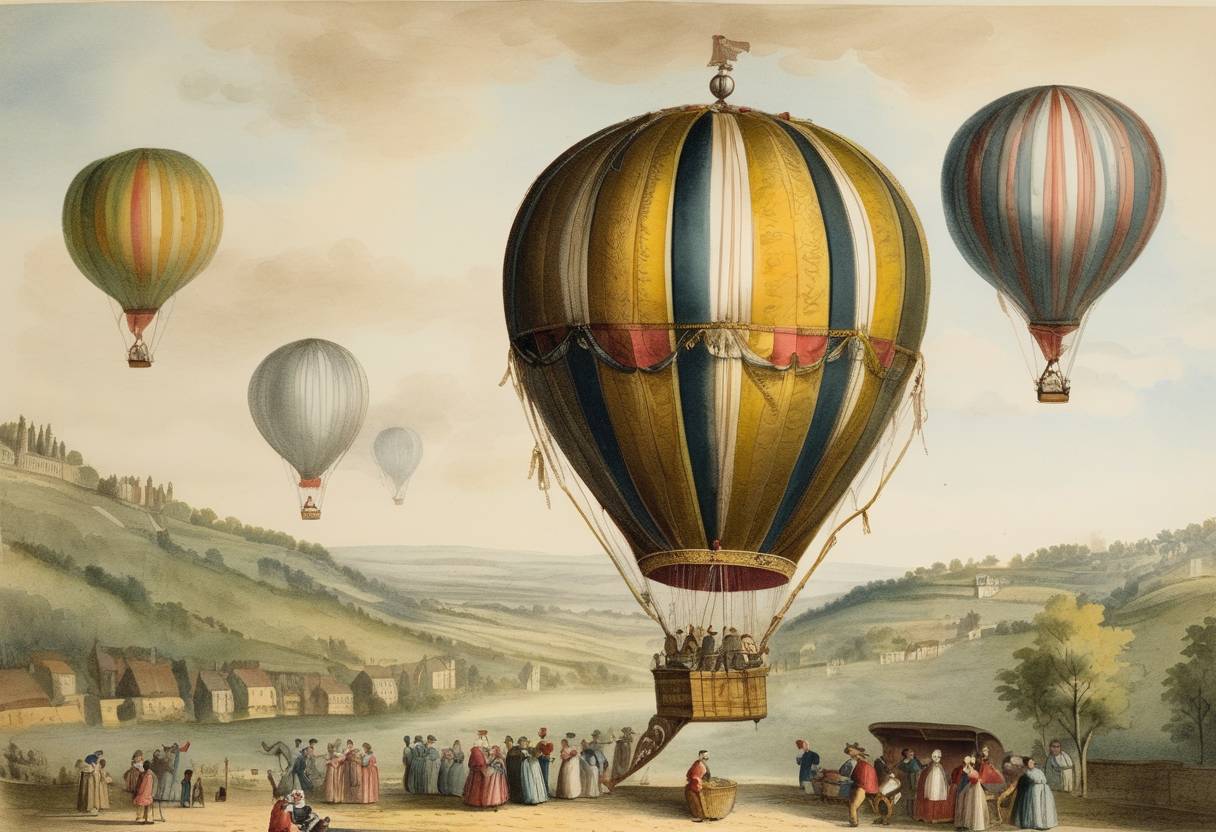
The First Public Demonstration of the Montgolfier Brothers’ Hot Air Balloon
On June 5, 1783, in Annonay, France, the Montgolfier brothers, Joseph-Michel and Jacques-Étienne, conducted the first public demonstration of their hot air balloon, marking a significant milestone in the history of aviation. This event established them as pioneers in balloon flight and sparked widespread interest in aerial exploration.
Background
The Montgolfier brothers, coming from a family of paper manufacturers, were inspired by the concept of flight and the possibilities that air buoyancy presented. They began experimenting in 1782 with different gases and materials that could potentially lift an enclosure off the ground. The inspiration for their work stemmed from their observations of how smoke rose from a fireplace, leading them to hypothesize that heated air could provide lift.
The Demonstration
The demonstration on June 5 was held in the city of Annonay. The brothers constructed a balloon made of taffeta and paper, measuring approximately 11 meters (35 feet) in diameter. This ingenious combination of lightweight material enabled the balloon to harness the lift provided by hot air.
During the demonstration, the Montgolfier brothers successfully launched their balloon, which ascended to an estimated height of 1,500 to 2,000 meters (4,900 to 6,600 feet) and remained airborne for about 10 minutes, landing approximately 2 kilometers (1.2 miles) from the launch point. The event was witnessed by a large crowd, including prominent local dignitaries, who were astonished by the sight of human-made flight.
Impact and Legacy
The success of the Montgolfier brothers’ public demonstration had a profound impact on scientific communities and the general public across Europe. It triggered a series of experiments and advancements in ballooning technology, ultimately leading to the first manned flight later that year, in November 1783, when a Montgolfier balloon carried Pilâtre de Rozier and the Marquis d’Arlandes over Paris.
The achievement of the Montgolfier brothers paved the way for the development of lighter-than-air travel and contributed significantly to the burgeoning interest in aviation. Their work symbolized the Enlightenment’s spirit of inquiry and innovation, influencing subsequent generations of inventors and explorers in their quest for conquering the skies.