The Chartering of the University of California on March 23, 1868
1868 · Oakland, United States
The University of California, initially consisting of the College of California and the Agricultural, Mining, and Mechanical Arts College, is chartered.
February 12, 1855
Michigan State University, the first land-grant institution as a model for future land-grant colleges in the United States, was established by the Michigan Legislature.
East Lansing, United States | Michigan State University
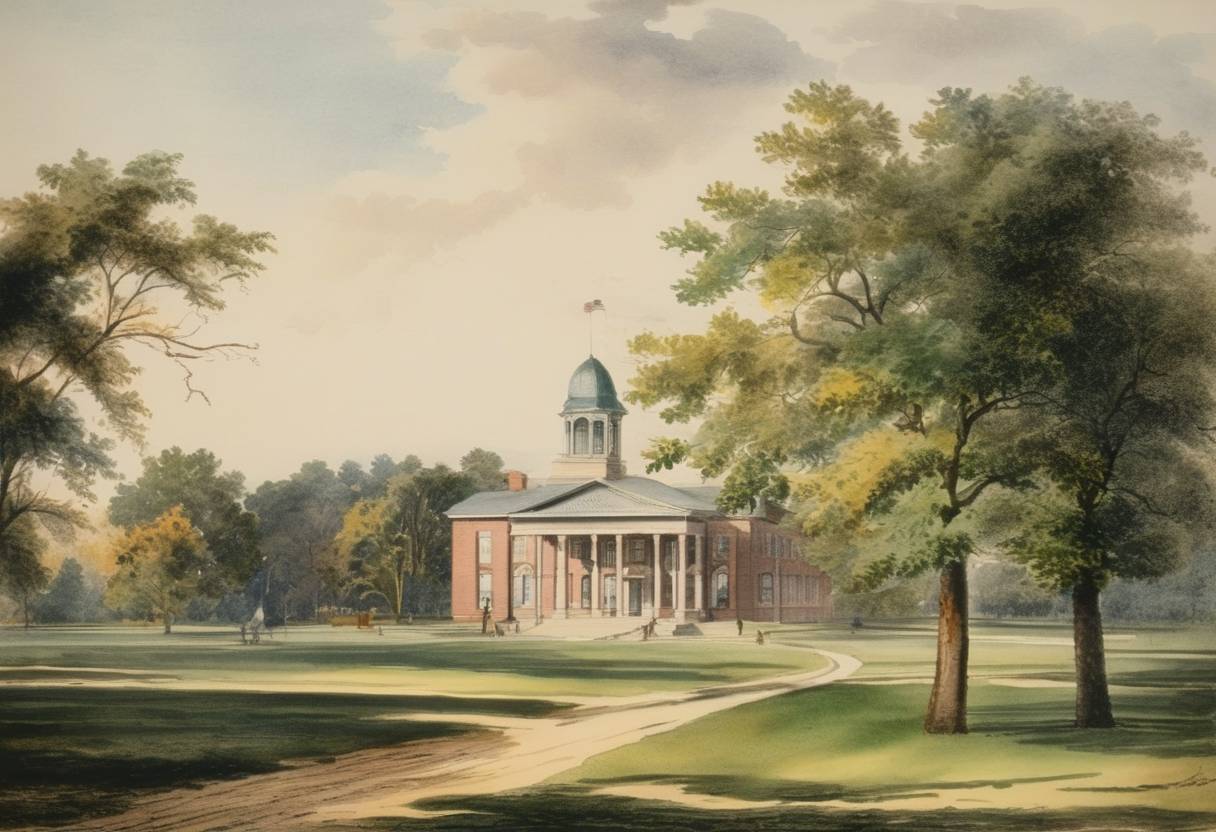
On February 12, 1855, Michigan State University (MSU) was established by the Michigan Legislature, marking a significant development in higher education within the United States. It was initiated as the Agricultural College of the State of Michigan and served as a pioneering model for the future land-grant universities across the nation.
The mid-19th century in the United States was characterized by a growing need to educate the populace in practical subjects such as agriculture and mechanics—fields that were essential for the country’s development. Amidst this backdrop, the drive to establish colleges that focused on practical education gained momentum.
Although the Morrill Act, which federally established the land-grant college system, was not signed until 1862, Michigan State University predated this legislation. The institution’s founding was precipitated by a proposal from the Michigan Board of Education and was subsequently authorized by Michigan’s governor, Kinsley S. Bingham.
The Morrill Act, proposed by Vermont Congressman Justin Smith Morrill, would later create a land-grant system by providing federal land to the states to finance colleges dedicated to agriculture and the mechanic arts. MSU’s establishment in 1855 thus acted as a forerunner to this national initiative.
MSU’s creation illustrated an innovative approach to education—one that combined classical studies with practical applications, serving both the economic needs and intellectual demands of a growing nation. The university initially focused on scientific agriculture, but over time, its curriculum expanded to include a broad range of disciplines.
Michigan State University set important precedents for the future land-grant institutions: it emphasized accessibility and the utility of education as a means to advance both individuals and society. Its foundation allowed for the dissemination of agricultural and mechanical knowledge, which was crucial for the United States as it moved towards a more industrialized and agrarian economy.
Following its establishment, MSU grew rapidly in terms of curriculum and infrastructure. It soon developed into a comprehensive university, becoming one of the largest and most prominent institutions in the country. The educational model it adopted influenced the development of similar institutions and policies across the United States and continues to be an integral part of the American higher education landscape.
By serving as a prototype for the Morrill Act and subsequent land-grant colleges, MSU’s establishment on February 12, 1855, represents a pivotal moment in the democratization of higher education, merging vocational training with academic scholarship in a new and impactful way.
Source: www.msu.edu