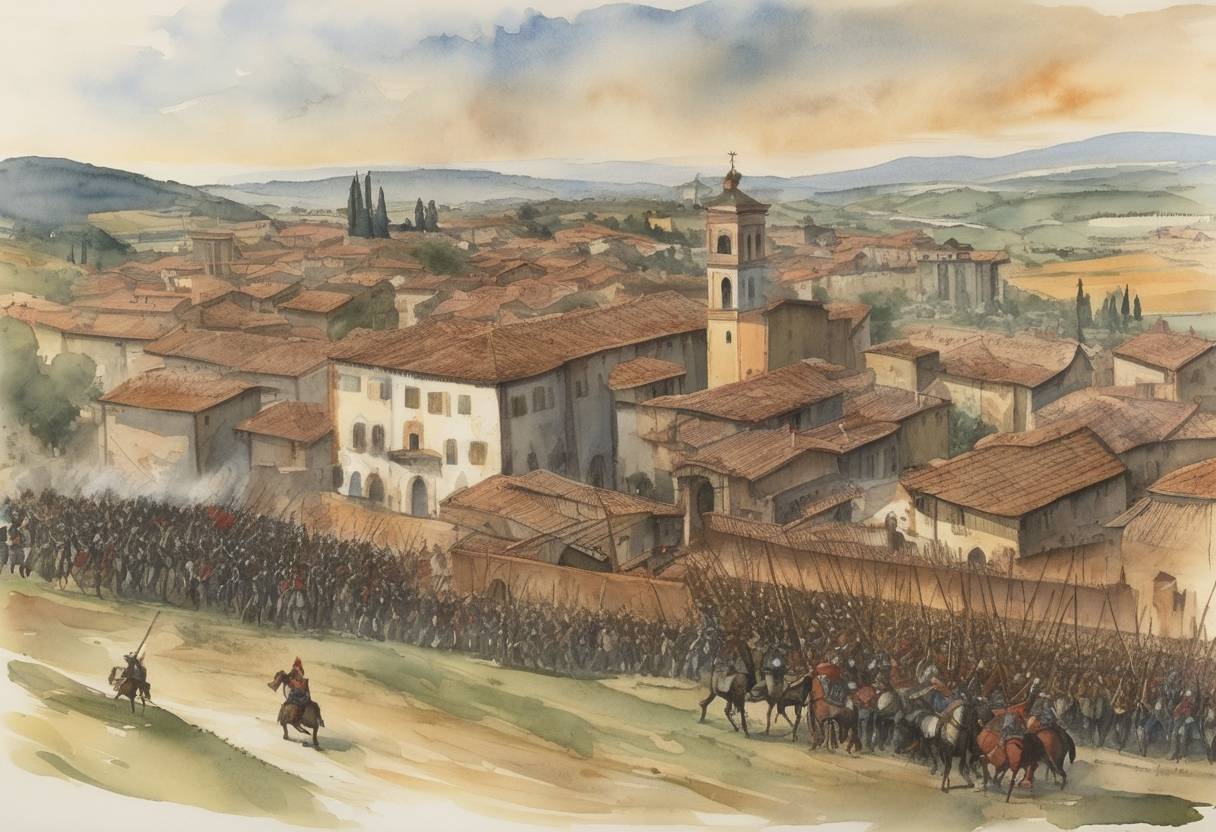
The Battle of Cascina - July 28, 1364
The Battle of Cascina took place on July 28, 1364, involving the Republic of Florence and the Republic of Pisa. This conflict was part of the larger struggles for power and territory among Italian city-states during the late Middle Ages, a period characterized by political fragmentation and frequent warfare in Italy.
Background
Florence and Pisa were major city-states in the Italian peninsula, both seeking to expand their influence and control over the region. The latter half of the 14th century was marked by repeated clashes as these cities, among others, vied for dominance in Tuscany and the surrounding areas.
Catalysts to the Conflict
The animosity between Florence and Pisa was fueled by territorial disputes and economic rivalries. Pisa’s control over key trade routes and ports was a significant point of contention for Florence, which was keen on securing its mercantile interests and ensuring unfettered access to the sea.
The Battle
On the 28th of July, 1364, these tensions culminated in the Battle of Cascina. Fought near the small town of Cascina, located strategically between Florence and Pisa, this battle saw Florence emerging victorious. The Florentine forces were commanded by Galeotto Malatesta, a skilled condottiero or mercenary leader, who managed to outmaneuver and defeat the Pisan troops decisively.
Significance and Aftermath
The victory at Cascina was a major military gain for Florence. It allowed the Florentine Republic to assert control over key territories in the region and significantly weaken Pisa’s military and economic power. This battle also reaffirmed Florence’s military capabilities and served as a deterrent against further Pisan aggression, consolidating its status as a preeminent regional power.
The battle’s outcome contributed to a shift in the balance of power in Tuscany, with long-term implications for the political landscape of Italy. It marked a continuation of the trend toward larger regional states overshadowing smaller political entities within the fragmented structure of medieval Italy.
Despite its significance, the Battle of Cascina is often overshadowed in historical memory by the more famous and similarly contested Battle of Anghiari in 1440, largely due to the artistic legacy left by Leonardo da Vinci’s unfinished mural depicting the latter event. Nevertheless, the encounter at Cascina remains a pivotal moment in the historical narrative of Florentine ascendancy.