The Spanish Armada and the Battle of Gravelines: July 31, 1588
1588 · Gravelines, France
The Spanish Armada was sighted off the coast of England, leading to the Battle of Gravelines, where the English navy defeated the Spanish fleet.
July 29, 1588
The Spanish Armada was spotted off the coast of England, marking a significant moment in the Anglo-Spanish War.
English Channel, England | Spanish Armada
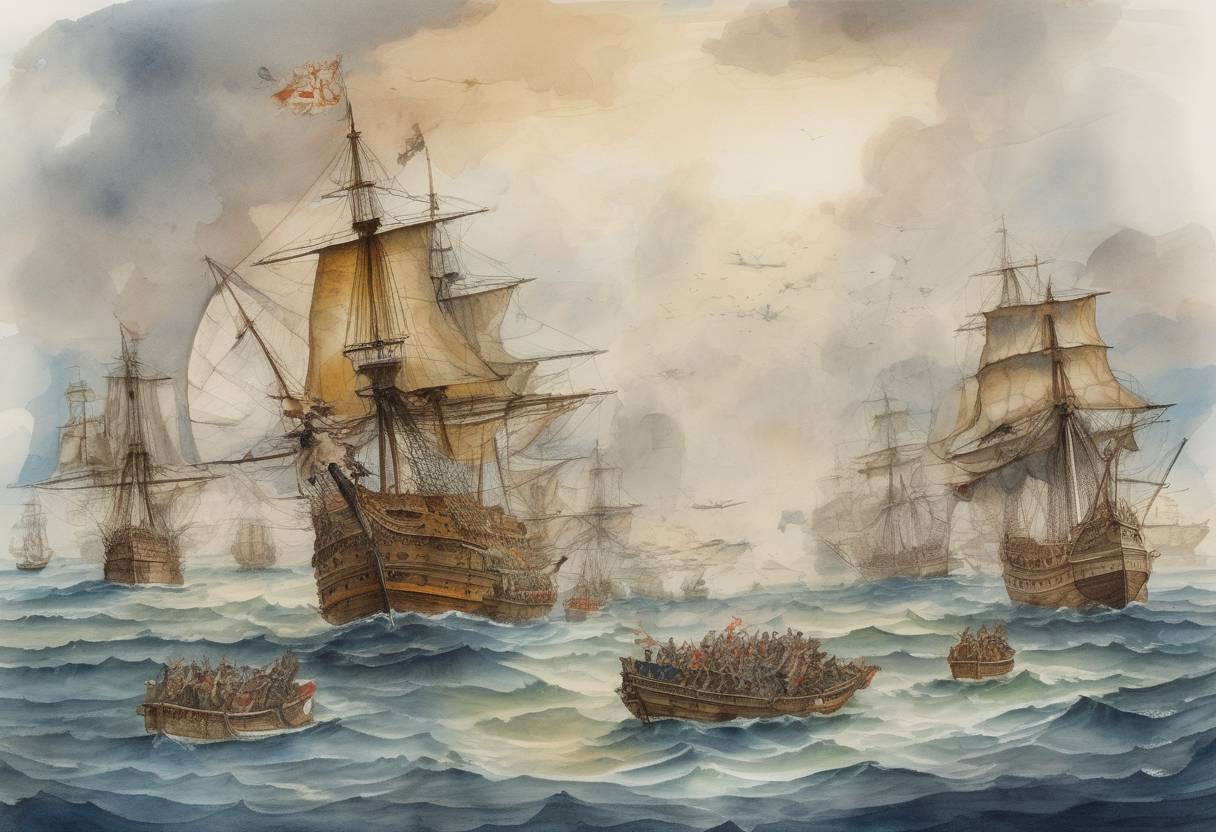
On July 29, 1588, a pivotal event in the Anglo-Spanish War unfolded as the Spanish Armada was sighted off the coast of England. This moment marked a significant turning point in the conflict between England and Spain, two of the most powerful nations of the time.
The Anglo-Spanish War (1585–1604) was rooted in religious, economic, and political tensions. Spain, under King Philip II, was a staunch Catholic power, while England, led by Queen Elizabeth I, had embraced Protestantism. The execution of Mary, Queen of Scots, in 1587, a Catholic and a claimant to the English throne, further inflamed relations. Additionally, English support for the Dutch Revolt against Spanish rule and English privateering against Spanish ships exacerbated hostilities.
The Spanish Armada was a formidable fleet assembled by King Philip II with the aim of overthrowing Queen Elizabeth I and restoring Catholicism in England. The fleet consisted of approximately 130 ships, carrying around 30,000 men, including soldiers and sailors. The plan was to sail to the Netherlands, join forces with the Duke of Parma’s army, and invade England.
On July 29, 1588, the Armada was first sighted off the coast of Cornwall by English lookouts. The English navy, commanded by Lord Charles Howard and Sir Francis Drake, was prepared for the encounter. The sighting set off a series of naval engagements known as the Battle of Gravelines, which took place from July 31 to August 8, 1588.
The English navy, utilizing smaller, more maneuverable ships and innovative tactics such as the use of fire ships, managed to disrupt the Spanish formation. The Armada, hampered by adverse weather conditions and logistical challenges, was forced to retreat northward around Scotland and Ireland. Many Spanish ships were lost to storms and shipwrecks during the return journey.
The defeat of the Spanish Armada was a significant victory for England and marked a decline in Spanish naval dominance. It bolstered the reputation of Queen Elizabeth I and established England as a formidable maritime power. The event also had long-lasting effects on European geopolitics, contributing to the rise of England and the gradual decline of Spain as the preeminent global power.
The sighting of the Spanish Armada off the coast of England on July 29, 1588, remains a landmark event in European history. It symbolized the clash between Protestant and Catholic powers and underscored the strategic importance of naval supremacy. The defeat of the Armada is often seen as a turning point that paved the way for the expansion of the British Empire in the centuries to follow.
Source: en.wikipedia.org